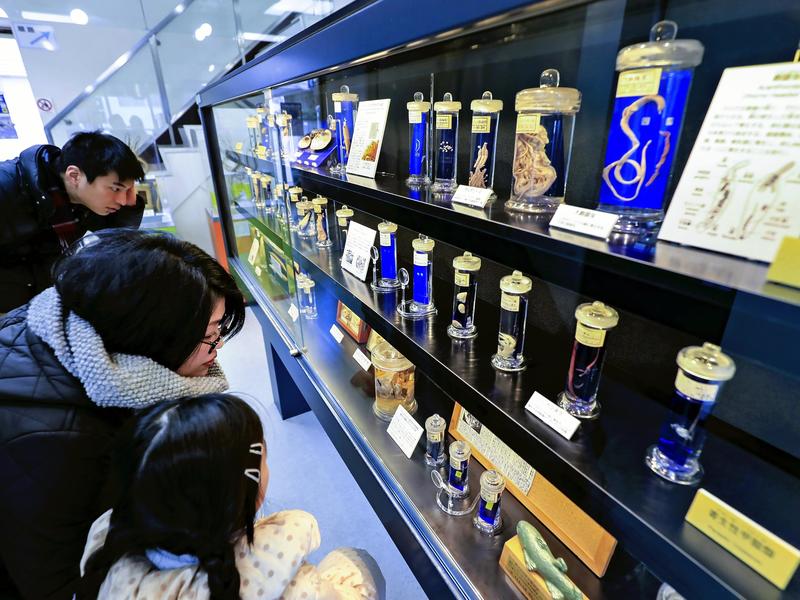
It's hard to believe that about 60,000 parasitological specimens are housed in a building on bustling Meguro-dori avenue, which is lined with fashionable shops. Stepping inside Meguro Parasitological Museum, I prepared myself for an eerie atmosphere, but it was actually crowded with families.
About 300 exhibits, some in formalin, are neatly showcased and illuminated by LED lights, which does give the scene a mystical look.
The exhibits on the first floor show the diversity of parasites, such as a type of mite that swells up to the size of a 500 yen coin from sucking blood, and futagomushi (Paradiplozoon skrjabini), an organism that spends its entire life fused together with another of its kind, forming the shape of a butterfly. The parasites on display have various types of biology. For example, leucochloridium sneaks into snails and makes their eye stalks look like caterpillars in order to be eaten by a bird and thereby reproduce.
"Parasites are usually viewed as bad fellows. But most of them have evolved to coexist with their hosts. Only a few are harmful," said Museum Director Kazuo Ogawa.
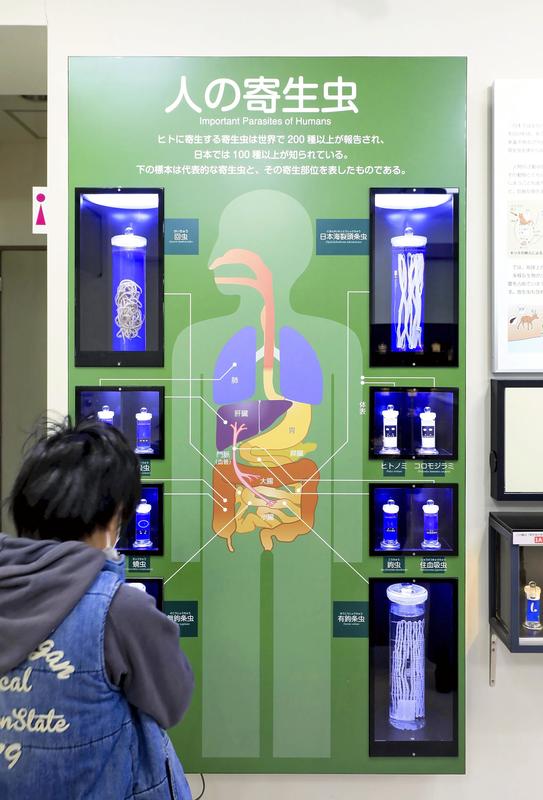
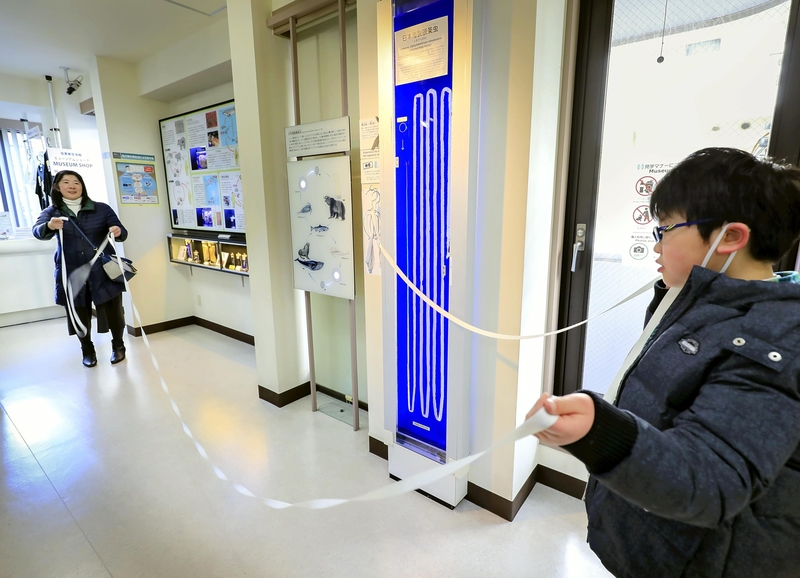
Parasites that have a relationship with the human body are shown on the second floor. An eye-catching exhibit here is an 8.8-meter-long tapeworm. The man who was the parasite's host reportedly said he didn't notice any symptoms at all. An 8.8-meter-long rope to the side of the exhibit allows visitors to get a sense of how long the parasite was, appalling visiting children who picked up the rope.
The museum was founded by the late Satoru Kamegai, a doctor who studied malaria and other diseases at a research institute of the now defunct South Manchuria Railway and opened a clinic in Meguro Ward, Tokyo, after World War II. He put his own money into the museum, in the hope that people would get a better grasp of parasites during a time when intestinal worms and other parasites were rampant in Japan.
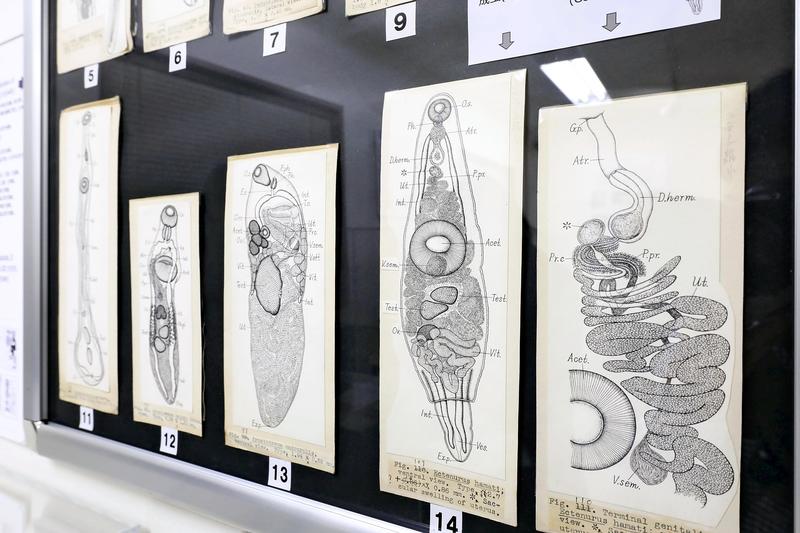
Only about 70 specimens were on show when the museum opened. But from that point on, Kamegai collected specimens by whatever means possible, such as by getting parasites from dead dogs on the side of the road or obtaining organs removed from stuffed specimens.
The museum also exhibits a new type of parasite that Kamegai found as a result of six months of research when he participated in an academic study of the anatomy of coelacanths, an order of fish.
The number of parasitic diseases in Japan has decreased sharply due to better hygiene and prevention measures. Now pinworm egg tests at schools have disappeared. Even so, awareness of parasites such as anisakis, which can be contracted from fish and seafood, is still needed.
"It's rare to get infected with parasitic disease these days, and knowledge of them may be lost. I want more people to come here and learn," Ogawa said.
Meguro Parasitological Museum
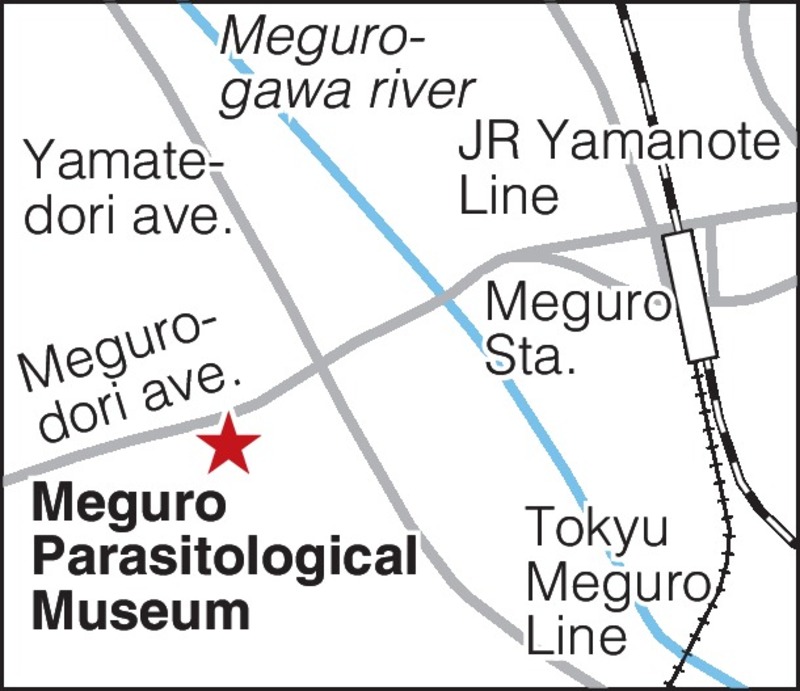
The museum opened in 1953. It was refurbished in 1991 and 1992 into the current six-story building. Researchers give expositions once a month. A T-shirt printed with a 3-D tapeworm and a cell phone parasite specimen charm are popular gifts that can be bought at the museum. Reservations are necessary for group admissions. The museum is a 12-minute walk from JR Meguro Station.
Address: 4-1-1, Shimomeguro, Meguro Ward, Tokyo
Open: From 10 a.m. to 5 p.m. Closed Mondays, Tuesdays (closed the following day if a national holiday falls on Monday or Tuesday.)
Admission: Free (donations welcome)
Inquiries: (03) 3716-1264 (recording only)
Read more from The Japan News at https://japannews.yomiuri.co.jp/