"Even if I go back to my country, I don't have any family and there are no jobs. I want to keep living in Japan with my Japanese wife."
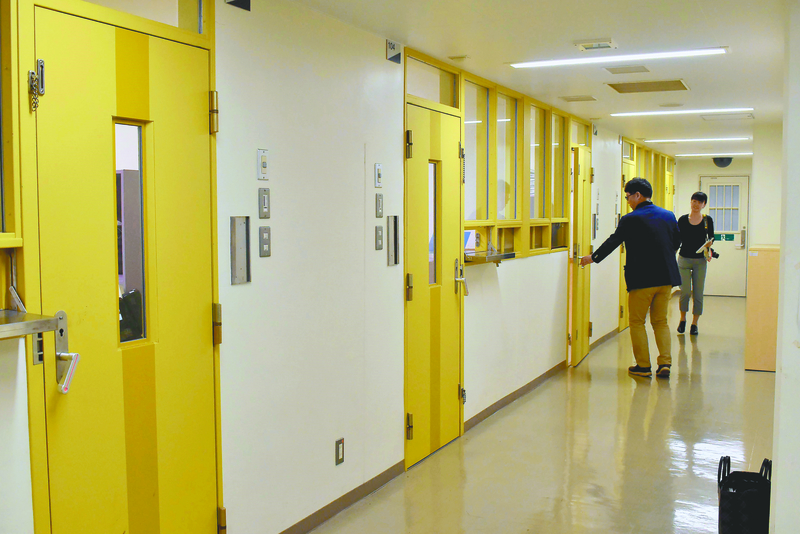
Through an acrylic board in the interview room of the Higashi-Nihon Immigration Center in Ushiku, Ibaraki Prefecture, a 55-year-old Pakistani man repeatedly pleads in Japanese.
He came to Japan in 1986 on a tourist visa. He was issued a deportation order for working as a house painter without a work permit and for falsifying his status. He has been detained for about two years at the center, where those refusing deportation are held.
In August last year, he joined in a hunger strike to protest his prolonged detention. However, he was denied a provisional release from the facility for humanitarian reasons.
His is just one example of a growing problem of evading repatriation.
As of the end of June last year, the number of people ordered to leave the country who are being held in facilities nationwide stood at 1,147. Of them, 858 are refusing to go back. Detention periods tend to get longer as they keep evading repatriation, and as many as 679 have been held for six months or longer.
There have been calls for expanding provisional releases, saying that long-term detention is a humanitarian issue. However, the government's stance is that promoting repatriation is more important, in that 366 of those refusing to return to their home country have been convicted of serious offenses, such as drug crimes, heinous crimes, theft and fraud.
The situation in Japan is certainly serious. But in Germany, where I was dispatched as a correspondent, it is even worse, and offers many lessons for Japan, which is expecting to increase the number of foreign residents in the future.
Since 2015, more than 1.8 million people have applied for refugee status in Germany, and the repatriation of those denied such status has become a major issue.
According to local media, the number of people obliged to leave the country was 246,737 as of the end of June last year. Of them, 77% were hesitantly accepted to stay for reasons such as they could not be properly identified because they did not possess passports. The remaining 55,620 people were classified as those obliged to leave immediately.
From January to the end of June last year, 6,786 people voluntarily returned to their home countries, and 11,496 people were forcibly deported. Deportation appears to be progressing at first glance, but the number of people obliged to leave the country increased by around 20% compared to that of 2015.
One reason behind this trend is the resistance to deportation. In 2018, there were 1,637 cases in which deportees getting violent at airports and the deportation was abandoned. Protests by crowds over 100 have also frequently occurred, in which protesters and police officers clashed, causing injuries on both sides. The limited capacity of detention facilities, at around 500 deportees, is another obstacle.
In 2016, a terrorist attack was carried out in a Christmas shopping area of Berlin by a man who was not recognized as a refugee, but unwillingly allowed to stay in the country. Last June, the lower house of the German federal parliament passed a law that doubles the number of detention facilities and makes it easier to detain people to prevent them from escaping.
We can only now wait and see how effective these measures will be.
Read more from The Japan News at https://japannews.yomiuri.co.jp/