In your article on Oxfam’s new inequality report (Half global wealth held by the 1%, 19 January) you quote Thomas Piketty’s theme of our drift back to 19th-century levels of wealth concentration. However you do not mention his solution, the wealth tax. He says that for democracy to regain control over global financial capital it must invent new tools, including a progressive global tax on capital plus a high level of transparency. He suggests 0.5% on wealth between €200,000 and €1m, 1% between €1m and €5m, 2% above €5m and 10% above €1bn. It should be levied on real estate, financial and business assets, art treasures and vintage cars – no exceptions.
It appears President Obama is moving in that direction (Obama to raise taxes on rich to aid middle class, 19 January), but will this appear in our party manifestos? The OECD and EU will be necessary partners if we are to move in this direction. Oxfam’s report is an urgent call to action. Piketty says his proposed wealth tax could be done at EU level, with a clear distributive system; it would affect only 2.5% of the population and bring in 2% of the EU’s GDP annually. The rich should be delighted to be contributing to a fairer world, they shall have treasure in heaven.
Rev David Haslam
Methodist Tax Justice Network
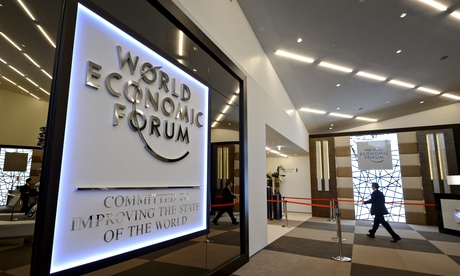
• It’s horrifying to read that the world’s 80 richest people now own as much as half the world’s population, but are we seriously expecting the politicians and the global business elites at the World Economic Forum in Davos to tackle this urgent problem?
What’s presented as entrepreneurial talent and business acumen at Davos is actually a series of aggressive economic and political policies that have concentrated wealth in the hands of a few while exacerbating poverty for hundreds of millions. Neoliberal free-trade deals, tax evasion, financialisation, privatisation – these are the tools that the “great and good” of Davos are using to ensure that by 2016 the richest 1% will own more than 50% of the world’s wealth.
The world will not be “saved” by a tiny group of super-rich who have done incredibly well from putting their economic dogma into practice. Hope lies in challenging their wealth and power, rather than looking to them for answers.
Kevin Smith
Global Justice Now
• Is it not clear that “Half global wealth held by the 1%” is the major factor behind the global economic stagnation? At the bottom end of the wealth/income spectrum we have the lack of sufficient income to finance the effective demand which would attract sufficient investment to initiate growth; at the other end of the income spectrum we have enormous income failing to find sufficient markets for investment and seeking to invest in public institutions – health, education, prisons etc – which will only increase the problem of maldistribution; not to mention antisocial investment in armaments etc. The widespread avoidance of tax only adds to the problem of financing government services. Similarly, the Keynesian solution of quantitative easing – the creation of new finance – and its spending on infrastructure by government bodies will only have a limited effect as the ensuing spurt in income multiplication is largely siphoned up to the top end of the income spectrum. There can be no lasting solution to this problem save through the actions of governments devoted to the general welfare of all citizens and not acting as partisans for the interests of the few.
Francis Westoby
Hitchin, Hertforrdshire
• At the moment, 99% of people behave as if the power of the wealthy 1% does not directly affect them, because their world seems “austere” but otherwise still recognisable. However, the power of the 1% could become very apparent if major instability arises. There is a good lesson from the time of the Pharaohs in Genesis chapter 47. With the help of his chancellor Joseph, Pharaoh accumulates vast food reserves during seven good years. Then years of food shortages grind most people down. Pharaoh acquires all their modest assets of money, livestock and land. Only the bureaucrats of Egypt (its priesthood) remain homeowners – the royalty take all that the 99% formerly possessed. If power corrupts, powerful inequality indebts and ultimately enslaves.
Woody Caan
Professorial fellow of the Royal Society for Public Health
• The churches’ growing condemnation of governments which tolerate poverty and inequality is welcome (Editorial, 19 January). But they should also draw the attention of affluent Christian believers to the teachings of Jesus Christ. For example, “Do not store up for yourselves treasures on Earth”, “You cannot serve God and mammon”, “woe to you who are rich”. The implication is that wealthy Christians should redistribute most of their riches to those in need, that they should live close to ordinary families, send their children to state schools. This is not to say they should not hold important jobs, but they should do so while having lifestyles which bring them close to those on low incomes.
Bob Holman
Glasgow
• In 2012 the Tax Justice Network estimated that $21-32 trillion is hidden in tax havens worldwide. Just who does this stash benefit? It is certainly of no benefit to the people who own it, and they can’t take it with them. The means are there to make the world a more equal place, and in the runup to the election we need some concrete pledges on this.
Lorrie Marchington
New Mills, Derbyshire