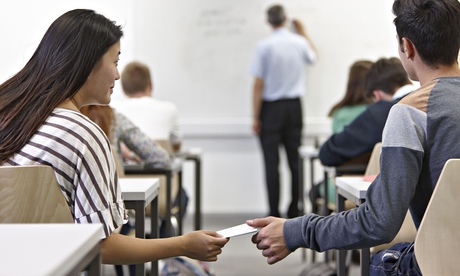
Low-level disruption in classrooms has been an issue for as long as anyone in education can remember (Silliness in class must stop. The Tsar says so. 16 June); certainly as far back as the 1989 Elton report, which outlined and advocated positive behaviour policies. But positive behaviour policies need constant and consistent application if they are to be effective; they need teachers trained in their use and usefulness, able to apply them as necessary, yet to respond flexibly and sympathetically when called on to do so. These skills lie at the heart of good teacher training, and are not somehow magically inherent in a person who decides to “have a go”. The flaw lies in Nicky Morgan’s wilful failure to make mention of all those untrained teachers now allowed to educate our children. These include the unqualified ones that may be employed by all but state schools and the army of employment-based trainees thrown into classrooms on virtually full timetables each September.
The numbers of these unqualified people and learner teachers are set to grow as we force pupils to study a narrow range of English baccalaureate subjects for which we have failed to train adequate numbers of teachers. Top sets, well taught by linguists, have always been the norm in language teaching. What price good behaviour in a bottom-set language class taught by a well meaning amateur?
Dr Neil Denby
Denby Dale, West Yorkshire
• So, we’ve suddenly discovered that low-level disruption is impeding the learning process in schools. Some of us could have told you that 20 or even 30 years ago. Before I took early retirement 15 years ago, silly, attention-seeking behaviour from an admittedly small minority of students had become the bane of my life – and of many of my colleagues, if only they’d had the honesty to admit it. The removal of one or two of what the late Terry Casey of the NASUWT used to call “corridor cowboys” from our classrooms would have allowed me and their fellow students to get on with what we were there for in the first place.
By all means teach “strategies” to combat bad behaviour if you wish. I would support all schools having an area, staffed by appropriately trained colleagues, to which this very small number of students could be sent to cool off, only to be readmitted to classes when they agreed to behave in an acceptable manner. I doubt if schools would buy into this as it would label them as failing, such is the paranoia around these days.
However, if this approach strikes too many as crude overreaction then we really must spend the money to find out why some youngsters persistently behave in a way that impacts on the progress of their contemporaries, and find ways to help them.
John Marriott
North Hykeham, Lincolnshire
• The most effective way to address bad behaviour – low-level or otherwise – is to create schools that children want to go to and lessons that are both engaging and meaningful to young people. When children feel listened to within their school and have ownership over their learning, they are far less likely to disrupt their class. This involves moving away from a top-down approach to an education system in which children and other “stakeholders” – teachers and parents – have a genuine say in school decision-making. There are a number of schools in the UK and overseas that exemplify such principles.
Appointing a behaviour tsar is a sticking plaster on an outdated system. What is needed is a complete rethink about how we make education relevant to young people and to life in the 21st century. Sadly the Department for Education, with its commitment to a narrow view of education and an obsession with testing and targets, is very far from recognising that it is part of the problem rather than part of the solution.
Fiona Carnie
European Forum for Freedom in Education
• Every teacher knows good classroom behaviour is the result of the complex interaction of a range of factors. Learning experiences that are challenging, engaging and fun as well as feeling a sense of achievement and success are two crucial factors. Government policy is making it more difficult for teachers to deliver the above. The curriculum in primary schools is being reduced to test practice and rote learning. In secondary schools older students will be forced to take subjects they are failing at, when they could be succeeding elsewhere. The testing and assessment regime will repeatedly label the same group of students as failures. Ms Morgan has the duplicity to suggest that setting the bar higher will allow students to get on in life when she knows the majority will fail to reach the new grade 5 benchmark. It is going to need more than a behaviour tsar to deal with the consequent student disaffection. A massive expansion of pupil referral units for excluded students should be next on Morgan’s agenda.
James Whiting
London
• Perhaps Nicky Morgan might be more successful if she was to put a stop to the major disruption government education policy is causing: free schools, new academies, changes to the national curriculum, abolition of levels, changes to GCSE assessment arrangements, abolition of the speaking and listening component of GCSE English, exclusion of major world literature from GCSE syllabuses, reception-year tests, changes to initial teacher training, English baccalaureate, downgrading of arts subjects, changes to inspection regime, phonics screening, grammar testing etc.
John Paxton
Hertford, Hertforshire
• Recently doctors warned about the long-term health dangers to adult workers who spend too much time sitting still (Report, 2 June), and the importance of frequent activity. Now the education secretary plans to ensure that schoolchildren sit still for hours, without “rocking on their chairs”. The hours of school time spent on organised PE and games is outnumbered by the hours spent sitting on chairs, often badly designed, or on the floor. This is particularly hard on primary school children, who are younger and do not even move around between lessons. Of course, this is the way to manage the largest numbers of children in the smallest space, with the minimum number of adults. It is certainly not in the interests of the pupils’ wellbeing.
Averil Lewin
Witchford, Cambridgeshire
• Will the new silliness tsar have powers to send offending children to the naughty steppe?
Rev Dr Peter Phillips
Swansea