The deadly fire at a beer hall in Lat Phrao has left the public with a haunting image: a long jet of flame bursting through the upper part of the main entrance like a fire-breathing dragon, even as people at floor level were still trying to escape.
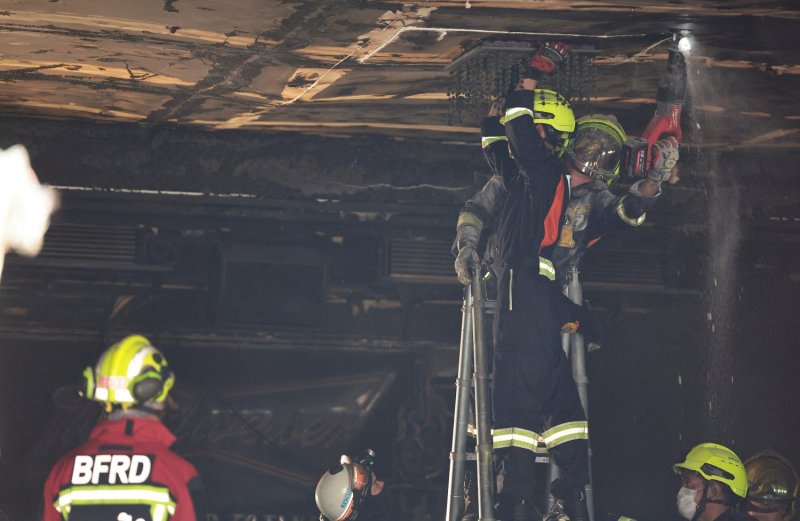
Preliminary inspection findings, witness accounts, photographs and video evidence support a working hypothesis I formed soon after the incident: the most dangerous phase of the fire may have begun and developed inside the concealed space above the suspended ceiling, particularly near the stage, where electrical wiring and other building services were located above the ceiling near the stage.
The joint inspection by fire-protection engineers and forensic officers subsequently found fire damage involving insulation, electrical systems and other materials within the ceiling cavity. Gypsum ceiling boards were also reported to have fractured with openings at several key locations. Other evidence is equally significant.
Many tables, chairs and belongings in the hall remained recognisable after the incident, and damage across the floor area appeared uneven. During the early stages, some people inside were still able to move and search for exits.
Taken together, these observations suggest that the most severe fire processes may have developed in the concealed ceiling void for a while before breaking into the occupied space below.
Fire requires three elements: a heat source, oxygen and fuel. The initial heat source may have been an electrical fault, arcing or sparking. Possible fuels within the ceiling cavity could have included cable insulation, thermal or acoustic insulation, adhesives and other synthetic materials.
Once a fire begins in a poorly ventilated ceiling cavity, it consumes the available oxygen. As the oxygen concentration falls, the fire becomes ventilation-limited. Visible flames may weaken or reduce to smouldering, but the danger does not disappear.
The remaining heat continues to drive pyrolysis -- the thermal decomposition of materials. This process releases flammable vapours and gases even when there is not enough oxygen for complete combustion.
A concealed cavity can therefore become an invisible reservoir containing fuel gases, smoke, soot, products of incomplete combustion and toxic gases. People below, surrounded by music, lighting and normal activity, may have had little warning that a serious fire was developing above their heads.
The critical transition may have occurred when ceiling panels cracked, dropped or otherwise created new openings between the hall and the ceiling cavity. Fresh air from the hall below could then flow upwards.
If the cavity was already hot, oxygen-depleted and filled with accumulated fuel gases, the incoming air might have triggered rapid deflagration and a sudden rise in pressure. This is the classic mechanism of a backdraft.
There is another possibility. If the fuel gases had already mixed with enough air to enter their flammable range and were then ignited by a flame, spark or hot surface, the event would fall more broadly under fire-gas ignition.
If that ignition produced a rapid, pressure-generating deflagration within the smoke layer, it might more specifically be described as a smoke explosion.
Whether investigators ultimately classify the event as a backdraft, smoke explosion or another form of fire-gas ignition, the central engineering issue remains the same: combustible gases appear to have accumulated and ignited rapidly within or around the concealed ceiling space.
The tragedy may not have been caused by flames alone. Even before the ceiling failed extensively, smoke and gases could have leaked downward through panel joints, lighting fixtures, speaker openings, cable penetrations and air-conditioning pathways. Dense smoke could subsequently have flooded the upper level of the hall within moments.
Incomplete combustion generates carbon monoxide, which reduces the blood's ability to transport oxygen. Nitrogen-bearing materials, including some polyurethane foams, may also produce hydrogen cyanide, which prevents cells from using oxygen effectively.
Together with heat, irritant gases and severely reduced visibility, these substances can cause confusion, weakness, loss of coordination and unconsciousness before flames physically reach a victim.
Weighing the evidence currently available, the following working hypothesis emerges:
The fire began and developed inside the ceiling cavity near the stage under ventilation-limited conditions. Continued heating drove pyrolysis, filling the concealed space with fuel gases, smoke and toxic products. A sudden influx of fresh air, or another change in the flow path, then triggered rapid combustion -- possibly in the form of a backdraft, smoke explosion or another type of fire-gas ignition. Flames and smoke subsequently broke through into the hall and vented through the upper part of the main doorway, while fresh air continued to enter below.
Whatever the precise mechanism, the broader policy lesson is already clear.
The most dangerous fire in an entertainment venue may not be the one people can see. It may be the one developing silently above a ceiling, behind a wall or inside a service shaft, where electrical systems, insulation, foam and synthetic materials coexist beyond public view.
Thailand's inspection system must therefore go beyond checking visible fire extinguishers, exit signs and doors.
Inspectors must be able to open ceiling access panels, examine concealed electrical installations and insulation, verify fire stopping around cable and duct penetrations, and confirm that acoustic and decorative materials meet appropriate fire-performance standards.
The deadliest part of this fire may have developed out of sight. Our system of prevention must learn to look where the public cannot.
Professor Emeritus Worsak Kanok-Nukulchai, PhD, Fellow of the Royal Society of Thailand, Founding Executive Director, AIT School of Professional Intelligence (AITSPIN).