I begin to grow testy with the perverse attempt to stage all of Beckett's prose pieces. He believed strongly that works belonged in the medium for which they were written. And, despite the skill of Olwen Fouere's Cottesloe performance, I see little point in trying to turn this bleakly pessimistic 1969 prose poem, built around repetitive clusters of words, into a form of theatre.
George Steiner once pointed out that, whereas in Joyce and Nabokov the polyglot impulse generated superabundant stylistic invention, in Beckett the opposite occurred. "The artist," said Steiner, "strips and strips first to the bone and then to the bone's shadow." We have certainly reached that shadow in this litany of distress where images of ruin, refuge, decay and decline are underscored by a series of repeated abstract negations: issueless, flatness, timeless, endlessness. There are momentary flickers of resilience but the piece constantly reminds one that Beckett is the poet of terminal stages: "No sound no stir ash grey sky mirrored earth mirrored sky" perfectly sets the tone.
How to explain Lessness? It may be relevant that Beckett wrote the piece in the solitude of his rural retreat in Ussy-sur-Marne while recovering from illness and fearing that he had shot his creative bolt. Or it may be taken as a statement about the human condition: that, despite fleeting memories of "other nights better days", we all decline into physical infirmity ("genitals overrun") before dwindling into nothingness. But whereas in Beckett's dramas there is always a necessary tension between stoical resistance and despair - think only of Happy Days - in a prose piece such as this he is at liberty to pursue his reductive vision unchallenged. That is why the piece is inherently unstageable: it offers no internal argument. And, although Judy Hegarty-Lovett's production for the Gare St Lazare Players is full of shadowy lighting and stained-glass poses, it lacks any dynamic.
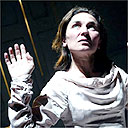
What we see is Fouere crouching on a table, slowly uncoiling her white-gowned body and increasingly resembling, with her sculpted profile and delicate gestures, a renaissance Madonna. What we hear is Fouere using all her vocal skill to break up Beckett's unpunctuated phrases and intersperse them with cries and ululations.
As she has proved in countless productions from Salome to Life is a Dream, Fouere is a real artist with a strong visual presence and vocal technique. But, although she here tries to give the action physical momentum by gradually rising from her semi-recumbent posture before exiting into emptiness and death, she is striving against the odds. When Beckett wanted to write a drama about finality and extinction he did so. Here he has written a spartan prose poem which should be left where it belongs: on the printed page.
· Until October 4. Box office: 020-7452 3000.