Oct. 31 will mark the first House of Representatives election since the enactment of a law aimed at achieving an equal number of male and female candidates for the Diet and local assemblies, but women account for only 186, or just under 20%, of those running in the lower house election.
This figure is down 23 from the previous House of Representatives election in 2017. Candidates and parties have been calling for policies aimed at improving child-rearing and working conditions for women, but women's participation in the political arena has not progressed.
-- High hurdles
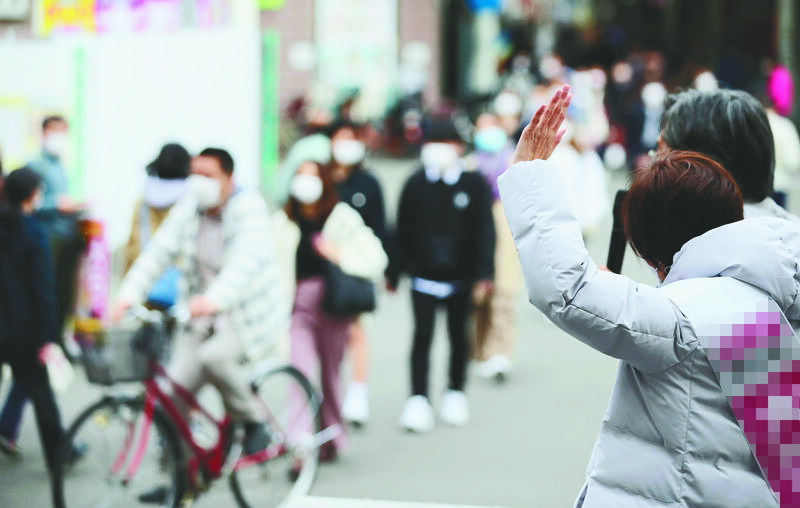
"A society in which people have to quit their jobs to raise children is unacceptable," a female candidate from Osaka Prefecture said in a speech in front of a station on Saturday morning.
The woman said her decision to run was prompted by conversations she had with parents who are raising elementary school children like herself. "It's important to apply what you've learned in daily life to policy," the candidate said.
"Women are still a minority in the political world," she said during her speech. "It's really difficult to run for election while raising children, so there are few female candidates. Let's work together to create a society in which women can play an active role."
Of the 1,051 candidates for the lower house election, 186 are women, or 17.70% of the total. Compared with the previous election in 2017, in which the percentage of women was the highest since the end of World War II, there are 23 fewer women running, which is 0.01 percentage points lower.
In the Fifth Basic Plan for Gender Equality adopted by the Cabinet at the end of last year, the government set a goal of raising the ratio of female candidates in both the House of Representatives and the House of Councillors to 35% by 2025.
A female candidate from Kagawa Prefecture who used to be a secretary to a Diet member said, "There are few women who step forward to become politicians."
She decided to run because "unless the number of female lawmakers increases, the core of the nation will not change. I want [my candidacy] to motivate other young women" to become politicians, she said.
As the number of female candidates has not increased, political parties have started to take measures, including holding seminars for women to study politics and setting up consultation offices for women who want to run for office.
In Osaka Prefecture, a local unit of a political party set up a team this month to discuss policies for women and to train female politicians. But such efforts are still in their infancy.
-- Ranked 165th globally
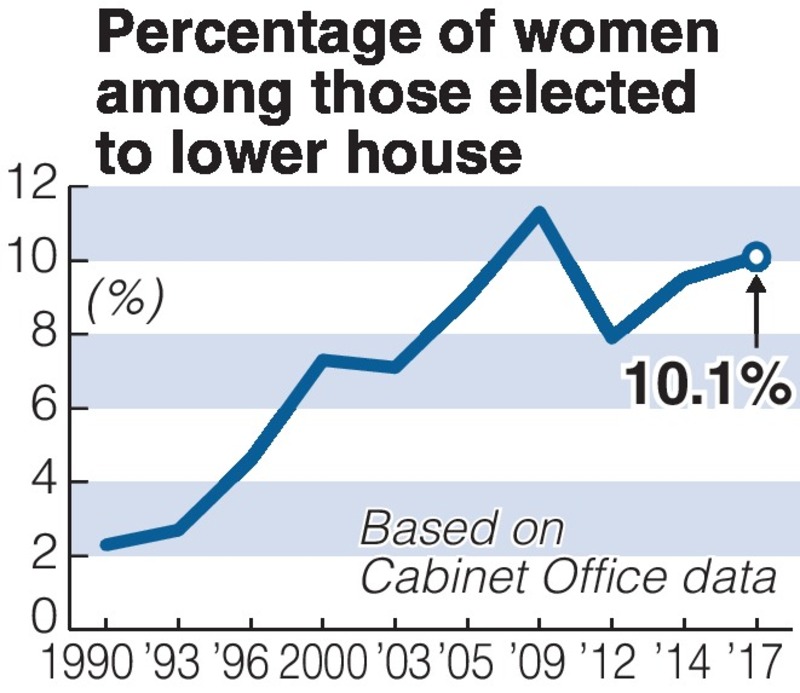
The percentage of women elected to the lower house is even lower than that of female candidates. According to the Cabinet Office, women accounted for 2.3% of those elected in 1990, a figure that rose to 10.1% in 2017. But the ratio of women is still low internationally.
According to the Inter-Parliamentary Union (IPU), the number stood at 9.9% as of Oct. 1, putting Japan 165th out of 193 countries.
However, some voters say it is not enough to just increase the number of female lawmakers. A 46 year-old female office worker in Shimamoto, Osaka Prefecture, who is raising her high school student daughter as a single mother, said: "I agree with the idea of increasing the number of female Diet members, but those who become Diet members have the image of being 'strong women.' It's important for them to work on behalf of women after they're elected."
The biggest problem is that the Promotion of Gender Equality in the Political Field Law is not enforceable and there is no competition among political parties to improve in this regard, said Reiko Oyama, a professor at Komazawa University who studies political systems.
"As in other countries, it may be necessary to increase subsidies to political parties that field many women," Oyama said.
Read more from The Japan News at https://japannews.yomiuri.co.jp/