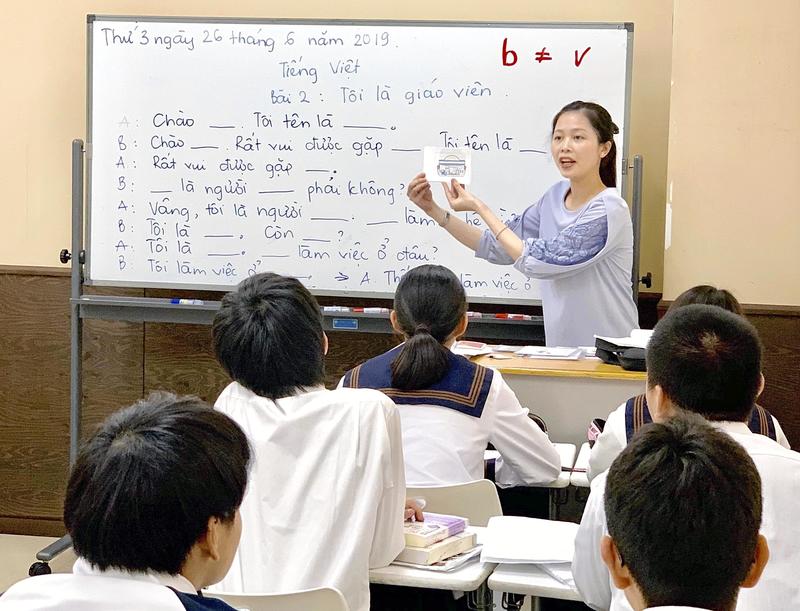
Languages less familiar to the Japanese are also learned at some high schools. "What do you do?" "Where do you work?" In late June, Vietnamese phrases were heard at the private Kanto International Senior High School in Shibuya Ward, Tokyo, which runs a Vietnamese course in the Department of Foreign Studies.
Do Cam Ly, a 31-year-old part-time Vietnamese lecturer, read out a sentence and about 20 first-year students repeated it. They learn vocabulary by looking at cards with pictures of things like schools and hotels.
The Department of Foreign Studies has courses in seven languages including Vietnamese. A study-abroad program in which students can live and study in Vietnam for nine months was newly established this summer.
"I want to work in the tourism industry in the future and spread Japanese culture overseas," said Sakura Inomata, a second-year student taking the course. The 16-year-old will be one of the first students to take part in the program and plans to study at Newton Grammar School in Hanoi.
The school began offering three Southeast Asian language courses -- Vietnamese, Indonesian and Thai -- in 2007.
"It was aimed at nurturing promising human resources in anticipation of the future economic development of Southeast Asian countries," said Shinji Kurosawa, vice principal at the school.
A study-abroad program in Thailand was also launched two years ago and three students were to take part this year. The school hopes to ramp up educational opportunities for its students in the country.
Keio Shiki Senior High School in Shiki, Saitama Prefecture, offers classes in the study of 24 languages including English, Arabic, Finnish and Mongolian. University lecturers serve as teachers. Second-year students are required to choose one of these 24 languages and learn it as a compulsory subject during class hours, as part of an integrated learning course.
In addition, students of any year can learn a language of their choice in the extracurricular foreign language course.
"In terms of practical benefits, not all languages are useful. However, we aim to help students learn various ways of thinking through studying various languages, without considering whether it is useful for entrance exams or obtaining qualifications," Hiroshi Miyahashi, a teacher at the school, said. He said that all 24 language classes have students.
Harima High School in Himeji, Hyogo Prefecture, offers a Polish class, which is rare in Japan.
The Polish class began in 2016 after the school established a sister-school relationship with a girls school in Warsaw. Second-year students take language lessons conducted by a Polish nun living in the prefecture, with about 10 students taking it as an elective class each year.
"I'd like students to learn an international sense of feeling through learning the language," Ryosuke Hotani, vice principal at the school, said.
There are also educational programs outside of schools that are offering various language courses.
As of May this year, 38 institutions other than schools -- including language schools, cultural centers and local government international exchange associations -- were providing education for 85 languages other than English, according to a survey by Mamoru Morizumi, professor emeritus at Osaka University and J.F. Oberlin University.
The 77-year-old multilingual education expert pointed out that there is a great variety of language needs in society.
"A foreign language education policy should not place too much emphasis on English but allow students to learn other languages in elementary, junior high and high school and at universities, which will lead to true globalization," Morizumi said.
Read more from The Japan News at https://japannews.yomiuri.co.jp/