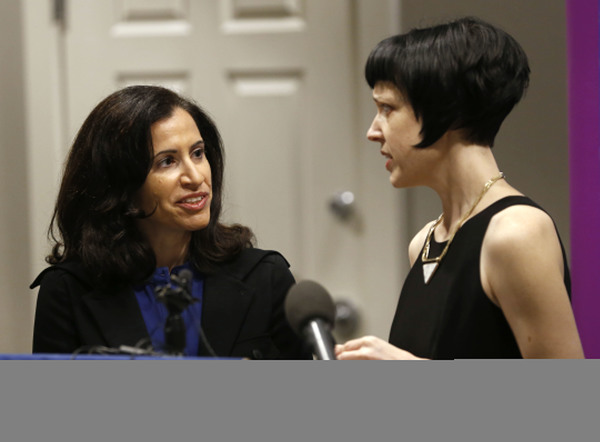
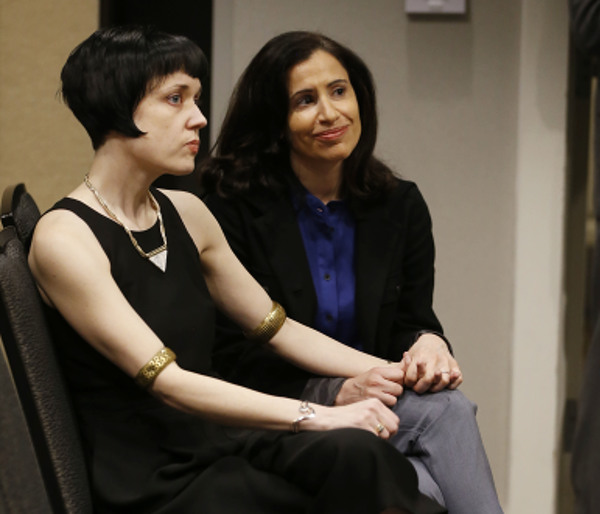
AUSTIN, Texas _ Two Texas women are suing the Trump administration after the couple say they were told they could not foster a refugee child because they don't "mirror the Holy Family."
Fatma Marouf and Bryn Esplin, both professors at Texas A&M University, said they were turned away by Catholic Charities Fort Worth after they expressed interest in applying to be foster parents to a refugee child. Catholic Charities, which has multiple regional offices, is the only organization in Texas that works with the federal government to resettle unaccompanied refugee children here.
Catholic Charities' program is overseen by the U.S. Conference of Catholic Bishops, one of two lead agencies that partners with the federal Office of Refugee Resettlement. With the help of the LGBT legal group Lambda Legal, the couple is suing both the Conference and U.S. Health and Human Services, claiming the decision to reject their interest in foster care violated the U.S. Constitution.
In a statement, the Texas Conference of Catholic Bishops and Catholic Diocese of Fort Worth did not comment on the couple's specific allegations but insisted their refugee foster care rules comply with all federal regulations and laws.
"Finding foster parents _ and other resources _ for refugee children is difficult work," Catholic Diocese of Fort Worth Bishop Michael Olson said. "It would be tragic if Catholic Charities were not able to provide this help, in accordance with the Gospel values and family, assistance that is so essential to these children who are vulnerable to being mistreated as meaningless in society."
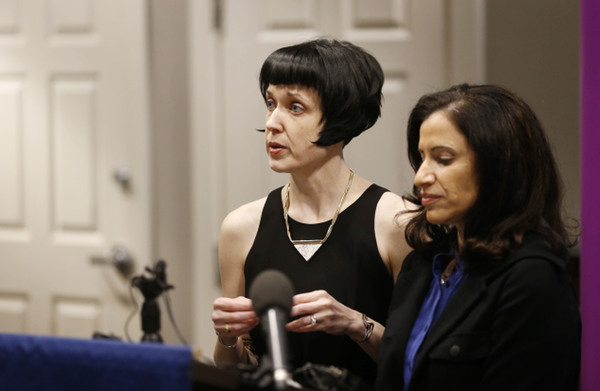
Marouf, who was raised Muslim, and Esplin, a Mormon, have been married for the past three years. They moved to Texas in 2016 and reside in Fort Worth. In their lawsuit, the couple claim administrators at the Catholic Charities Fort Worth invited Marouf to learn about their foster care program for refugee kids.
But when Marouf and Esplin showed up for an interview, they claim they were told they did not "qualify" to be foster parents. Donna Springer, chairwoman of the organization's board of directors executive committee, allegedly told the couple that foster parents must "mirror the Holy Family," according to the suit.
Marouf, who directs the A&M School of Law's Immigrant Rights Clinic, said the agency put its religious views over the best interests of the kids in their care.
"Refugee children have been through enough trauma to last a lifetime," Marouf, 41, said. "They need love, stability, and support, which Bryn and I have in abundance."
Esplin, 33, who designed the curricula for the A&M College of Medicine's child and adolescent psychiatry bioethics fellows, added: "Being denied the opportunity to foster a child because we don't 'mirror the Holy Family' _ clearly code for being a same-sex couple _ was hurtful and insulting to us."

In the lawsuit, the couple states that Catholic Charities Fort Worth was aware the women were married prior to their interview. The women said they were told they did not qualify just before the organization's director of immigration services invited Marouf to give a presentation on her legal work at A&M.
Catholic Charities Fort Worth denies the couple ever spoke with Springer _ saying she "never had any contact with the couple" _ but acknowledged the then-director of child welfare services talked to them over the phone. The organization also denied allegations in the lawsuit that the couple was told the agency did not have any LGBT kids among the roughly 70 refugee children in its care at the time.
"We do not screen or otherwise ask the children we serve to self-identify if they are LGBT," said Katelin Cortney, Catholic Charities Fort Worth's communications director. "We train our foster families to accept children from all cultures and walks of life so they can be as prepared as possible to welcome someone new into their home."
Last year, Texas passed a law giving legal cover to adoption and foster care agencies that cite religion to turn away prospective parents. Many faith-based adoption groups, including those that receive taxpayer money through state contracts, already turn away LGBT couples or prospective parents who are single, unmarried or not Christian.
For example, Abilene-based Christian Homes & Family Services considers only prospective adoptive parents who attend church weekly and have been married for two years. Buckner International, based in Dallas, will consider single people on a case-by-case basis, but lets only couples married for four years or more become foster parents. Many have policies to turn away LGBT couples or people of other faiths, and one agency rejects prospective parents who own trampolines.
The new Texas law, which went into effect Aug. 1, extended additional legal protections if the child placement agency rejects couples based on "sincerely held religious beliefs."
But the law doesn't apply to Marouf and Esplin's case, Lambda Legal said, because refugee child foster care is run through the federal, not state, government.
"We are challenging federal funding to an organization that permits religiously-based discrimination," said Currey Cook, director of the Youth in Out-of-Home Care Project at Lambda Legal. "But while our case does not challenge the state (law), it goes to the heart of the issue in that equally unconstitutional law and demonstrates clearly the danger of such laws _ harm to children as result of fewer homes available to them and harm to the loving families turned away."
Millions of dollars in federal aid flow from the Office of Refugee Resettlement to the U.S. Conference of Catholic Bishops and Lutheran Immigration and Refugee Services, the two organizations responsible for overseeing the placement of unaccompanied minor children in suitable homes.
Marouf and Esplin's lawsuit claims the federal government and these organizations violated the establishment, equal protection and due process clauses of the Constitution by imposing a religious test in the provision of child welfare services.
Marouf said she contacted the federal government regarding the incident at Catholic Charities Fort Worth but has received no response other than a "thank you" for providing the information.
The Conference of Catholic Bishops did not immediately respond to requests for comment. The lawsuit will be filed Wednesday in the U.S. District Court for the District of Columbia.