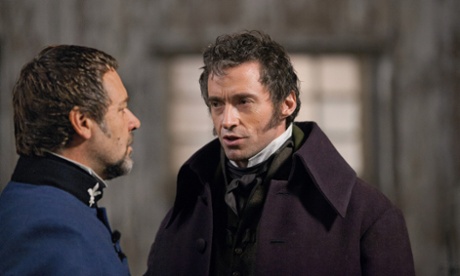
It all starts with out-of-tune Russell Crowe. Let’s just say it’s not the most fortunate of beginnings. I approached Les Misérables with an open mind and had hoped that, despite my dislike of musicals, this film would be so good that the format wouldn’t matter. But, faced with that cringeworthy exchange between Crowe’s Javert and Hugh Jackman’s Jean Valjean, in which the former offers parole to the latter in a weird, no-man’s-land tone between singing and speaking, I feared the worse. I looked around, and the rest of the audience seemed to be pleasantly immersed in the revolutionary drama. Already.
Let’s get this out of the way: Les Mis is technically spectacular and the performances are good – the singing was filmed live, which is impressive. It is a good screen adaptation of the musical (which I’ve also sat through in the West End) – but it’s still a three-hour movie version of Les Misérables, and that, for me, just does it.
I’m in the half of the population that hates musicals. I cannot deal with them. Right at the peak of the action, when any scene is getting interesting, someone bursts out singing. Goosebump-inducing, you say; insufferably uncomfortable, I say. I felt the way I would if a friend started singing in the middle of a bar: embarrassed for them, and looking round for the nearest exit. I mean come on, it’s just awkward.
Back in 2012, I thought the rest of the world would be with me – not a bad film, but just another annoying musical, right. I entered conversations with the self-assurance of she who knows herself in the safe opinion of the majority. Imagine my surprise when I discovered that I was, in fact, alone. Everyone loved it. Critics praised it. The Academy nominated it. A friend who loves film and whose taste tends to coincide with mine went to the cinema THREE times to experience it in full. Three times.
Was I missing the charm of Anne Hathaway’s famous performance? Nope. I did appreciate it, as well as the rest of the actors’ – excluding the lack of singing abilities of some in this, a musical, but we’ve touched on that. Did that 10-minute cry scene deserve an Oscar? I most certainly don’t think so. I admit my outrage with the film grew in direct proportion to the accolades it got, so when I saw her get the award, I just had had enough (correction: that was when the Academy snubbed 93-year-old Emmanuelle Riva to give the Oscar to Jennifer Lawrence, but that’s a whole other story).
This is, of course, top drama: the Hollywood version of Victor Hugo’s 19th-century novel has all the melodramatic elements you could want: love, treason, social injustice, forgiveness. Don’t get me wrong: who doesn’t love a bit of French Revolution tragedy? It’s not that the songs are bad, either: they’re catchy, they’re epic. But do they really need to mix the two? I can’t help it – as soon as they start singing, I think: we got the point after about a minute, next spoken sentence please.
Jackman gives a great and dedicated performance, as do the rest of the starry cast. On paper, it all makes sense. I have tried. But the reality is, watching Les maudits Mis, I just want to scream, “Stop singing in my face, all of you!” and run.