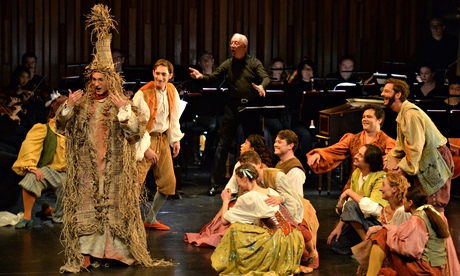
Subtitled Maître à danser, William Christie’s latest Rameau tribute with Les Arts Florissants focused on what might broadly be classified as ballets. Broadly, it should be added, is the operative word. The 17th- and 18th-century French tradition of melding genres resulted in works usually regarded as hybrid, and the two one-acters performed here in a staging by Sophie Daneman, Daphnis et Églé and La Naissance d’Osiris, are as much about song as about dance. Both were written for private performance at Fontainebleau, rather than Versailles. Both are exercises in pastoral. And, musically, both are exquisite.
However, Daneman’s staging proved problematic. The narratives are slight: it could indeed be argued that La Naissance d’Osiris, written to celebrate the birth of the Duc de Berry, the future Louis XVI, has no plot whatsoever. Daneman linked the two by making Daphnis and Églé, the reluctant lovers of the first ballet, the parents of the child in the second, whose birth brings Jupiter and Cupid down to earth to hail him as one of their number. One drawback was a presentation of pastoral rusticity so cute as to verge on saccharine. Another was the eclectic mix of choreography by Françoise Denieau. Some of it looked more 19th century than 18th, though an angular, flat-bodied pas de deux nodded in the direction of Nijinsky’s Faun, and the adult, bare-chested Cupid and his three graces were reminiscent, intentionally or otherwise, of Balanchine’s Apollo.
But you couldn’t fault the performance. It was beautifully danced and sung, with some wonderful choral singing and a particularly glorious solo contribution from Reinhoud Van Mechelen as Daphnis, fast emerging as one of today’s finest Baroque tenors. Élodie Fonnard was the silver-toned Églé, Pierre Bessière the sonorous Jupiter. Christie has an instinctive feel for Rameau, and orchestrally everything was immaculately judged, wonderfully gracious and admirably sensuous.