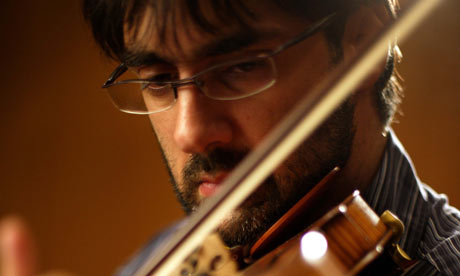
Many have tried, but few have succeeded: Greek violinist Leonidas Kavakos attempts the impossible tomorrow night with the London Philharmonic, the start of his four-concert residency as the South Bank Centre's Artist in Focus. In programmes in which you can hear Kavakos as a conductor and director with his orchestra, Camerata Salzburg, as chamber musician and concerto soloist, Kavakos is searching for what he calls the "source" of music: the transcendent, ethereal realm that, for him, is the place that the great masterpieces come from.
Kavakos has even had a go at defining what this "source" actually is, and how it manifests itself in the music he's playing by Bach, Schnittke, Mozart, Tchaikovsky, Bartok, and Berg. There are four elements to Kavakos's essence of music: memory – the way a piece of music relates to other masterworks, or how a work memorialises or celebrates human life; silence – without which, Kavakos paradoxically but correctly says, there would be no music at all; folk music – traditions that our Platonic violinist sees as coming from the people; and Bach – every composer's favourite musician.
If there's one piece in Kavakos's week of concerts that brings all four elements of his source together, it's the one he's playing tonight with the London Philharmonic Orchestra and Vladimir Jurowski, Berg's Violin Concerto. (Always assuming that the LPO have recovered from the shock of their erstwhile general manager and finance director's alleged, extraordinary fraud. The orchestra has begun a court action against Cameron Poole to recover £560,000 they claim was embezzed. Hald a million quid would come in handy in these tough times for our major orchestras.)
Berg's piece is dedicated "to the memory of an angel" (Alma Mahler's daughter, Manon Gropius, who died of polio aged 18), the piece quotes and transforms a Bach chorale, "Es ist genug" ("It is enough") in its final pages, it includes references to Carinthian folk tunes, and emerges from primordial quietitude to dramatise an existential battle of life and death. Kavakos's violin-playing has always been astoundingly virtuosic and blazingly insightful. Whether that's enough to qualify him as the artist-seer he wants to be is another matter, but whether you call it "source" or "essence" or some other place that passeth understanding, if his ideas inspire his playing, I'm happy to admit Kavakos to the pantheon of musician-philosophers.