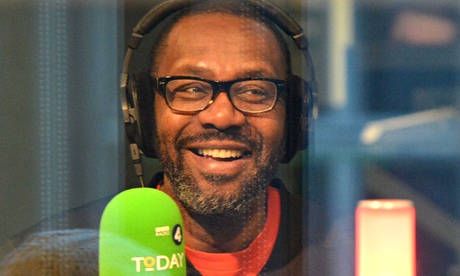
Although Radio 4’s morning news show has had the word “Today” in the title for 57 years now, Tuesday’s edition might more accurately have been called The Tomorrow Programme. Lenny Henry – one of the guest editors the show traditionally employs in the week between Christmas turkey and new year fireworks – offered his vision of how broadcasting might be if his campaign for greater BAME (black, Asian and minority ethnic) representation in the industry is successful.
But the problem with having a vision on the radio is that people may not notice.
Because race is generally indicated visually, the radicalism of Henry’s agenda was apparent only when he mentioned it or to listeners watching the studio webcam: every single on-air presenter – the hosts, weather, sports, business – was non-white.
This was only possible through some buy-ins from the World Service: Nkem Ifejika (denied a listing in Radio Times) joined breakfast regular Mishal Husain as co-presenter with Karthi Gnanasegaram in for Garry Richardson on the back-page stuff.
The celebrity festive editors on Today are often familiar with studios only as interviewees, but Henry has an impressive record as a presenter and his personalised segments were high-class: especially an interview with Amjad Bashir, an Asian who is an MEP for Ukip. While the chat contained some signature giggles, there was a Paxmanesque whack in one challenge – “There are people in your party who wouldn’t want you living next door to them?” – that was painfully underwritten by Henry’s childhood history of facing racism in the Midlands.
It was as pointed as the presenting lineup that every item fronted or curated by Henry had a racial aspect: jazz, black literature, interviews with the culture secretary, Sajid Javid, and MP Diane Abbott.
However, the problem with this policy, as Husain and Ifejika spiritedly raised with their boss in the final segment of his tenure, is that there is a narrow divide between diversity and divisiveness. Can only people of colour discuss race? Is it the only thing they think about? “Black people,” memorably argued crime writer Dreda Say Mitchell in a literary debate, “don’t wake up thinking: ‘Gosh, I’m black!’”
Husain wondered how Downton Abbey, given its subject matter, could become more diverse. Henry replied that the actors could be white but the production crew non-white.
He politely avoided saying that his Today edition was probably more the other way round: BAME faces out front, with aristocrats and public school boys behind the controls.
Whereas another campaigning comedian-actor, Russell Brand, is accused of having no policies, Henry is vulnerable to the charge of possessing only one. Although he happened to be a West Bromwich Albion supporter in charge of Today on the morning after their manager was sacked, he brought no fresh angle to that story. And, for some of his items, it might have been intriguing to see if he could get a different kind of interview from one of those white people – David Cameron, Nigel Farage, Bob Geldof – who form the usual cast list of the programme.
Twice in different items, Henry punningly suggested that an opponent of his views was playing “devil’s avocado”, and this must surely soon become the title of a series in which he is sent into a different broadcasting institution each week – The Archers, Question Time, Doctor Who – with the challenge of producing the first totally non-white edition.
For a man campaigning to force a greater range of faces on TV screens, it may count as second best to have got them on the radio. But Henry – whose expansion into stage acting and activism has made him one of showbiz’s most interesting figures – has scored another powerful polemical point, although the test of his success will be judged on whether any of Tuesday’s diverse first-timers is given other gigs on Today. And whether Henry can ever appear on the BBC without, as he said on-air had happened on Tuesday, “getting racist comments on Twitter.”