The Rugby World Cup hosted by Japan starts on Friday, and the home side has a strong captain who loves Japan deeply and ably leads the Brave Blossoms.
Japan national team captain Michael Leitch, 30, was addressing his teammates at a hotel in Sakai, Osaka Prefecture, on July 29, speaking to his strong squad in Japanese.
The topic of his lecture was Sinali Latu, 54, a Tonga native who played for Japan in three World Cup events.
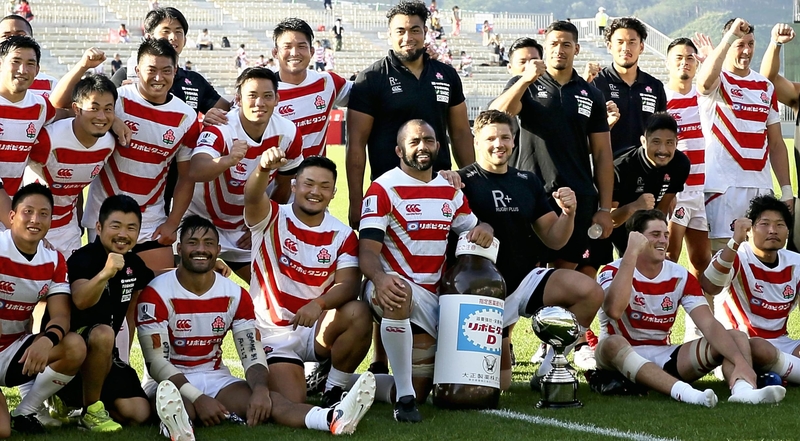
As it was just several days before a match against Tonga in the Pacific Nations Cup, Leitch talked about how the national team coaches at the time were concerned whether Latu could play with real fighting spirit against his home country. Despite such apprehensions, Latu played well, Leitch told his Brave Blossoms teammates, among whom are many rugger men from Tonga.
Leitch also discussed parts of Japanese history. Touching on Japan's isolation during the Edo period (1603-1867), the captain told his men that Japan become a major country by adopting overseas cultures after ending the isolation. "Like that, we can become strong as a mixture of various countries," Leitch urged.
Leitch came to Japan from New Zealand when he was 15. Now he has spent as many years in Japan as in New Zealand, and has obtained Japanese nationality. He is able to understand the thinking of both Japanese natives and those from overseas.
In rugby, overseas players can join other country's national teams if they meet certain conditions, even without obtaining the nationality of that country. Among the Brave Blossoms, about 40 percent of the players are from overseas.
"This team can be united when knowing about Japan," Leitch said.
Tough as nails
At the Japanese national rugby team's Miyazaki training camp in June, Leitch spent about an hour signing autographs for fans, showing the kind heart within his fierce bearded appearance.
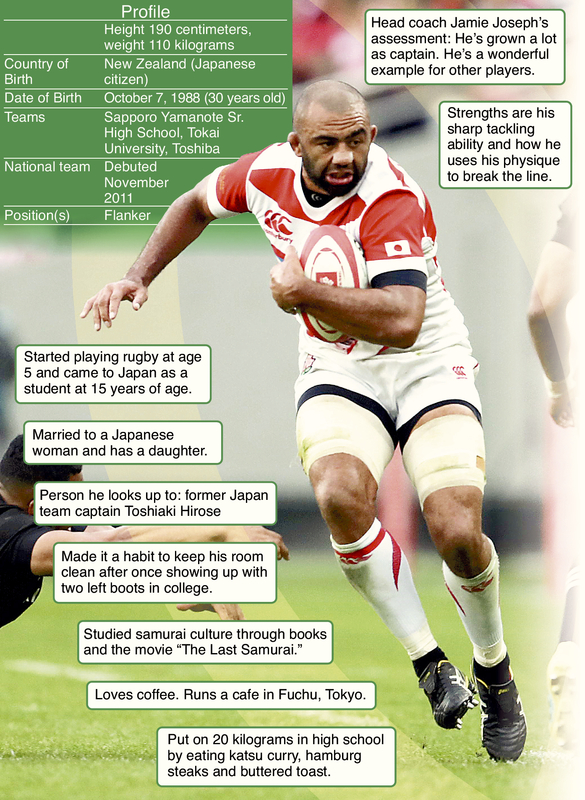
Leitch, 30, once a skinny teenager, became the captain of the national team. He is praised by head coach Jamie Joseph as being a "natural born leader." He is more focused on the upcoming World Cup than anyone else out there.
At age 15, Leitch came from his native New Zealand to study at Sapporo Yamanote High School in Hokkaido. Although he was thin, he had a strong sense of responsibility.
When he was a first-year student he represented the school in the national high school tournament at the Hanazono Rugby Stadium in Higashiosaka, Osaka Prefecture, where his team was thoroughly defeated by a team that included a foreign student from Tonga.
"I am also a foreign student, but I couldn't contribute to my team," he thought. This experience stimulated his motivation to grow as a rugby player.
To gain weight, he ate eight slices of buttered toast before going to bed and attended weight training sessions.
Leitch's first World Cup appearance was in New Zealand in 2011. With Leitch starting in all matches, Japan finished with three losses and a draw.
He regretted the results, thinking that his team could not show the people of his homeland a strong Japanese side. He thought that the team was overconfident after winning the Pacific Nations Cup right before the World Cup.
When Leitch was first named skipper in April 2014, he got nervous. "The team was sometimes criticized for having too many foreigners. Is it OK that I am going to be the captain?" he thought. On top of that, strict demands from then head coach Eddie Jones nearly made him give up.
During a European tour in autumn that year, then general manager Kensuke Iwabuchi told him, "The team won't grow any further if the captain can't talk to Eddie on equal footing."
Leitch replied, "No matter what I say, Eddie replies harshly." He was yet to stand on his own feet as a captain.
In 2015, which became a turning point, he joined the New Zealand-based Chiefs competing in the Southern Hemisphere's top league, Super Rugby.
Leitch watched the captain practice the hardest of all and express his opinions to the coach. That became his goal.
At the 2015 World Cup in England, toward the end of the match against South Africa, Leitch decided to go for a scrum, contrary to Jones' order and proof of his maturity as a captain.
After taking some time off to recharge after the 2015 World Cup, he returned to the national team in May 2017, before regaining the captaincy in October.
"This time I wanted it," he said. He was ready and determined to lead his national team at home.
This time, he is paying the most attention to "listening to the little voices."
During another European tour last autumn, Japan played well against a powerhouse England side, before struggling against lower-ranked Russia. Leitch felt laxity in locker room conversations before the match against Russia. Consequently, he realized the need to strictly train from a subconscious level as well.
An example would be talks about Japanese history, an effort aimed at creating a strong consciousness to fight for Japan in players from foreign countries. Leitch set up opportunities during last year's training camp for 2011 World Cup players, including himself, to talk about their experiences.
On August 10, Japan won the Pacific Nations Cup. "We shouldn't be overconfident. Things could turn out like they did in 2011. The World Cup is totally different," he said with a cool head.
The Japanese team is supported not only by his world-class play, but his mentality as well.
Read more from The Japan News at https://japannews.yomiuri.co.jp/