It was 60 years ago that Phillip King, then a young conscript doing his national service, was posted to Paris. “I could speak French and was supposed to be joining a general’s staff. But when I got there my post had been taken by someone else and so I found myself living this very independent life, with my own flat, and a lot of time to explore the city.” He got into photography, he wrote poetry and even started a novel. He also went to the Louvre where he began to make drawings of the sculptures. “And I found that while I could sense there were certain forms within the marble, no matter how hard I looked I couldn’t see them. In those days, there were no invigilators and so you could touch the statues if you wanted, and when I did, I could feel the curves I had sensed. It made me think for the first time about sculpture being the art of the invisible; it was quite a discovery.”
King says it is an idea he has explored throughout his career, and when he later taught sculpture – which he did for 40 years – it was always one of the first things he talked about with new students. “Sculpture might ostensibly be the most visible of arts in that the viewer can quickly gauge size, weight, colour and so on, but there is also something that escapes you in the most mysterious manner. It can never be totally visible in the way that a painting can, where surface is everything. With sculpture, there is surface, but there is so much more going on behind. I remember going to see some of Bill Tucker’s giant cloudlike bronzes in New York and getting this strange feeling in my stomach. It happens sometimes and is, I think, something to do with weight and taking in a piece not just with your eyes, but with your whole body. Exploring that sense of mystery is one of the things that has kept me making things for all these years.”
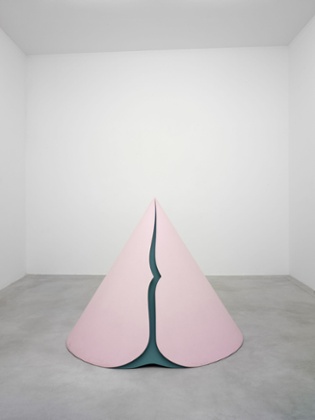
King’s CV is remarkable. As a New Generation artist in the early 60s he was part of the movement that revivified British postwar sculpture. His work was acquired by the major museums, with his pink, fibreglass cone Rosebud, a groundbreaking early work, bought by Museum of Modern Art in New York at the personal instigation of its founding director Alfred Barr. King has represented the UK at the Venice Biennale, and has been the subject of significant retrospectives at home and abroad, including at Forte di Belvedere in Florence, only the second English sculptor after Henry Moore to be shown there. He has been a trustee at the Tate, professor of sculpture at the Royal College of Art, president of the Royal Academy and was awarded a CBE.
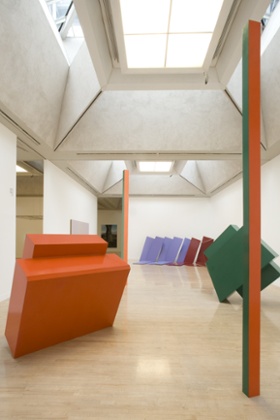
But despite these many achievements, there has long been a feeling that King has not enjoyed the kind of recognition his career warrants, certainly not in comparison with, say, his former tutor then long-term friend and colleague, Anthony Caro. That has to an extent been rectified this year, in which King has turned 80, by three London shows, the last of which opens next week at Tate Britain and features some of his best-known work from the 1960s and early 70s, including Rosebud as well as some of his larger, and equally brightly coloured, works in steel.
“As someone who has never stopped making work, my primary focus is always on what I am doing today,” he says. “But I am also aware that the work of mine that sells for the best prices is from the 60s, and there remains a strong interest in it. Looking at it for this Tate show has been fascinating in the same way as seeing someone again you were once in love with. Do you deny that love existed just because you have moved on to somebody else? No, you don’t. After a time you accept it as part of a longer story and enjoy it in that spirit.”
King was born in 1934 in Tunis, where his English father had started a trading company. His mother was French and he was brought up in both languages, going to the same school in Carthage that was attended by Claudia Cardinale, “who, annoyingly, I can’t remember”. He says he could always draw well, but when the family moved to the UK in 1946, art was not encouraged at school. “I was much more interested in sport, anyway, although I also loved literature and was so shaken by reading Camus’s La Peste that I wrote to him via his publisher. It must have been something pretty heartfelt, as Camus responded by sending me a signed copy with a little note saying only that he had been moved by my letter”.
After his epiphany in the Louvre while in the army, King studied modern languages at Cambridge but devoted most of his energies to sculpture, producing a series of small clay works that were exhibited and sold well. “I made £50 having spent £30 to hire a gallery.” He had avoided formal art tuition at university, but, after graduating in 1957, enrolled at St Martins, where Caro was a tutor. Within a couple of years he had followed in Caro’s footsteps to become an assistant of Moore, before returning to St Martins to teach.
In terms of his own art, he says, as a student “all the talk in the pub with my friends was about painters. I thought people like Rothko and Pollock were using a kind of physicality as part of the making process, but there didn’t seem to be anything in sculpture that resembled that kind of adventure.” It wasn’t until he had left St Martins, and visited Greece, that “Brâncuși made sense. Brâncuși had discovered the pileup, physically putting one thing on top of another. What really struck me in Greece was the way the Parthenon rooted itself into the landscape. My later reluctance to see abstraction as something worthwhile was to do with it being cerebral and not from nature. Greece allowed me to rediscover how things can be of the mind but also of nature, and the idea of using gravity as a way to make things stand up.”
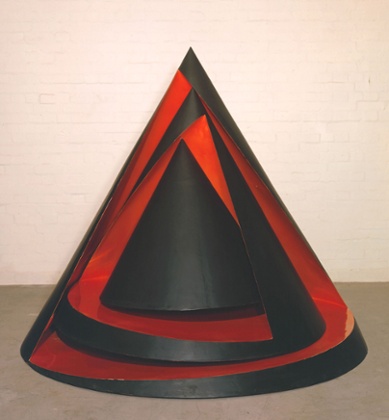
On his return from Greece, King “put to one side everything he had done before” and set out on a new path that soon led to Rosebud. “From Brâncuși I was thinking about adding one thing to another as a way to make things stand up, and when leaning two leaves against each other I came up with the cone shape.” Soon King was famous for his cones, although they didn’t always provoke reverential responses and he remembers the time when a follow-up work, Genghis Khan, was displayed in the grounds of a gallery in Germany, and the police were called after complaints that someone was camping in the woods. King then moved on from fibreglass to brightly painted steel pieces, and both styles were exhibited at the 1968 Venice Biennale.
It was a time of student revolution all over the west, and King left a Venice with troops in St Mark’s Square to return to an equally febrile atmosphere in London. Back at St Martins he and Caro had long operated an informal hard-cop, soft-cop system of dealing with the emerging generation of artists such as Richard Long and Gilbert and George who had little time for conventional sculpture. (King was the soft cop, always trying to find something positive to say, and Long has spoken about him being one of the more sympathetic tutors.)
“The 60s were a very exciting time, but also very fraught. At St Martins in 68 and 69, people were questioning everything so much that you couldn’t really be a teacher. That was good in a way and eventually gave rise to new artists who were very independent and anti-authority.” But for King, only in his mid-30s, there was a feeling that he had become the establishment and “might be sidelined at any minute. The idea of the avant garde became worrisome – the notion that you could do something new, and that it would eventually be upgraded, didn’t make sense any more.”
King later endured more confrontation when he became president of the Royal Academy at a time when the organisation was embroiled in one of its periodic disputes between the artists, who own the academy, and the administrators they appoint. “There was work pressure, health pressure and academy pressure. It did affect my productivity, and for a time I was only producing about one new work a year. But I always felt as an artist it was too easy to stay in your ivory tower, and I fought against that, not least by teaching, but also by taking on public roles.”
Since he retired from the RA in 2004, King says he has had a few health scares – his exercise regime now entails bouncing on a small trampoline – but his productivity has increased in his north London studio, a former stamping machine factory crammed full of new and old work, tools, paint, materials and an alarming amount of wiring snaking across the floors: “I fall over about once a year, but I haven’t broken anything yet. And I think Giacometti and Bacon had much more untidy studios than this!”
He has just finished a large new sculpture that will be displayed at the Tate at the same time as his pieces from the 60s, and despite the physically demanding nature of his work, he employs only a couple of part-time assistants. Has he ever considered enlarging his studio staff, an approach that had paid significant artistic and financial dividends for many artists? “It just doesn’t appeal. I once had lunch with Dubuffet and he was moaning about his assistants. He said he started working alone above a shop and now he had 30 assistants and all he did was find work for them to do. But maybe it’s a generational thing as the next lot do seem to have made it work.”
Although King is to a degree still defined by art made in the 60s, he has always readily embraced different artistic methods and materials. He still “thinks about sculpture all the time” and is in a “constant state of keeping an eye open for things that might be a trigger”. A broken children’s toy found on the pavement features in another new piece he is working on and, he says, while in the past he has been “scared of the blank page, I’ve learned that something will always turn up. The idea that you go for a walk, as Klee said a long time ago, is a good one. And it doesn’t matter if you sometimes find your road blocked, or you go down a blind alley. The detours are all part of the journey.”
He says he is particularly fond of a quote from Ingres, “who was supposed to be a bit stupid when talking about art: ‘I keep what I like and I get rid of what I don’t like.’ What he was really saying was that you need to develop a taste, or more accurately a way of working, which allows you to have likes and dislikes that are strong enough to let you create a good work of art. And in the end liking and disliking is what it is all about.”
• Phillip King is at Tate Britain, London SW1, from Monday until 1 February. tate.org.uk.