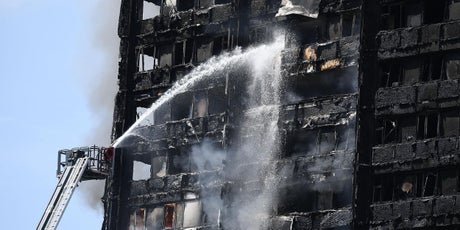
A £3.5bn package to end the cladding scandal has been condemned as “a betrayal”, after it left huge numbers of residents to pay the bills for making their homes firesafe.
No funds will be provided for other safety defects revealed when cladding is removed – and leaseholders in shorter buildings face £50-a-month charges to repay loans for the cost of their repairs.
With those costs easily reaching £40,000 in many cases, those residents could be paying off their debts for decades, it is feared.
Conservative MPs joined campaigners in protesting that the government had failed to fix the problems facing leaseholders, three-and-a half-years after the Grenfell tragedy claimed 72 lives.
A furious Stephen McPartland said he listened to the announcement, by housing secretary Robert Jenrick, “with my head in my hands wondering how he can have got this so wrong”.
“It is a betrayal of millions of leaseholders. It is not good enough. It is shocking incompetence. It is clear the PM has to step in now,” he said.
Paul Afshar, campaigner for End Our Cladding Scandal, said: “The government promised us no leaseholder would have to pay to make their homes safe. Today we feel betrayed.”
Grenfell United, which represents bereaved families and survivors, protested that “residents should not be forced into loans and new debt just because of the height of their building”.
And the Royal Institute of British Architects said it was “shocked by the government’s continued underestimation of the scale of our building safety crisis”.
The backlash came after Mr Jenrick announced a £3.5bn top-up to the existing building safety fund to finally remove and replace cladding on all buildings above 18 metres.
“Leaseholders in high-rise residential buildings will face no costs for cladding remediation works,” he told MPs, adding: “This will ensure that we end the cladding scandal in a way that is fair and generous.”
But no help was offered with other safety defects – and there will be “a long-term low-interest scheme” for buildings between four and six storeys.
“No leaseholder will ever pay more than £50 a month towards the removal of unsafe cladding, many far less,” Mr Jenrick told the Commons.
But Mr McPartland accused him of “smoke and mirrors”, adding: “No mention of fire safety defects, waking watches or excessive insurance premiums which are often the main costs for millions of leaseholders.”
And Mr Afshar added: “Many people living in buildings under 18 metres will still have to bear the cost – saddled with debt around their necks for 30 years.”
Andy Burnham, the Manchester metro-mayor, echoed the criticism, saying: “You just create a new injustice by shutting them out of the scheme by saying they have to turn to a loan or, worse, live with unsafe cladding.”
There were fears that flat-owners in those shorter blocks will be plunged into negative equity if they attempt to sell them, after taking out loans.
Around 274,000 high-rise flats are estimated to have dangerous cladding, with more than 650,000 people believed to live in them.
But that figure is thought to reach into the millions when those living in buildings of under 18 metres are included – where residents also face problems protecting and selling their homes.
After the 2017 Grenfell disaster, a ban on using combustible cladding on new buildings was introduced and sprinklers made mandatory on new-builds over 11 metres.
But the removal of existing cladding has been painfully slow. Mr Jenrick said 95 per cent of taller buildings with Grenfell-style cladding had been tackled or “had workers on site”.
Some lenders are refusing to offer mortgages on properties with similar cladding, insurance premiums have soared and some homeowners fear potential bankruptcy.
In the Commons, Mr Jenrick also announced a “developer levy” to be paid when companies seek permission to develop certain high-rise buildings.
And a new tax, from next year, would “raise at least £2bn for a decade to help pay for cladding remediation costs”.
“The tax will ensure the largest property developers make a fair contribution to the remediation programme in relation to the money they make from residential property,” he argued.
He defended the loan scheme as “reasonable”, telling MPs: “It’s about the equivalent of the average service charge for a purpose-built block of flats.”


.png?w=600)