
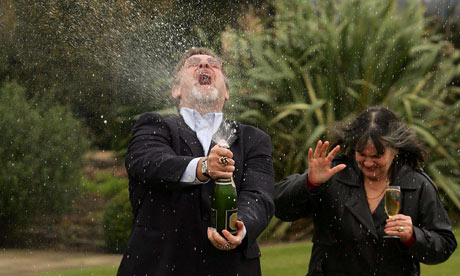
The world is an uncertain place. Every day we face decisions about potential risks and benefits, large and small, ranging from whether to fly in a plane to whether to eat more of this week's miracle vegetable. And to add to the confusion, unlikely things, such as winning the lottery, happen all the time.
Newspapers, 24-hour news channels and social media such as Twitter present us with increasing quantities of information of all kinds. How are we to make sense of it all? How are we to decide what to believe and how to act?
Fortunately help is at hand. It comes in the form of statistics, the science of uncertainty. This branch of mathematics enables us to deal with the masses of data and facts to make some sense out of the confusion.
This series aims to provide you with an arsenal of statistical tools in the fight against complexity, misrepresentation and deception.
You may remember statistics lessons from school with a sense of dread, but these ideas will empower you to uncover the truth behind the numbers and unpick arguments in the real world. There are fascinating patterns and trends out there just waiting to be discovered.
Statistics is the preparation, collection, organisation and interpretation of data, the raw material of science. Data is the key ingredient of the scientific approach to discovering the truth. Statistics touches everything, whether it's engineering, medicine, psychology or politics. Where there's data or measurement you will find statistics.
Put like this, it seems obvious that everyone should have at least the basic skills required to understand data.
This series will be a guided tour taking in means, medians and modes, p-values, confidence intervals and bias along the way. Each topic has been chosen because it is a useful tool that is often poorly understood. We will show how each should, and should not be used. And no doubt, you'll soon be spotting statistical abuse everywhere you look.
The first article explores how a sample of people can be used to represent an entire population in a piece of research, and the ways in which that sample could skew or bias its conclusions












