
Fear is a terrible thing. For example, some people have a fear of owls. Others have no fear of jumping out of an airplane with only the laws of physics and a bundle of ripstop nylon on their backs, but if you ask them to sit next to a clown.
Many publishers we work with face a common concern that keeps them awake at night. Though not quite as visually shocking as an owl or a clown (or an owl dressed as a clown), publishers are concerned about how to improve their user engagement, specifically across the following two metrics:
1. Increasing the number of video views per session
2. Increasing the viewing time per video
Some publishers react defensively by either substituting quality for quantity or by creating video content of shorter duration. Content is still king, and any publisher that considers a quantity-for-quality compromise is likely risking brand erosion and negatively affecting the loyalty of their core audience.
Even re-purposing content by segmenting it into shorter, more mobile-friendly and limited-attention-span-friendly durations is a tricky endeavour. For publishers that monetise with a traditional in-stream pre-roll, shorter video segments must also be balanced with monetisation. Some publishers have implemented coarse-grained rules, trafficking one or more pre-rolls (30 and/or 45-second creatives) with clips that were anywhere from 90 seconds to five minutes. While this advertising-to-content ratio may be standard for traditional broadcast, publishers need to consider that online viewing is also competing with time-shifted viewing experiences (i.e., skippable ads) and a seemingly reduced variety of advertisements. Watching the same 30-second creative 10-12 times while watching your favourite primetime catch-up episode can instil that smallest nugget of... fear.
One of the most effective ways to balance this approach is to enforce a logical ratio of advertising-to-content and limit the in-stream advertisements (pre-roll, mid-roll and post-roll) based on the amount of content actually viewed, thus reducing the browsing penalty of the user while maintaining an acceptable level of monetisation.
Keep On With The Force Don't Stop / Don't Stop 'Til You Get Enough
I encourage publishers to think of every viewing experience as a leanback experience. With this concept in mind, publishers should focus on two interrelated items:
1. Every video is just one moment in an infinite playlist
2. Every video experience is linear in consumption context but dynamic in content control
The infinite playlist

For every "play" request from the user, the publisher should redefine the concept of the end of a video. Today, many video experiences simply present an end screen that prompts the user with a social-sharing option. While this call to action can be effective for promotional purposes, this is disruptive to the viewing experience. The end screen typically presents additional content in the form of related content (e.g., based on popularity or some metadata-driven relevance to the previously viewed content). As with typical user behaviour, too much choice often leads to a lack of choice - or analysis paralysis.
In a model of an infinite playlist, every video should be logically sequenced to another video, providing the video with the suggestion of what they should - and will - watch next.
Content programming in this model can be as sophisticated as a dynamic recommendation model (a la Pandora or Netflix), a curated daypart model (a la Sirius, broadcast television), or some hybrid.
But the overall intent is the same: every video has a "next," and "stop" is removed from the content programming vocabulary.
Linear + Dynamic = Leanback
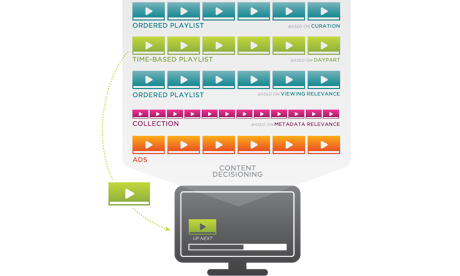
For every critic of the wizard-behind-the-curtain engine that powers the Netflix screen, one will likely also find them ordering from the virtual aisles of Amazon, searching via Google, and shopping at their local market--all navigational, selection, data-driven experiences that influence our definition of choice.
Many publishers we have worked with express their desire to fulfil two competing needs:
1. Curating content that helps establish their point-of-view or expresses what should be relevant for the publisher's editorial and/or promotional voice
2. Delivering content that is directly relevant to the individual consumer based on their preference or manual selection and search (though one could argue that even search results are the outpost of a clearly defined criteria of preference, priority, and curation)
Beyond providing the standard navigation and search mechanisms, the approach worth considering is creating a model of dynamic linear channels. Each channel consists of multiple factors to influence its selection and sequencing. As the viewer watches or skips a video, this behaviour is captured, processed, and used to influence future channel creation in a closed loop model.
Beyond the more common logical linkage based on video metadata, the channel could be dynamically generated based on:
• Duration - the viewer may specify a preference for shorter or longer content based on their consumption context)
• Time of day - content may be prioritised by its consumption patterns across the entire audience during a 24-hour period
• Type of device - content may be prioritised by its consumption patterns specific to the mobile platform, mobile OS (i.e., iOS vs. Android), and form factor (i.e., phone vs. tablet)
• Geolocation - content may be prioritised based on physical location
These channel rules do not exclude the desire for content curation. Publishers could also create more formalised channels that are modelled after radio and broadcast dayparts and use those as standalone content channels or use those as source channels with the factors mentioned previously.
There are also a number of visual cues that should be added to the video consumption experience to guide the viewer in a dynamic linear model. First, publishers should inform their users that content will be presented as a linear channel. This means enabling the viewer to see upcoming content but not necessarily giving the viewer complete freedom to disrupt the "scheduled/sequenced" programming ad hoc. Especially in full screen mode, the video experience should explicitly message to the viewer the upcoming video to dissuade their inherent nature to click away. This is a common method for broadcast and syndication since rolling credits tend to prompt the urge to explore other options. This message could be as direct as displaying an overlay of an animated interstitial to introduce the next video or as subtle as a single line of text or a graphical bug with a countdown timer.
As with any leanback experience, whether playback occurs on a tablet or a television (via AirPlay, Miracast, or a similar model of a device-first model), publishers should ensure that the core video playback experience maintains a quality of consumption that is essential for this context. The core video playback experience must:
• Minimise buffering of content and advertising, either through client-side functionality or server-side stitching (for manifest-based models such as HLS)
• Deliver the highest quality ABR playback appropriate for the available bandwidth (up to full HD 1920x1080 for tablets and televisions)
By combining the traditional linear programming model with the dynamic nature of digital targeting and playlisting – and by thinking of video as an infinite stream of content for a viewer – publishers can evolve the video consumption behaviour into a leanback experience, engaging the viewer's desire to discover and consume great content without lifting, or swiping, a finger.
Albert Lai is the CTO, Media & Broadcast Solutions at Brightcove, sponsors of the next generation video experiences hub.













