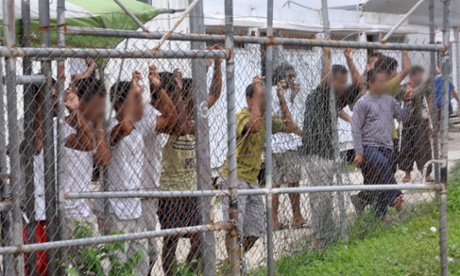
The transcript of a speech to asylum seekers in immigration detention on Manus Island detailing how they are soon to be moved to a temporary “transit centre” in nearby Lorengau is an illuminating document.
The leaked speech sheds light on an arcane and capricious process, being kept largely secret from those who are paying for it – Australian taxpayers – and, more importantly, from those upon whom it is being enacted – refugees.
But while the document sheds some light, it obscures too, asking as many questions as it provides answers.
And above all, the speech appears to demonstrate that the resettlement in Papua New Guinea of refugees who sought asylum in Australia is very much a work in progress; more bluntly, that it is being made up as it goes along.
The original memorandum signed between the Rudd Labor government and PNG was “little more than a blank sheet of paper”, the Coalition’s former immigration minister Scott Morrison said. The details of the deal had to be worked out later.
Those negotiations continue, and the plan keeps changing.
The Lorengau “transit” facility was originally being built as accommodation for women and children. When Manus got too dangerous to keep them there, they were removed from the island. It will now house only men.
In March last year, the PNG prime minister, Peter O’Neill, stunned Australia by announcing his country would only resettle “some” of the refugees from the Manus Island detention centre, and that other Pacific nations would need to take others.
Then in October, he insisted an entire new plan for resettling refugees be negotiated because the existing one was deeply unpopular with the PNG population.
In an environment so uncertain, what exists in this document is not sure to remain.
But, as the plan stands now, this leaked document reveals:
- Refugees will be housed in the Lorengau facility only temporarily, in preparation for their long-term “resettlement” within PNG.
- While in Lorengau, they will receive an allowance of 100 kina (A$46) a week. They will also be given “enough food to cook for yourself”.
- Refugees will be given lessons in Papua New Guinean languages (presumably English and Tok Pisin) and helped to find jobs.
- But they will not be allowed to resettle in Manus province. Instead they will be moved to other parts of PNG. Many, it can be assumed, will end up in Port Moresby, where employment opportunities are greatest (though still severely limited).
- Refugees will be forced from the detention centre – they cannot stay, as the speech says three times – whether they agree to apply for a PNG visa or not. They have been told they will be removed forcibly if they resist.
- After eight years, refugees can apply for PNG citizenship.
- After an indeterminate period – “when you have established yourself” – they can apply to be joined by their families.
- Once outside the Lorengau transit centre they will be required to support themselves: “there is no public welfare system in Papua New Guinea”.
But the questions it raises are perhaps of greater concern:
How does the Papua New Guinean government intend to keep refugees safe? PNG has told refugees “you will be safe, there is basic security … and the local police are also nearby”.
This ignores the fact that it is security guards and the police (many of whom are from other parts of PNG, and are especially hostile to outsiders) who pose the greatest threat.
This week, a detainee reported being told by a guard: “We will rape and then kill all of those who enter new accommodations in Lorengau. We are fully equipped and ready. We hate you. Leave our land. Australia is not boss, we are boss here.”
The imposition of a new population of men, without roots or connection, within the Manus community is fraught with danger. Beyond a wariness of outsiders from alien cultures, is a feeling among Manussians that the needs of refugees sent from Australia are being put above their own.
The refugees will be paid – at Australian expense – 100 kina a week for living costs. They will live in new homes — built with Australian taxpayer dollars – that have running water and 24-hour electricity. Simple by Australian standards, by local comparison they are palatial.
The guards charged with keeping those detainees safe earn four kina an hour. They live, like most of Manus, in homes far more modest, many without water or power.
It is a recipe for animosity. As the governor of Oro province, Gary Juffa, told the ABC: “when they are settled here they are going to be cashed up, they are going to be given money. How is that going to sit with the Papua New Guineans who are already significantly marginalised and who don’t feel that they are able to participate meaningfully in their own economy?”
How long will refugees be accommodated and supported at Lorengau? They have been told once they have learned Tok Pisin and have found a job (necessarily outside of Manus) “you will need to support yourself … there is no public welfare system in Papua New Guinea”.
But do refugees have months to achieve this, or years, or weeks? Will the circumstances of refugees suffering physical injury or mental illness be individually assessed and taken into account?
When and how will family members be allowed to join refugees? PNG has told refugees “when you have established yourself here in PNG and are able to support your family, they will be permitted to join you here”.
Who will make the decision about a refugee’s level of establishment and capability to support a family? What will be the criteria and the process for applying?
The leaked speech is, ostensibly, a product of the PNG Immigration and Citizenship Service Authority, but the noisy clack of a Canberra keyboard is deafeningly apparent. These words did not come from Port Moresby.
It shows, to start with, a breathtaking ignorance of Papua New Guinea’s history, culture and economic situation.
“When you have learnt PNG languages and thoroughly understand PNG culture,” the speech says, apparently unaware of PNG’s extraordinary cultural and linguistic diversity.
There is not a single, homogeneous “PNG culture”. PNG is one of the most ethnically diverse countries in the world, home to more than 800 distinct cultures and languages.
The speech’s script also promises “we will help you find a suitable job and to relocate to wherever that job is”.
More than 70% of Papua New Guineans work in agriculture, almost all of them in the informal economy, farming ancestral lands which are tightly held and off-limits to outsiders. There is almost no land in PNG not held by the people who already live there.
Manufacturing and industry employs less than 3% of the population, and service industry jobs are informal and carefully distributed, largely via the complex wantok system of kinship and obligation.
Unemployment, particularly among disenfranchised young men, is a huge factor in feeding the social violence for which PNG has become notorious.
Finding jobs for men from outside will not be the uncomplicated task suggested.
The leaking of this speech to detainees publicly discloses more about the plan for refugee resettlement than either the Australian or Papua New Guinean governments are happy to reveal.
But it shows, too, how much of the plan is unknown, even to those in charge of it.
What is known is flawed. What is to come is unknown.