The MLS was not the only league to kick off a new season last weekend. Minus the hype, 60,000 sellout crowds and media coverage that is expanding across the globe, in the Republic of Ireland there was a more subdued introduction to the new League of Ireland campaign. Optimism is short on supply and those close to the action know trouble is never too far away.
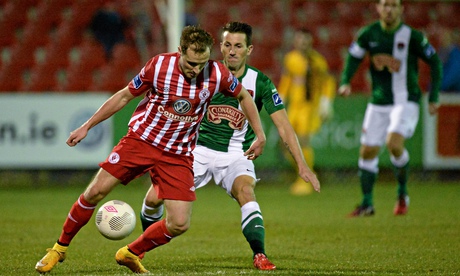
Relatively speaking there were, much like in the US, a few big-name signings making their bow. More familiar to the confines of Celtic Park and Old Trafford, Liam Miller must have pondered what he had got himself into when he ran out into the driving wind and rain for Cork City at Sligo on Saturday night. The game passed him by – the conditions meant resorting to high-ball tactics, bypassing midfield – and he will have to wait for brighter days before making his impact felt.
Miller will spend much of the season perched next to another former Ireland international in Colin Healy. At Shamrock Rovers, Keith Fahey and Stephen McPhail will form another midfield partnership that has made fans wish these players were a few years younger and not entering the latter stages of their careers. There are 60 international caps between the four, all earned when they were performing on a much grander stage.
However, the most high-profile name of all is still to come. Earlier this week Damien Duff confirmed his intention to return home from Australia in the coming weeks. “I’ll be looking for a job,” he said in an interview on Monday. He is expected to join a Dublin-based club in June. Little wonder some observers are quick to declare the league is becoming a retirement home.
Yet that flicker of glamour – again, relatively speaking – is as good as it gets for the league at present because familiar problems remain on the horizon. Limerick are one of many cases in point. They had spent the off-season planning for a return to their renovated home ground, Markets Field, after renting at Thomond Park, the home of Munster, in the two previous seasons.
Then disaster struck when the new stadium failed to pass a health and safety test and they had to begin their campaign at a decrepit Jackman Park, where they used to play when in the second tier. They are now expected to return home in mid-May but the owner, Pat O’Sullivan, has confirmed he will no longer be investing the same amount of money in the club. The squad has been weakened and their pre-season was shambolic.
Similar to the MLS, there was also a new team to welcome into the fold. Cabinteely, based in south Dublin, joined the first division after the league sent out an invite for new clubs to apply following the withdrawal of Shamrock Rovers’ B team after one season – a warning to those in favour of allowing B teams to compete in the Football League.
Cabinteely’s introduction was met with plenty of resistance but alternatives were sparse. They are renting the rugby pitch belonging to Blackrock for the foreseeable future and the condition of it for their opening game against Wexford Youths – whose women’s team are better known after being the opposition for Stephanie Roche’s Puskas award-nominated goal – was nothing short of a disgrace.
Result aside and congrats to Cabinteely they deserved it but this is an embarrassment to league of Ireland football pic.twitter.com/WTE3UhifS0
— Danny Furlong (@danny_furlong) March 6, 2015
Blame should not lie at the feet of a club whose place in the league was not confirmed until five weeks before their opening fixture though, even if the general consensus leans heavily on the negative. One strong argument goes that the league is too focused on Dublin and would benefit from having more regional based teams, but non-league clubs are aware that it is a loss-making venture and therefore reluctant to join.
Because of the close proximity of more established clubs – who also struggle to lure fans through the turnstiles – Cabinteely will rely on their members to come and watch them play. Due to having 60 underage teams, they immediately became the league club with the best youth structure. That brings internal problems of its own with coaches of schoolboy sides questioning whether the significant sums spent on this loss-making venture will detract from their investment in young players.
The compensation available when a young player moves to an English academy is more beneficial, and that in itself is a major problem. There are dozens of scouts dotted around the country every weekend in pursuit of the next Séamus Coleman or Shane Long.
English clubs are aware of the value available and continue to exploit it; £100,000 for a rough diamond is more often than not a worthwhile gamble.
It is a vicious circle where nobody seems capable of providing a solution to spawn genuine progress. Three clubs are sitting patiently, waiting for the opportunity to make some decent money in the Champions League and Europa League qualifying rounds when summer arrives but – with the league’s financial position in a perilous state – teams are destined to remain in the mire for years to come.