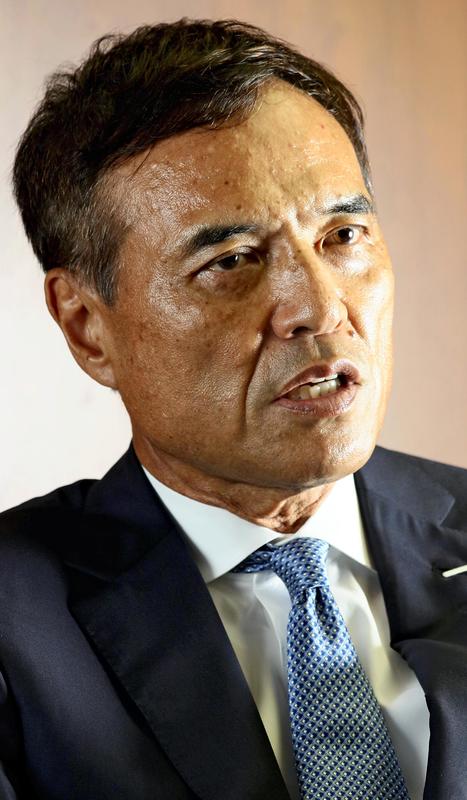
What qualities should Japan's next leader have? In the second installment of a series of articles presenting the views of business leaders and academics, Yomiuri Shimbun Senior Writer Koichi Kuranuki interviewed Suntory Holdings Ltd. President Takeshi Niinami. The following are excerpts from the interview.
Since the 16th century, global prosperity has shifted from Spain to the Netherlands, to Britain, and to the United States. With the international community in turmoil due to the novel coronavirus pandemic among other factors, China appears to be on the cusp of challenging the U.S. position with Chinese-style capitalism and military might.
What course should Japan take in such an era? Leaders must have a broad perspective of history and an awareness of the times.
Diversity in the U.S. has triggered technological innovation that has held up the U.S. economy. Under the administration of U.S. President Donald Trump, however, that strength is being lost as racial and income disparities deepen and the country becomes more divided. Even if a new president is elected in the November presidential poll, U.S. influence will gradually decline.
Caught between the United States and China in this period of change, Japan is in the most difficult position. I hope that Japan's leaders will strike a balance between the United States and China while keeping the Japan-U.S. alliance at the core of their actions.
Although Japan cannot partner with China in the field of security, opportunities for cooperation may be found in such fields as combating global warming. It is important for the international community, too, that Japan and China think about environmental issues together.
Leaders need a keen sense of risk when dealing with major issues. Even if they cannot always immediately respond to changes at hand or devise the best measures, they must be able to identify the next best solution and implement it. To lead the country, Japan's highest officials must always have a Plan B option in addition to Plan A.
Japanese people are not good at switching policies that have been decided upon to respond to changes. Old-fashioned ways of thinking are firmly entrenched, such as the belief that being unable to implement Plan A means mental strength and determination are lacking.
Leaders need to be more cunning and flexible, in a good way.
-- Focus on people's life
Managers like us need the support of shareholders. Politicians, too, need to get voters to cast ballots for them in elections. That is why leaders must clearly prioritize issues and choose between policies that will be carried out with unyielding determination, even in the face of strong opposition, and policies that meet the demands of the public to a certain degree.
To do this, it is important for them to be great communicators, capable of making their policies understood by the public. First, they will need to show the public that by implementing their policies, Japan will be better off in a few years.
Japan has traditionally managed its economic policy on the assumption that an increase in the gross domestic product (GDP) would improve the lives of its citizens. But at a time when growth is expected to be sluggish due to factors such as the coronavirus crisis, aiming to achieve a 2% annual economic growth rate is unlikely to resonate with the general public.
Going forward, the government should shift its focus to measures that will improve people's quality of life.
For example, a more fulfilling lifestyle could be achieved by moving to a rural area where people can live in larger homes surrounded by nature, commuting to the office via Shinkansen a few days a week, and spending the remaining days teleworking.
The proliferation of the so-called sharing economy has made it possible for people to improve their quality of life without having to buy goods. Digital transformation driven by the advancement of artificial intelligence and big data will also be important.
The Japanese industrialist Eiichi Shibusawa and Microsoft co-founder Bill Gates are managers I admire: Shibusawa, for his extraordinary ideas that placed importance on the Analects of Confucius and the abacus, and Gates, for working on measures to fight infectious diseases after achieving success in the business world.
I would like to see more leaders place importance on virtues as well as business.
Read more from The Japan News at https://japannews.yomiuri.co.jp/