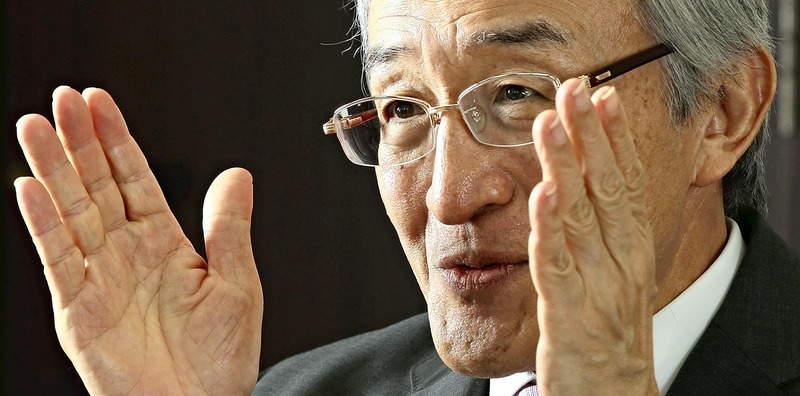
With accelerating progress on technological innovations such as self-driving vehicles, how will our safeguards change? In this installment of The Leaders, a column featuring corporate management and senior executives, The Yomiuri Shimbun interviewed Tsuyoshi Nagano, the president of leading property and casualty insurance firm Tokio Marine Holdings, Inc.
Risk does not go away, no matter the times. Therein lies our raison d'etre.
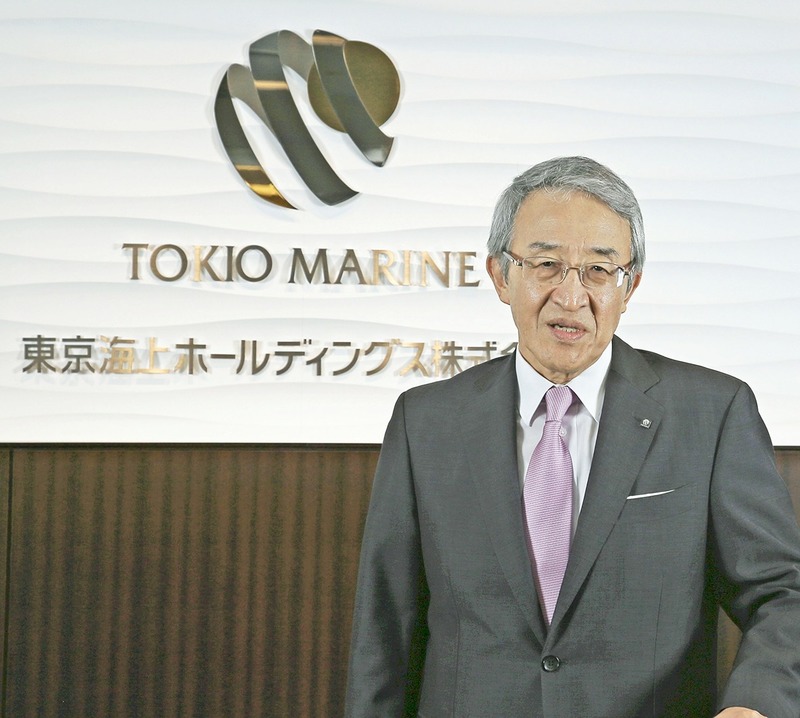
Auto insurance makes up half of our domestic sales, but what would become of it in a world where all vehicles are self-driving? We're thinking about that as a future threat. However, when new technologies come along, they also create new risks.
The adoption of self-driving vehicles will go through ups and downs created by a combination of various factors, such as the evolution of technology and the sharing economy, the establishment of laws and regulations, as well as culture, in the sense of how the public receives it. Ultimately, we may see the development of completely unmanned vehicles and advanced public transport systems. Nevertheless, during the transition period, an extremely complex framework will be necessary to establish indemnity liability -- including how to establish proof -- for when accidents occur.
[Since April 2017, group company Tokio Marine & Nichido Fire Insurance Co. has included a special contract covering accidents involving self-driving vehicles in all auto insurance policies.]
It is anticipated that when an accident involving a self-driving vehicle occurs due to malfunction rather than driver error, it may not be clear where liability rests. Even in such cases, the insurance money is first paid out to the victim, then when the responsible party is ascertained, our company will request indemnification from that counterparty [including the system's developer]. In the course of technological progress, risk diversifies. Contrary to expectation, I believe the opportunities for insurance increase.
There are many other kinds of risk created by the changing of the times. The textbook example is cyber-attacks.
Insurance is not practical when it covers a single, great risk and offers an amount of compensation that is too large. It is necessary to spread out the risk. For cyber risk, there are cases where the data that must be protected is concentrated in a single place, such as on the internet. If this one location is attacked, it may suffer all of the damage, even if the places selling the insurance are split between Japan and the United States, for example. This makes it difficult to sell insurance for large amounts of compensation, in the current circumstances. If we are able to analyze cyber risk, the insurance market may be extremely large in the future.
There is nothing that cannot be insured if the customer desires it. Our company also deals in group life insurance, with a focus on the health and medical fields. We are devoting efforts to new fields like insurance that has you wear a monitor on your arm and gives a larger discount on premiums the more you walk; insurance for people undergoing infertility treatment; and insurance that provides financial support to small and medium-sized companies and pro sports teams.
Global expansion to protect Japan
Japan faces major risks from natural disasters as well. From an international perspective, it has a large number of active volcanoes, and experiences many direct hits from typhoons and localized heavy rains. There is no way to escape this. According to a study by a Swiss insurance company, Japan accounts for as much as 20 percent of economic damage from natural disasters worldwide. By its very nature, this is a country where nonlife insurance companies play a major role. To protect our customers in this country, we must go abroad. We're always considering ways to stabilize our financial situation as a group by enhancing our overseas operations.
[Tokio Marine Holdings is expanding its overseas operations by means that include acquiring major American insurance firm HCC Insurance Holdings, Inc. for roughly 1 trillion yen. In the business year ending March 2017, Tokio Marine Holdings earned 41 percent of its profits overseas.]
In the next five years or so, we especially want to grow our Asian business in places such as Indonesia, Malaysia and India. In addition to expanding our own operations, we will go ahead with mergers and acquisitions when the opportunity presents itself. While taking advantage of the growth of emerging countries, we also aim to disperse risk both operationally and geographically.
Recently, it seems that the risk of natural disasters is rising around the world. It is said that the surface temperature of Japan's coastal waters will rise, increasing the power of typhoons. Throughout the world, extreme phenomena are spreading, such as more torrential rains in areas where concentrated heavy rains are likely to take place.
Last year, there was major hurricane damage in the United States. The economic damage caused by natural disasters around the world is climbing year after year. As a leading country in the realm of disaster prevention, I believe Japan's experience will be of use elsewhere in the world.
Hit products have stories
In high school and university, I was in swimming clubs and did long-distance swimming. In my senior year at university, I swam the crawl 42 kilometers from Shimoda, Shizuoka Prefecture, to Izu Oshima island.
In long-distance swimming, any given stroke can seem totally meaningless. There are also times when the current sweeps you back. All the same, you make it in the end. The moment your feet touch the beach, you realize, "It's because of each stroke that I am here now." Work is the same. You may not be able to see the steady progress day in and day out, but if you keep it up, you will always get closer to your goal. I learned that from long-distance swimming.
Actually, I joined Tokio Marine at the invitation of an older member of the swimming club.
My toughest time after I joined the company was when we created "Super Insurance," a product that combines life and damage insurance, while I was in charge of product development. It was during the liberalization of the insurance industry when I was asked by Kokei Higuchi, who was president at the time, "Can't we create a single insurance product that can give peace of mind to a person and their family?" We formed an elite team of about 10 people inside the company. We worked out a product concept, and visited the Financial Services Agency frequently to get approval.
[The company rolled out Super Insurance in 2002 as a product that combines all of the various kinds of insurance like auto, fire and medical insurance, and averts gaps and duplications in coverage.]
On the first day, we sold fewer than 20 policies nationwide. We had thought there would be 1,000. Perhaps the product was too far ahead of its time. Although we spent over 10 billion yen on system development, it didn't work at all. Some within the company said, "We should give up on it sooner rather than later."
Still, younger employees and our agencies across the country held firm, saying, "The thinking behind this product is not wrong." The agencies also spoke words of encouragement, telling us, "This product will support us in the future, so stay positive and hang in there."
Today, it is one of our leading products, with about 2 million households enrolled. I think it succeeded because it had a clearly defined story as a "one-of-a-kind insurance" put together through consultation with the customer.
The wave of technological innovation, such as big data and artificial intelligence, is sweeping through insurance work as well. It is simplifying the enrollment process, or making service after accidents more efficient. From the starting point of selling the same product to many people, it has also made it easier to customize products based on the customer's characteristics, preferences and family situation.
That said, it does not mean that all you have to do is gather up technology. Even if the technology is superior, products will not sell without a story. You envision how society will change, and tell a story of people achieving happiness. Cultivating people who are capable of doing that is my biggest job right now.
-- Tsuyoshi Nagano / President of Tokio Marine Holdings, Inc.
Nagano was born in Kochi Prefecture in 1952. After graduating from Keio University's Faculty of Business and Commerce in 1975, he joined Tokio Marine Fire Insurance (now Tokio Marine & Nichido Fire Insurance Co). Appointed to the board of directors in 2008, he oversaw corporate planning, overseas operations and other businesses. He assumed his current post in June 2013. In swimming, he won the 60 and over category at a swim meet held by nonlife insurance companies three years running from 2013 to 2015.
-- Key Numbers: 35%
By strengthening its overseas operations, the company increased the proportion of its overseas employees to 35 percent of the consolidated number of 38,842 (as of the end of March 2017). Ten years previously in 2007, the proportion was 11 percent. Its business currently extends to 38 countries and territories. Expansion of its overseas operations has also contributed to its financial performance. On its consolidated balance sheet in March 2017, the company reported 3.48 trillion yen in net premiums written, equivalent to sales, and a final profit of 273.8 billion yen, both new highs.
Read more from The Japan News at https://japannews.yomiuri.co.jp/