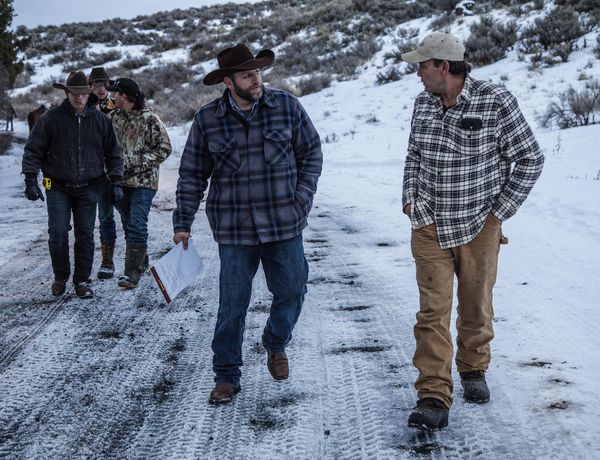
SEATTLE _ In a stunning loss for federal prosecutors, the leaders of a 41-day armed standoff at a national wildlife refuge in Oregon last year were acquitted of federal charges Thursday.
Brothers Ammon and Ryan Bundy and five others had been charged with conspiracy to prevent federal employees from doing their jobs by occupying the Malheur National Wildlife Refuge in Oregon's sparsely populated high desert in early 2015.
A jury found them not guilty, setting off celebrations outside the federal courthouse in Portland. A man waved the American flag at passing traffic as someone blew a horn in celebration and a man trotted by on horseback while holding a flag.
"I think the jury saw through this and saw these were well-meaning, well-intentioned individuals," occupier David Fry's attorney, Per Olson, told reporters, according to a live-feed broadcast from outside the courthouse by the Oregonian newspaper. "They all came out here for a good purpose, because they cared."
The defeat for the prosecution was especially unexpected because three of the seven defendants had chosen to represent themselves during the trial. Critics of the occupation said the verdict might embolden similar actions by right-wing anti-government groups in the future.
The Malheur occupation began as a protest of the imprisonment of two Oregon ranchers who had been convicted of setting fire on federal lands. The occupation eventually drew right-wing anti-government protesters from across the U.S. to protest the federal government's control of public lands across the West.
The occupation, which starkly divided members of the rural towns outside the refuge, was eventually ended after federal and state law enforcement arrested the protesters' leaders on a highway near the refuge. One of the occupiers, LaVoy Finicum, was shot and killed after he tried to escape law enforcement and reached for a gun, officials said.
"While we had hoped for a different outcome, we respect the verdict of the jury and thank them for their dedicated service during this long and difficult trial," Billy J. Williams, United States attorney for the District of Oregon, said in a statement after the verdict.
"For many weeks, hundreds of law enforcement officers _ federal, state, and local _ worked around-the-clock to resolve the armed occupation at the Malheur National Wildlife Refuge peacefully. We believe now _ as we did then _ that protecting and defending this nation through rigorous obedience to the U.S. Constitution is our most important responsibility," said Greg Bretzing, special agent in charge of the FBI in Oregon.
"Although we are extremely disappointed in the verdict, we respect the court and the role of the jury in the American judicial system," Bretzing said.
Oregon Gov. Kate Brown said she was "disappointed" by the jury's decision.
"The occupation of the Malheur Refuge by outsiders did not reflect the Oregon way of respectfully working together to resolve differences," Brown said. "I appreciate the due diligence of our federal partners and stand with the communities of Harney County and residents of Burns."
In addition to Ammon and Ryan Bundy, the other defendants were Shawna Cox, Jeff Banta, David Fry, Kenneth Medenbach and Neil Wampler.
During the trial, flag-waving supporters, some in boots and cowboy hats, marched around the courthouse, in part hoping jurors might see one of their signs stating "Google: jury nullification" _ effectively urging jurors to acquit the defendants out of a belief that the law under which they were charged was wrong.
Ryan Bundy acted as his own attorney, and in his opening statement announced that he's "in favor of government as long as it's done correctly." He also submitted a copy of the Pocket Constitution as a court exhibit.
Attorney Matthew Schindler, who assisted Medenbach, the only Oregon resident among the defendants, said his client's participation was, in part, an attempt to prevent the demise of rural life in America. "These people have no voice in Washington anymore," he said. As for the takeover, Schindler added, "It worked."
Federal prosecutors relied a great deal on evidence, including videotapes, that was provided by the defendants _ the occupiers regularly filmed themselves during the standoff and held daily press briefings.
Ammon Bundy, who started attending court in a suit, later in the trial resorted to wearing blue jail scrubs in protest. "Mr. Bundy," said his attorney J. Morgan Philpot, "desires to appear as he is, a political prisoner not free to dress as if presumed innocent." Bundy also complained that he'd been "molested like an animal" at the county jail
Angela Bundy, wife of Ryan Bundy, said she was "on pins and needles for a week" while the jury deliberated. She returned to their Nevada home, where the couple live with their eight children, to await a verdict. "We have been praying so hard."
Her husband emailed her with the news on Thursday afternoon.
"Oh my goodness!" Angela Bundy said. "We are so excited. That judge tried really hard to keep the truth from coming out in that courtroom."
Others charged in the occupation pleaded guilty before trial: Jason Blomgren, Brian Cavalier, Blaine Cooper, Eric Flores, Wesley Kjar, Corey Lequieu, Joseph O'Shaughnessy, Ryan Payne, Jon Ritzheimer, Geoffrey Stanek and Travis Cox.
Seven additional defendants, Dylan Anderson, Sandra Anderson, Sean Anderson, Duane Ehmer, Jason Patrick, Darryl Thorn, and Jake Ryan, are still scheduled to stand trial beginning in February.
An environmental group opposed to the occupation, the Western Watersheds Project, condemned the verdict as a "disappointment."
"The failure to hold extremist militants accountable for their armed takeover of public property amplifies the risk to federal, state and local officials who are charged with the management of public property throughout the West," Executive Director Erik Molvar said in a statement.
"The sad result of this verdict is that it will now be necessary to increase the presence and patrols of law enforcement throughout our public lands in order to assure the safety of rangers, scientists and land managers who are required (to) travel to remote corners of the West in order to do their jobs," Molvar said.