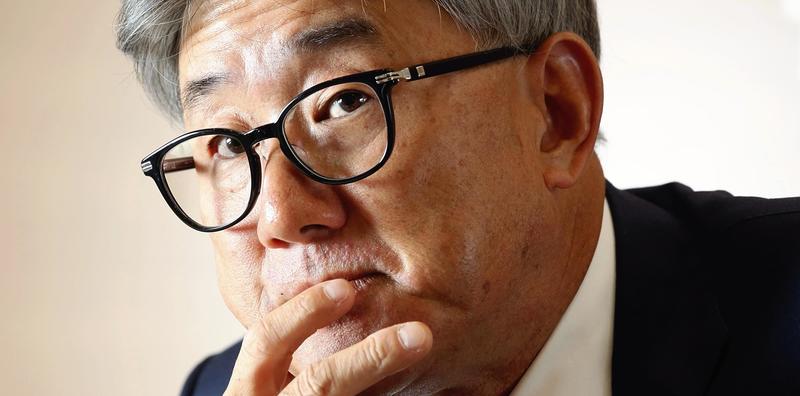
Nestle Japan Ltd., known for such brands as Nescafe, is the Japanese subsidiary of the world's largest food and beverage company. It has seen continued growth through a nearly singular focus on the domestic market. In this installment of Leaders, a column featuring corporate management and senior executives, The Yomiuri Shimbun spoke to President and Chief Executive Officer Kohzoh Takaoka about the secrets to the company's success.
In order for a company to grow, the first step is to make innovation to carve out a market. This comes from solving the customers' problems that give people stress. Through finding the problems that no one else notices, innovation happens. It's unrelated to population decline or deflation.
[Nestle Japan started selling capsules of authentic matcha for use with the company's exclusive coffee machines in October 2016. Its matcha-flavored KitKat, a chocolate confection, is also popular, and after coffee and chocolate, matcha is positioned as the third pillar of its business.]
You can't really drink matcha at home. It is usually served at upscale Japanese inns. Ours is made using a machine, and even has a lovely foam topping. One cup costs around 50 yen.
The idea for matcha came from the foam that's formed when making coffee with one of Nestle's machines. But the Swiss head office's guidelines forbid making tea with a coffee machine. They were firmly against it. I wasn't able to convince them even when I brought samples to the head office.
So, we did test-marketing in certain parts of Japan. Within two weeks we had sold out. One box of capsules that sold for 1,000 yen was fetching 5,000 yen on online auction sites. When I told the head office, they gave me the go-ahead.
Even in Japan I was asked, "Why are you taking on a small market with something like authentic matcha?" The marketing mind-set goes the opposite way. We do it because the market is small. In a big market, even if you sell a lot, it's hard to stand out. In small, new markets, it's easy to grow, and with little competition, the margins are high.
As for matcha-flavored KitKat, I got the idea after seeing foreigners enjoying matcha-flavored ice cream in Kyoto. It started as a souvenir product exclusive to Kyoto. Word of mouth spread, and now it's riding the wave of foreign visitors flocking to Japan. We have also started sales overseas.
With our Nescafe Ambassador service, machines are provided to companies, which then regularly purchase coffee cartridges. This was problem-solving allowing people to easily enjoy coffee at the workplace without having to go to a vending machine or convenience store. Such efforts support our company's growth.
Extend healthy lifespans
We also want to solve societal problems. In Japan's aging society, the number of elderly living alone is on the rise. Although they all have mobile phones, their children don't call very often. What can be done to ease the isolation and loneliness of elderly households?
[In October 2016, the company started selling the Barista i, a coffee machine that smartphones can connect to via an app.]
The app shows when family living far away drink coffee and what mood they were in, which lets you check whether they are okay. In two months, we sold 100,000 units, much more than expected. With advances in IT, we are able to solve problems that until now we hadn't been able to.
What is drawing even more attention is health. We want to extend the healthy life expectancy of the Japanese people.
Last October, we fully launched our Nestle Wellness Ambassador service, in which we provide a machine and sell special capsules of matcha and milk that include nutrients. Many people take health products and supplements without understanding their own nutritional status. I wanted to take a deeper look into this issue.
Big data shows us what nutrients users need when they respond to such simple questions as "How many servings of vegetables are you having?" At the end of May, we started distributing home blood and DNA test kits free of charge. By seeing trends in a person's health, we can provide them with the most suitable capsules. We are now considering collaborating with drugstores and having them serve as our help desks.
We have also linked up with AXA Life Insurance Co. Our companies have the common goal of extending healthy life expectancy. By teaming up with a variety of industries, my hope is that the health field will become a prominent business for us.
Cheer on students taking exams
I joined a foreign company because I wanted to take on big jobs at a young age. My grandfather and father both died aged 42. I thought I could end up the same. In Japanese companies, 42 is section chief or division chief level. Dying at that age would bring a lot of hardship on my family, I realized.
When I first joined, I was disappointed. It was all about seniority by length of service. But shortly thereafter, the company's line of thinking started to change. I myself became a department manager at age 30. That gave me the authority to speak directly with the head office in Switzerland.
When I was general director for marketing at Nestle Japan's confectionery sales subsidiary, I got involved in a KitKat sales promotion. It was because of something I heard from the branch manager in Kyushu. Every year in January and February, KitKats sold well there. When he asked customers why, they told him it was part of the good luck charm for entrance examinations, as KitKat sounds like "Kitto katsu to!" a way of saying in the Kyushu dialect, "You're sure to pass."
When we checked with the consumer hot line, we found that there was a need for this throughout Japan. So we started the support campaign for students taking exams. We asked hotels where students stayed the night before their test to tell the students when checking out, "Do your best," and hand them a KitKat and a postcard with cherry blossoms in full bloom. At first, only two companies accepted our proposal. But the response was huge. Some students went so far as to say, "If I fail, I'll come back to this hotel [when I try again] next year."
Entrance exams are the first big challenge of their life. It's a very nerve-wracking experience. I know full well, having failed the university entrance exam once and waiting a year to take it again. In five years, sales of KitKat tripled and profits quintupled.
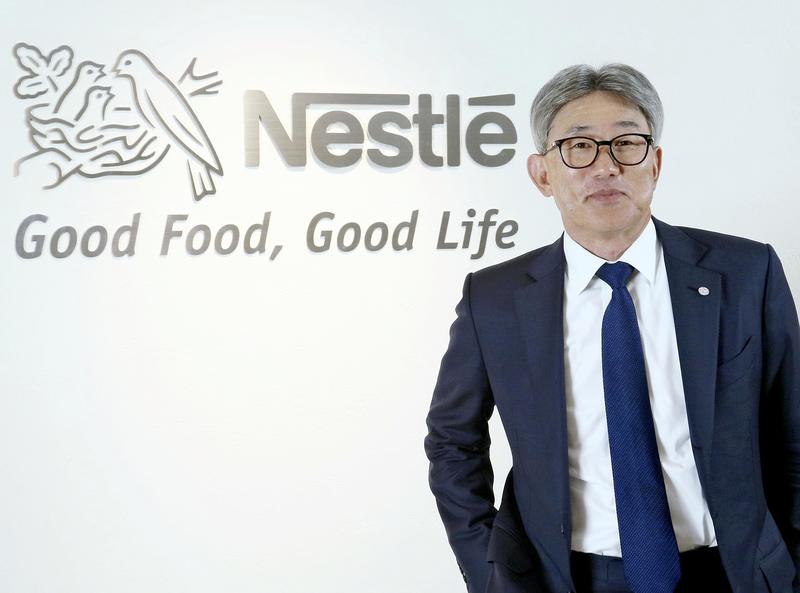
[In 2010, Takaoka became the first Japanese who started his career at Nestle Japan to become the company president.]
I don't know the exact reason why I was chosen, but for the past more than 20 years, when goals have been placed before me, I have continuously met them. You often hear about companies' V-shaped recoveries, but for me, it's not difficult to take something bad and turn it around. What is hard is maintaining growth.
From here on out, in order to solve customers' problems and grow, it's important to increase the amount of time staff have to think. Japanese companies don't even use 10 percent of work hours for thinking. We must raise white-collar productivity, stop doing busy work and think. For now, it's still hard for artificial intelligence to have the ability to find problems, right?
For that reason, we're putting effort into work-style reforms. I don't give high marks even if you work long hours. I pay your salary according to results. We also stopped paying wages based on seniority.
There is no particular secret to problem-solving. It's whether or not you think of turning something you thought was impossible into a reality. That's where differences emerge. It's important for the country as a whole to have a strong will toward innovation. I feel a sense of crisis that Japan, compared to the United States and China, is still coming up short.
-- Kohzoh Takaoka / President and CEO of Nestle Japan Ltd.
Born in 1960. From Osaka Prefecture. Graduated from the Kobe University school of business administration in 1983 and entered Nestle Japan. In 2005, became president of confectionery sales subsidiary Nestle Confectionery. Has been in his current position since November 2010. Has extensive experience in marketing and has even co-authored research in the field with marketing guru Philip Kotler, a professor at Northwestern University in the United States.
-- Key Numbers: 20%
Nestle Japan's goal is to raise the proportion of sales via mail-order, including online shopping, from 15 percent in 2017 to 20 percent in 2020. Effort is being put toward subscription shipments, in which coffee capsules and other products are delivered to customers on a regular basis. The company has had eight years of continuous sales and profit growth through December 2017. Nestle started its operations in Japan in 1913 and became Nestle Japan in 1960. There are 2,500 employees. Nestle Japan is headquartered in Kobe.
Read more from The Japan News at https://japannews.yomiuri.co.jp/