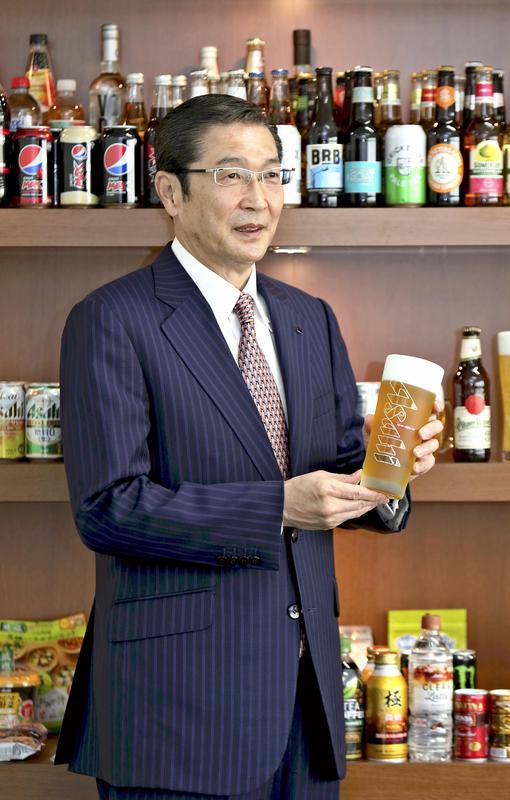
As beer consumption among young people in Japan has been on a steady decline, what are beer brewing companies' survival strategies? For this installment of Leaders, a column featuring corporate management and senior executives, Akiyoshi Koji, president, representative director and CEO of Asahi Group Holdings, Ltd. -- which has Asahi Breweries, Ltd., one of Japan's major beer companies, under its umbrella -- explains his management philosophy on expanding revenue.
When we were considering whether to acquire eight beer brewing companies operating in five countries in Central and Eastern Europe, the company was divided over the pros and cons of the deal.
[Belgium-headquartered Anheuser-Busch InBev, the world's largest beer company, placed its subsidiary beer firms in Central and Eastern Europe up for sale in 2016. This move was necessary to avoid violating antitrust laws as Anheuser-Busch InBev was preparing to acquire the second-largest firm in the industry, SABMiller of Britain.]
The acquisition was expected to cost us about 900 billion yen. If we failed in business management after the acquisition, the Asahi Group could have fallen into the red. Furthermore, Central and Eastern Europe are not familiar territory to the Japanese. No Japanese food manufacturer had made a huge amount of investment in the region. Calls opposing the acquisition were intense.
Looking into the matter more closely, however, we found that the five countries -- the Czech Republic, Slovakia, Poland, Hungary and Romania -- had higher economic growth rates than those in Western Europe. The disposable income there was not so low as to worry about. The eight beer companies were all long-established businesses and had long enjoyed the leading market share in their regions.
I talked with the CEO of the company that oversaw the entire business operation in those five countries. Through the exchange of ideas, I realized that their business philosophy aligned perfectly with ours.
The common idea was that the business would be centered on sales of premium beer. Although consumers' demand for "new genre beer," which is known as low-malt and low-priced beer, has been increasing in Japan, our main beer, Super Dry, has been placed as a premium product. We also shared the view on the importance of preserving brand value and always giving top priority to quality control .
I asked the CEO, "How would you feel if a Japanese beer brewing company owns your firm?" He said, "If our business philosophies are the same, it will work well no matter where the company is based, in Asia or elsewhere."
That made up my mind. The discussion with the CEO convinced me that I could persuade people opposing the acquisition. I convened two meetings of the board of directors and received the green light from those who had opposed the deal.
[The Asahi Group also acquired beer brewing companies in Western Europe in 2016 and 2017. According to the consolidated financial results for the fiscal year ended December last year, overseas business units contributed to 34 percent of revenue and 41 percent of core operating profit, the total revenue and profit of the Asahi Group marked record highs.]
We hold monthly meetings with subsidiaries operating in Europe and other regions. We discuss their reports on four main topics: branding, profitability, brewing skills and employee deployment and training. They are in charge of issues involved with their daily management.
The Asahi Group focuses on alcohol beverages, soft drinks and food. For these categories, business practices such as distribution and sales are the same irrespective of the country of operation. There is no reason to limit our business to Japan alone.
When we embark on new business overseas, we encounter ideas based on different cultures. It is essential for the future management to absorb various perspectives. Expanding overseas businesses surely gives us an advantage in this regard.
Meanwhile, we have proceeded with the restructuring of our business.
We have sold business units with a low capital investment ratio and that are almost irrelevant to our main business, such as food and beer in China, soft drinks in Indonesia and golf course facilities in Britain. We can expect greater synergistic effects by concentrating on our main business in which we are able to play a leading role in managing.
Packaged for new generation
Without a doubt, more young people have come to prefer highballs, cocktails and other such drinks to beer. One reason behind this, in my view, is we have not been able to offer attractive products for the young generation and women.
On my days off, I like to spend time at a small restaurant where a family has been running the business for decades and constantly welcomes regulars.
I often find myself in a situation where the chef asks customers, "How's the food today?"
Those hideaways serving delicious dishes have been subtly adjusting their flavors to satisfy customers. Instead of offering the same flavors for decades, they have developed their dishes in accordance to customers' changing preference with the passage of time.
That gives us a clue for how to do our business. I remember when I became the president of Asahi Breweries in 2011, at that time, there was an unwritten rule that we were not allowed to develop sister products to the Super Dry brand. Changing its silver-color cans was totally out of the question.
However, merely relying on the well-known packaging was not effective enough to attract new customers. I then proposed pink cans for the cherry blossom season. I was not surprised that all of the directors opposed the idea.
So we conducted a customer survey and found 85 percent of respondents supported the idea of packaging featuring images of sakura cherry blossoms and putting such a product on the market during that season. We finally launched Super Dry in the new packaging design and subsequently other beer brewing companies followed suit. Since then, we have created other Super Dry-related products, including the refreshing and sharply dry Shunrei Karakuchi to expand the customer base.
We will make utmost efforts to develop products to attract women and young people. For example, we created a new cocktail called Double-Cultured by mixing Super Dry and the soft drink Calpis, a popular product by our subsidiary. We envision the cocktail being added to menus at restaurants and bars popular with women, and the women spreading information on the cocktail via social networking services. We would like to be fully responsive to customers' expectations by constantly reviewing our business strategy.
Listen to silent voices
For about 10 years before and after 30, I assumed a full-time post in the labor union. At that time, sales of our beer products were not going well and we were losing market share year after year. While asahi means "rising sun" in Japanese, people started dubbing us as "yuhi," meaning "setting sun."
Due to the deteriorating business environment, the company decided to call for more than 500 people to accept early retirement. Because the company should obtain approval from the union beforehand, I visited the factories and branches across the country to seek employees who might accept early retirement.
I was in my 20s but I had to approach senior employees to ask them to retire. That was a tough experience.
One day, a senior colleague who accepted the retirement told me, "People who lead organizations should listen to the employees' silent voices." The message was clear. Do not make decisions merely listening to opinions of those who speak loudly or talk a lot. Many employees are out there just working hard without expressing themselves or insisting on anything. Leaders should address their inner voices.
After I became the president of Asahi Breweries, I made tours of visiting domestic bases and exchanged views with dozens of employees at izakaya bars and restaurants.
I have quite often found about a third of employees at each izakaya meeting remain quiet the entire time. So I move over to sit with them and ask: "Any request to our management?"
Then they start speaking up little by little. By listening to the voices from diligent but quiet employees, I am able to understand various managerial demands within the company. Throughout my career, I always remember what that senior colleague told me.
I would like our products to help customers realize more enjoyable daily lives. To that purpose, it is vital for me, as a corporate manager, to equip myself with foresight, decisiveness and the ability to take action.
-- Akiyoshi Koji / President and Representative Director, CEO of Asahi Group Holdings, Ltd.
Born in Nagano Prefecture in 1951, Koji graduated from Aoyama Gakuin University's Faculty of Law in 1975 and joined Asahi Breweries. In 2011, he became the company's president when Asahi group companies shifted to a holding company structure. He took up the roles of president and representative director in March 2016.
-- Key Numbers
50-plus
The Asahi Group sells its three premium beer brands -- Super Dry, Pilsner Urquell and Peroni Nastro Azzurro -- in at least 50 countries and regions. According to the consolidated financial results for the fiscal year ended December 2018, its revenue was 2.1203 trillion yen and operating profit was 211.8 billion yen. The consolidated number of employees was 28,055 as of the end of 2018.
Read more from The Japan News at https://japannews.yomiuri.co.jp/