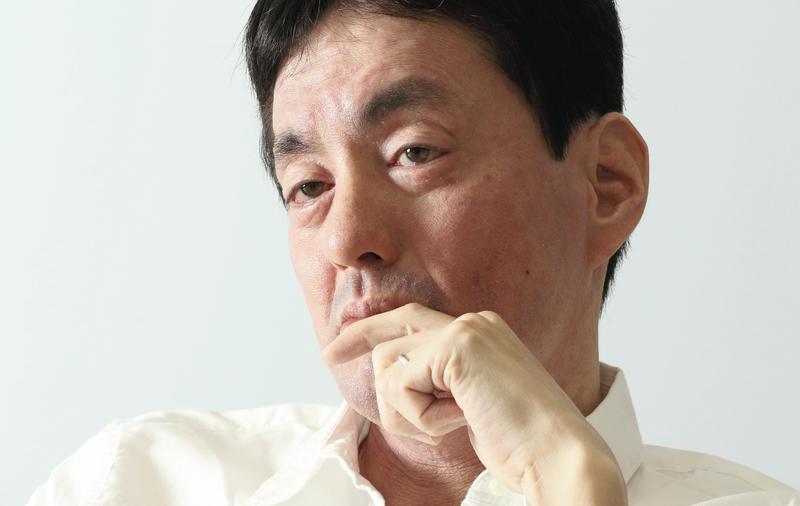
Mercari, a marketplace where users can easily buy and sell clothing, general merchandise and other goods via a smartphone app, is growing rapidly. For this edition of "The Leaders" column, which highlights corporate management and senior executives, The Yomiuri Shimbun sat down with Shintaro Yamada, cofounder of Mercari, Inc.
I took a solo trip around the world starting in early 2012 as a backpacker -- Bolivia, Kenya, India and other places, totaling some 20-odd countries. As I could see how everyone was working hard to make their lives better, it was a great experience.
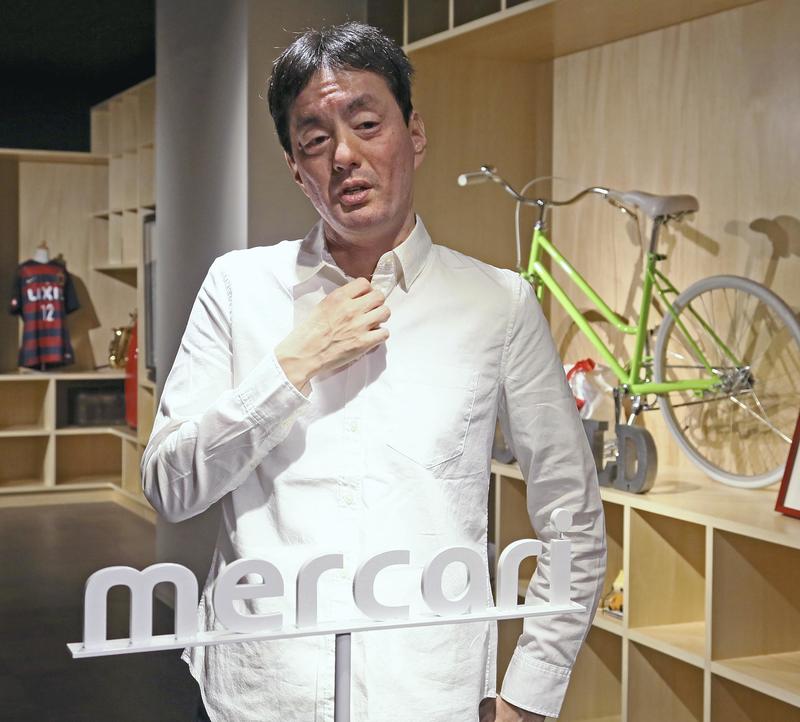
I always liked to travel, but since I started a company right after graduating university, it was difficult to do. I thought, I'll take a year or so to refresh, and then definitely start a new company.
When I got back to Japan, smartphones had made tremendous inroads. The time will come when everyone, even those like I saw in emerging economies, has one. As I was traveling, I realized that if emerging economies kept up economic growth at the same rate and raised their standard of living, the Earth's resources would clearly dry up.
I want to get rid of the concept of throwing things away. I thought, if it was possible to trade things using a smartphone, we might be able to save our resources to some extent. If so, I and the people around me should do it. It all started with that kind of feeling.
Mercari means "to trade" in Latin. Yamada gave the app the name out of a desire to create a market where individuals could safely and securely trade with each other. He started the business when he was 35.
Everyone has a smartphone, don't they? Ever since ordinary people started using them, it's become easier for individuals to connect with each other. We successfully moved with the times. There was already Yahoo! Auctions, a PC-focused giant for buying and selling things, but I wondered if I could make something more convenient for smartphones.
There were already flea market apps available. Mercari was a latecomer. There were also apps exclusively for women at the time. I thought we could succeed if participants weren't restricted by what they could sell.
The company first released the app in July 2013. It was designed to let users take photos of things and sell them with ease.
We aimed to make Mercari easy to understand and use, and I think it's good that we've continued to make simple, honest improvements. Most of us are engineers -- members of teams that made [internet-based] social games, so we have that know-how.
It's really a buildup of minor details. For example, among 10 people who download the app, target figures are placed on how many put things up for sale and how many buy things. We ask people who have never used Mercari to use a smartphone to sell and buy things in front of us, and then change any aspects of the app that are difficult to use. When you upload a photo of an item for sale, artificial intelligence (AI) suggests potential product categories -- those sorts of things.
About half of our roughly 600 employees are engaged in customer support. I think the ability to buy and sell goods anonymously, as well as our nationwide fixed-rate Mercari Mail option, have contributed to its usability.
In contrast to auctions, prices are already set, and the "first come, first served" aspect has been embraced by the generations that use smartphones. Roughly half of the items sold do so within 24 hours of being listed.
Series of failures, dreams
I was in a science course at university, but as I majored in math, I taught myself programming. While I was in university, I received a tentative offer of employment from Rakuten, and during my time there as an intern, I realized I could do it on my own. I declined the offer and decided to start my own company.
You may think it was smooth sailing, but it wasn't. I failed badly many times.
Yamada created a company called Unoh after graduating from university, operating a movie site and others.
I also made games for conventional mobile phones. I produced a heap of services hoping they'd catch on worldwide, but none were any good. I took my frustrations out on the engineers and designers. They quit, and I had nothing to show for it.
When I was 26, I spent one year in the United States, where IT companies are clustered. I realized that creating internet services was, after all, my greatest strength. I wouldn't be able to make an impression on the world with anything else.
When you're young, it's good to have big dreams and missions in life. I believe that setting out to do things you may not be able to achieve will ensure you advance.
He had been thinking about starting his own business since he was in junior high school.
I went to a combined junior high and high school centered on preparing for university entrance exams. When test rankings were posted, no matter how hard I tried, I would end up around 120th place out of the roughly 400 students in the same year as me. How do you differentiate yourself from students who are strong at studying? I decided not to pursue entering a major company, or becoming a bureaucrat or doctor, but to live the life of an entrepreneur.
Worldwide markets
Mercari is gaining attention in stock markets as a "unicorn," or start-up company that has an estimated valuation over 1 billion dollar (about 110 billion yen). Meanwhile, problems have arisen from improper goods being put up for sale.
As our customer base grows, there have been a few cases of Mercari being used in ways we never imagined when we started out, such as putting cash up for sale. I'm very sorry for the trouble this has caused.
In early December, we made it a requirement to register users' personal details when they first sell an item. If items resembling stolen goods from a theft are put up for sale, we report them to the police and take other action.
Until now, we've considered ourselves a start-up company that struggles to survive, but we're already viewed by society as a major service, which requires us to take further social responsibility. I'm aiming to make us into the "Mercari you can trust."
The company started the U.S. version of Mercari in September 2014, taking on overseas markets.
Markets elsewhere in the world are of a different magnitude than Japan. They are definitely worth entering.
There are a huge number of challenges. The U.S. version of our app reached 30 million downloads, but it's been slow to take off compared to Japan.
The United States is important because it is a microcosm of the world. There's a diversity of races and religions, and people's lifestyles and desires are completely different. You can get the hang of using Google and Facebook, which are used all over the world, just by playing around with your smartphone. Many Japanese apps and services seem like they can't be used without first reading the instructions.
In June this year, I invited former Facebook executive John Lagerling to join Mercari as an executive officer. (He is currently the CEO of Mercari U.S.) John had originally been at Google. Gathering talent from top Silicon Valley firms, he is constantly working to improve Mercari.
A car put up for sale in Japan can be bought in a country in Africa. Getting to the level where it is possible for individuals around the world to buy and sell with each other -- that's our mission.
I want to change, however little, the life of someone living in my times. The internet goes beyond regions of the world. I believe made-in-Japan services can compete head-on in the world.
-- Key Numbers: 90 million.
Flea market app Mercari has reached 60 million downloads in Japan which, combined with 30 million in the United States, means 90 million downloads in total. Each day, over 1 million items are put up for sale, including clothing, general merchandise, electronics and other goods. Sales in the fiscal year ending June 2016 were 12.2 billion yen, with an operating profit of 3.2 billion yen. Mercari has about 600 employees.
-- Profile
Born in 1977. From Aichi Prefecture. Helped set up an auction site for Rakuten Inc. while enrolled at Waseda University. After graduating, Yamada started his own company called Unoh, where he designed and developed such websites as a movie news site called Eiga Seikatsu (later bought by another company). Sold Unoh to a U.S. game company in 2010. After traveling around the world, he established Mercari in February 2013.
Read more from The Japan News at https://japannews.yomiuri.co.jp/