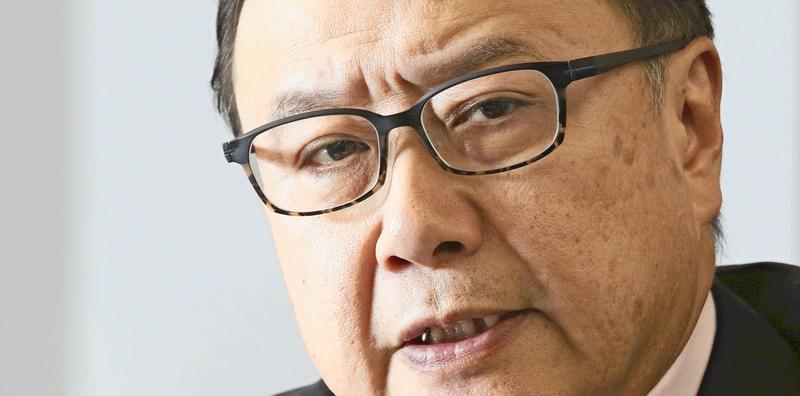
Sompo Holdings, Inc., a major holding company of insurers in Japan, expanded its business domain to include nursing care services three years ago. The business unit has grown to rank second largest in the industry. For this installment of Leaders, a column featuring corporate management and senior executives, The Yomiuri Shimbun asked President and Group CEO Kengo Sakurada about the group's aims in exploring the nursing care and health care industries.
We have to act on a new way of thinking, different from that of an insurance company, so as to establish a business growth strategy. The group aims to build a "theme park for the security, health and well-being of customers."
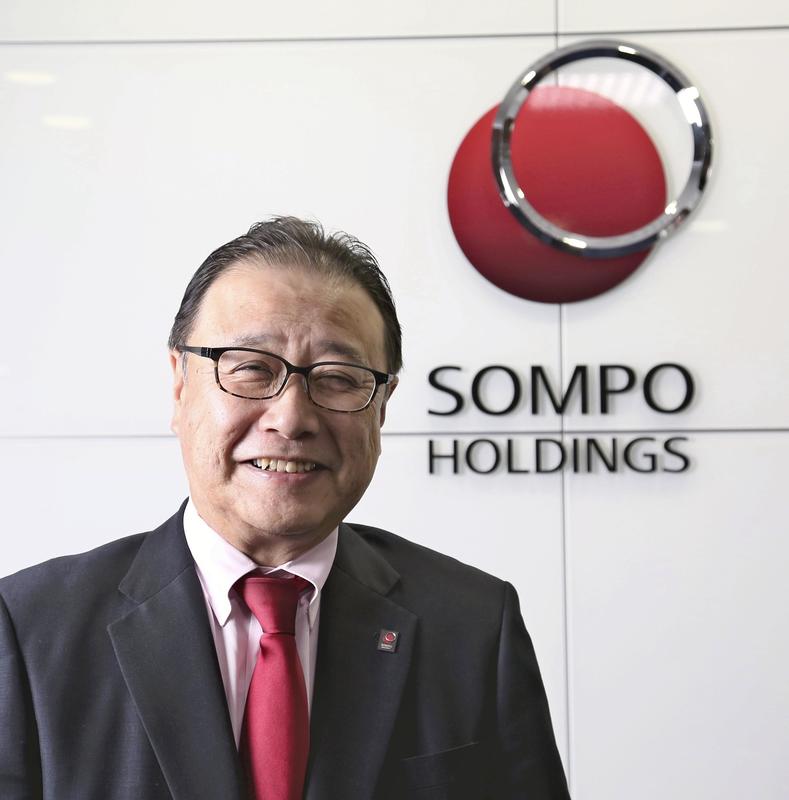
Insurance companies have helped customers, to a large extent, when they encounter undesirable situations. No one expects such unexpected circumstances to befall them. We have provided our insurance services by asking customers what they would do in case their home catches fire, they hit someone with their car or they become sick.
Ever since starting my career, I have been thinking about whether we should only focus on such a business. Apparently, customers prefer not to think about such unpleasant things as accidents and illnesses. Due to the population decline, the domestic market will shrink. Even if we expand our business overseas, it will not bring us a breakthrough as long as we continue business as usual.
I would like to have customers enjoy a sense of happiness, not only provide services when they face trouble. Building the theme park is a tool to realize the idea.
In my view, a theme park is a place shaping something abstract into visible and tangible form. Good cases in point are Tokyo Disney Resort, which re-creates the world imagined by Walt Disney, and Edo Wonderland, or Nikko Edo-mura in Nikko, Tochigi Prefecture, where visitors can somewhat feel and experience the atmosphere of the Edo period (1603-1867).
How can we present customers a concrete sense of security, health and well-being? What came to my mind as an answer is providing nursing care service. By increasing the number of places where people can comfortably ask for care for their family members, we can give a lot of people a sense of security, health and well-being.
In the car insurance industry, there is the so-called 10 percent rule -- among the insured, a person uses insurance once in 10 years. Some people do not even remember the name of their insurance company.
That rule does not apply to the nursing care industry. People carefully choose where to ask for care for their loved ones -- father, mother, spouse -- after visiting and checking facilities. Significant contact with customers exists in this regard. If we can earn a high reputation from customers for our nursing care services, providing them 24 hours a day, 365 days a year, and not just in emergencies, I thought we could develop an extremely strong bond with customers.
When we discussed entering the business at a board of directors meeting, a heated argument erupted. I encountered not a few opposing opinions: "The accompanying business risk is high," or "Business chances will become dim as spending on social security is getting tighter." Others expressed concern that our corporate value and image could become depreciated and ruined.
However, if customers' loved ones can feel happiness at nursing care facilities, our credibility will improve. If we do it right, it should become an asset. I explained those views and convinced the board members, including outside directors.
Roles for AI, staff
Now, having experienced the nursing care business -- even though we can expect market expansion in an aging society -- I have to admit it is easier said than done. Realizing our aim is not that simple.
At first, we focused on enhancing the quality of service above all things, such as improving treatment of care workers and our information system through investment. Although we ran a deficit at one point that exceeded the amount the unit had been losing during the fiscal year of the acquisition, we managed to reduce costs, generating a surplus in fiscal 2017. This could not have been done without efforts by directors and staff who are in charge of the nursing care business.
On the other hand, the labor shortage remains a serious issue. From here on, I would like to introduce advanced technology to the business as well. We have already embarked on making care programs for the facilities utilizing artificial intelligence.
As we accumulate the daily experiences of our staff in the form of data, it will help staff improve their work, including how to interact more appropriately with residents.
Whatever tasks robots can do will be done by them on behalf of staff. By monitoring a resident's bladder with a sensor that causes no discomfort, care workers will be able to assist the resident only when it is really needed. That will optimize the number of care interactions of that kind and the diapers to be used. If robots can handle changing the diapers instead of the staff, both residents and care workers would welcome it. There is still a lot of room for further enhancing work efficiency.
Furthermore, staff will be able to concentrate on what human beings alone are capable of, such as compassion and caring hands, among other things.
New vision, strategy
When I was a junior high school student, I began practicing kendo. At high school, there was a period when I could barely make it through the first round in a competition. I would feel nervous by thinking too much that I had to win.
One day a kendo instructor said to me, "It's OK to lose." Then I won a kendo match. I could even go on to later rounds. If we think excessively about winning or doing our best, it will make us unable to maximize our ability. There is no secret about that. Even so, it was an extremely important lesson for me.
I worked for the Asian Development Bank for four years when I was 36 years old. Throughout my career, I remember very clearly an experience I encountered back then. I introduced myself to the staff in a traditional and humble Japanese manner by saying, "I am a total novice here." The staff looked at me as if to say, "What brought you here, then?"
Another person assigned to the bank at the same time was a German with a Ph.D. in economics. When the newcomer said, "I would like to give the bank fresh input," the people applauded -- quite a different response from my case. That was a real cultural shock to me.
My boss was a Canadian woman. She often reprimanded me. In my workplace, people from more than 60 countries and regions worked together. Spending four years in such a multicultural environment was a valuable experience that has influenced my life.
While many governments in developed countries are becoming unstable, Japan can be described as one of the democratic countries enjoying the highest level of stability in the world. What we should do is to show people overseas in a concrete fashion that if their countries become like Japan, the world will be a happier place. Japan has security, health and well-being, as seen in our longevity.
By assuring Japanese people of living in a society with security and health, a decline in the birth rate will be restrained. I expect the government to work on fiscal reconstruction, which has been in a critical state and is causing anxiety among the people.
Our company can contribute to it through its services. In addition to the nursing care service, we began offering in October new services to assist people with dementia.
There is a possibility that big data may lead the way to preventing or alleviating dementia. Moreover, by using data already accumulated in an effective way, we may reduce the number of traffic accidents and fires. After all, my aim is to build a theme park where everyone can feel happy.
My goal is for people to someday say, "I didn't know Sompo used to be an insurance company."
-- Key Numbers
119.2 billion yen
Sompo Care Inc., a nursing care service subsidiary, recorded net sales of 119.2 billion yen in fiscal 2017, which ranked second in the industry. It has the largest number of senior living units in the industry -- approximately 25,500 units. According to the consolidated financial results for the fiscal year ended March 2018, Sompo Holdings' ordinary income was 3.77 trillion yen. The consolidated number of employees was 80,059 as of the end of March 2018.
-- Kengo Sakurada / President and Group CEO of Sompo Holdings, Inc.
Born in Tokyo in 1956. Sakurada graduated from the School of Commerce at Waseda University in 1978 before joining the Yasuda Fire and Marine Insurance Co. Ltd. After serving in posts including manager of the office of group CEO, he became director of Sompo Japan Insurance Inc. in 2007 and representative director, president and executive officer of NKSJ Holdings, Inc. (now Sompo Holdings) in 2012. He has been vice chairman of the Japan Association of Corporate Executives since 2017. He has compiled policy proposals including on the issue of utilizing diverse human resources.
Read more from The Japan News at https://japannews.yomiuri.co.jp/