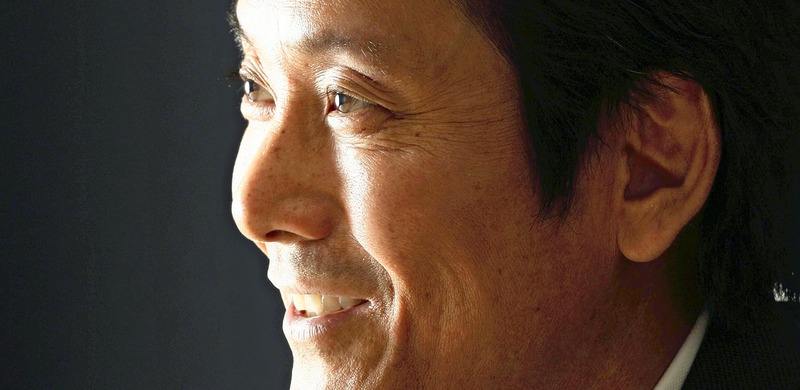
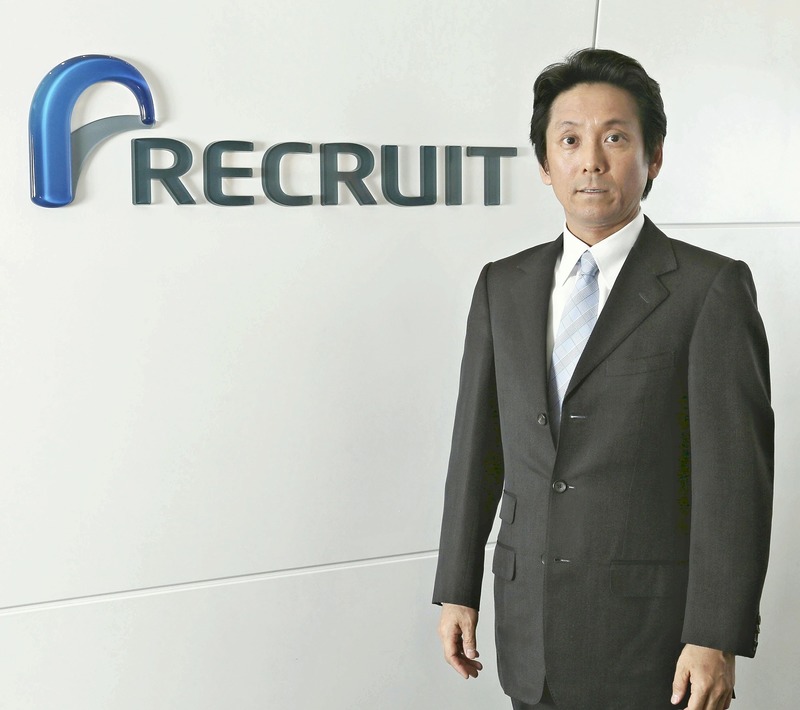
Recruit Holdings Co. operates a number of market-leading information businesses that provide recruitment, property, travel and other types of services. For this installment of The Leaders, a column featuring corporate management and senior executives, The Yomiuri Shimbun spoke to Recruit President and Chief Executive Officer Masumi Minegishi about the secrets behind his company's strength and the strategies they hope to employ in the future.
I believe that the biggest mission of corporations is to encourage innovation. Recruit has grown because it has launched new services that link individual users and companies through information.
I was a founding member of the wedding resource magazine Zexy in 1992. At the time, flashy wedding ceremonies involving gondolas, smoke and other gimmicks had become the norm. However, with the collapse of the bubble economy, more and more people began to feel uneasy with this situation.
[The company first published Zexy in 1993. This marked its entry into wedding planning, along with its existing recruitment and property businesses. That same year, the country buzzed with excitement about the marriage of Crown Prince Naruhito.]
Back then, it was common for intermediary wedding planners operating out of department stores and other locations to introduce engaged couples to wedding venues. People often had little flexibility in choosing a venue or plan. I strongly felt the need to connect individuals and venues, taking the consumer's point of view.
At that time, prices were also unclear, as detailed cost estimates were not provided. I wanted to eliminate consumer dissatisfaction by making the pricing system more transparent, which would also help us provide the best wedding, a once-in-a-lifetime event. We therefore decided to publish cost estimates across the board.
This caused headaches for the venues. Some of them even told us to "stop messing around." However, we weren't discouraged and visited each company individually to speak to them. We told them, "Let's work together to understand consumer needs and offer truly gratifying wedding packages, so that you're the venue that couples choose. We want to help you in that aim."
We pitched the wedding packages of couples' dreams to venues and also took sample photos that we published in the magazine. The response was completely different. In some instances when we introduced new plans, venues that had previously attracted few customers were suddenly inundated with reservations for the year ahead. I felt we helped these venues properly compete for business.
We also proposed holding weddings on holidays at fancy restaurants. Afterward, restaurant weddings really caught on. New companies also entered the industry, such as those offering weddings at venues modeled after European castles with gardens.
Linking people and companies together encourages innovation, which in turn can revitalize stagnating industries. I was able to witness such a challenging job first-hand.
Young chief's prompt decision
Originally, I wanted to be an entrepreneur. When I was asked in junior high school, "What do you want to be when you grow up?," I always answered "a young entrepreneur." I read books on management by people like Den Fujita, the founder of McDonald's Japan.
When I was in university, I led an organization that set up media clubs, such as advertising and broadcasting study groups, across many universities.
Once a year, we would all gather to hold a meeting, which would attract around 3,000 people. I also sought sponsors. The companies often made requests, like whether they could display cars at the meeting venue or if we could distribute cosmetic samples. One such sponsor was Recruit.
I was astonished by how quickly Recruit offered several million yen in sponsorship. I was also startled by the youth of the employee [who made that decision and] who handed me a business card with the title "section chief," as that individual looked to be the same generation as me. At other companies, employees seek approval from their section chief and then the division chief, and even then the request might be denied. I was very intrigued by Recruit, so I joined the company.
[Minegishi was first assigned to the department for Car Sensor, a magazine that publishes used car listings.]
I planned to quit after three years, once I had learned about management and sales structure. While working in the department for Car Sensor, I visited used car dealers and received photos of the cars for sale, among other information. However, the dealers wouldn't tell us if the cars had been sold or not after we published the information.
One day, I offered to help a dealer who was looking for part-time workers. I performed tasks like answering phone calls and washing cars. Eventually, the staff began telling me about the cars that had been sold after they were listed. I steadily increased the number of dealers who provided such information, which I used to build a computer database of those who bought cars.
This helped me understand which cars matched the preferences of Car Sensor readers based on characteristics such as model, year and price. I made a proposal to the used car dealers, and after working together to acquire and list cars, we found they sold quite well.
The number of listing pages increased, as did the number of used car dealers. It was very satisfying to grow together with my clients, and I found myself unable to leave after three years.
How can you encourage ideas?
I still haven't achieved my dream of starting my own company, but at Recruit, "entrepreneurial spirit" is an important part of our corporate culture.
[In 2012, Recruit, which had focused on the domestic market, aimed to lead the world in the fields of recruitment and sales promotion by expanding abroad. With that in mind, it opted to go public on the stock market. Its overseas sales currently exceed 40 percent.]
Around 2010, I initiated a lively discussion at the company while I was a director in charge of the long-term strategy project. The chances of success were higher if we aimed to continue pursuing growth at home. I even encountered a good deal of opposition from overseas investors at the time of our listing, with many claiming the idea to be reckless, as they'd never heard of a Japanese service company succeeding abroad.
However, you don't know until you try. Our entrepreneurial spirit eventually led us to the decision.
In line with our corporate culture, many employees leave Recruit to embark on their own projects. It's always difficult for the company when talented individuals depart. However, we put every effort into creating a structure that enables employees to do what they want to do. When strong individuals notch up successes, they naturally start thinking about applying their talents in a different setting. Attempting to keep them and hold them back would make the company turn inward. You can't have your cake and eat it, too.
Innovation is also not unrelated to entrepreneurial spirit. The process of innovation has completely transformed compared to the past. When Japanese companies dominated globally, there was no internet and technological advances progressed slowly. Management had the luxury of carefully refining and molding their strategy, with employees only needing to put it into practice.
Today, the spread of information is instantaneous, so management and those in the field tend to have almost the same information. As a result, it's more important to encourage and nurture the ideas of individuals rather than steadily implement and regulate processes within the organization.
Managers unearth excellent ideas and bestow leadership roles on people who have good ideas. Pay should also reflect results, rather than process. In the end, innovation comes from people. I would like to work toward the kind of management that draws out people's maximum potential, including in the recruitment industry.
-- Masumi Minegishi / President and CEO of Recruit Holdings Co.
Minegishi was born in 1964 in Chiba Prefecture. He graduated from the Rikkyo University College of Economics in 1987, whereupon he joined Recruit. He became Recruit's youngest-ever company executive in 2003, and took charge of the property listings business, spearheading the creation of such services as SUUMO. After becoming a director in 2009, he took charge of the company's management planning and was involved in devising mid- and long-term strategies. He assumed his current role of president and CEO in 2012.
-- Key Numbers: 40.1%
Recruit recorded consolidated sales for the business year ending in March 2017 of nearly 1.84 trillion yen. A total of 40.1 percent of sales came from overseas operations, a large increase over the 3.6 percent share recorded in March 2012. The company is steadily expanding its overseas presence by proactively acquiring other companies, such as the American job website Indeed. Founded in 1960, Recruit has 45,688 employees across all group companies as of the end of March 2017.
Read more from The Japan News at https://japannews.yomiuri.co.jp/