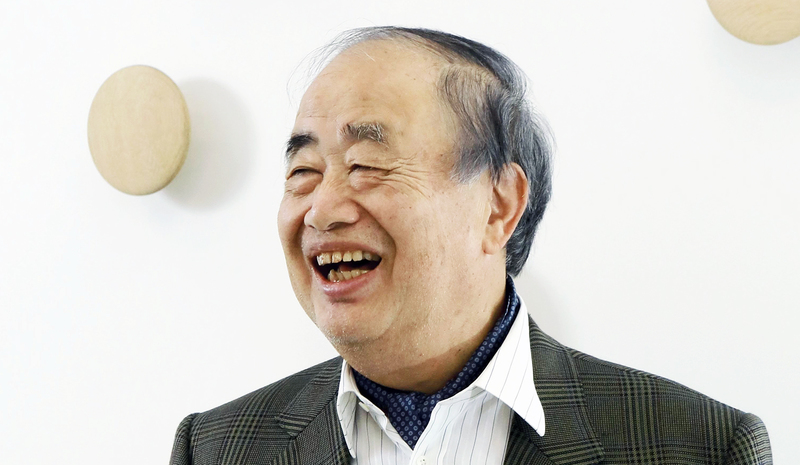
Tsuguhiko Kadokawa is a member of the family that founded the former publisher Kadokawa Shoten. Three years ago, he elected to merge with IT company Dwango Co., which had risen to prominence with the video site Niconico. For this edition of "The Leaders" column, which focuses on corporate management and senior executives, The Yomiuri Shimbun interviewed the chairman of Kadokawa Dwango Corp. about the upheavals of the age of digitization and his strategies for survival.
* * *
We're in the middle of an age that is switching from analog to digital. The digital age is an active, dynamic world. Ways of thinking and mechanisms have undergone a fundamental shift.
The [domestic] manufacturing industry was destroyed by the United States' digitization strategy. With the standardization of parts and the generalization of hardware, television sets, personal computers and mobile phones can now be made by anyone who buys the parts. Japan's competitiveness has been lost and power relationships have been transformed in a single stroke.
The rise of companies like Apple and Google, and the source of Japan's difficulties, lie in this fact. Looking back on this period from some point in the future, however, we may well describe it as an "interesting" era.
Digitization extends to content. Its impact can be found in every field, from visual media such as cinema, broadcasting and games, to music, books and news.
Apple has the advantage of the device -- the iPhone. Pick up an iPhone, and you can enjoy all manner of things -- music, movies, books and games -- and also find apps you might need. Creating this arena against the backdrop of digitization was a major achievement. Apple created its own platform that corrals everyone -- the copyright holder, the application developer, and us, the users of its device -- into the ring. The company has a monopoly.
In this game, the winner takes all, with staggering success. Observing this trend, I feel that each and every industry has entered an age of being redefined. I'm not talking about something superficial, such as industry restructuring or corporate restructuring. Businesses that exist now will either disappear or reinvent themselves into totally different forms.
Take a look at Fujifilm, which was a major player in the photographic film industry. Digitization changed the environment completely, and Fujifilm saw its market disappear. The company has experienced a magnificent rebirth into one that now centers on liquid crystal film, medical equipment and pharmaceuticals. In other words, it succeeded by redefining itself on its own, before it was redefined by society. Conversely, companies that find themselves unable to cope with change will lose support and eventually disappear.
This is also true for the publishing industry. We used to struggle within the narrow world of the industry, competing over who took up shelf space in bookstores. Then all of a sudden, Amazon.com joined the competition with e-books. Amazon is a giant company that competes for a top global position in these times of market capitalization, along with companies like Apple and Microsoft. We came to realize that we were competing against an opponent whose physical strength was hundreds of times greater than ours.
The unification of standards that comes with digitization opened the door to [these new foreign companies like] "Black Ships." Essentially, language barriers have collapsed and we have been thrown into the maelstrom of global competition. Neither cinema nor broadcasting are exceptions to this. On the contrary, they'll become the main battlefield of the future, and a new monopoly is sure to emerge.
And so I chose to merge with Dwango.
Supporting role
In the autumn of 2014, major publishing firm Kadokawa Corp. (formerly Kadokawa Shoten) took the plunge and merged with Dwango, which is known for the video site Niconico.
I decided we had to change with the times. People around me definitely had things to say, but I learned about change from my father, Genyoshi.
My father liked Matsuo Basho's haikai philosophy about fluidity and immutability -- fueki ryuko. There are many ways of interpreting this term, but my father understood it as "things that are constant come to be visible only when you follow a trend."
I think my father left me an understanding that we should follow what is changing, and that by doing so, we'll come to perceive what are truly unchanging values. This means that publishing companies must also change. So I felt my father would be OK with it, [even if the form of the company's business completely changed].
I had a sense of crisis over continually losing out to Apple and Google without our own digital platform for distribution. However, making our own would be costly, both in terms of labor and money. Then I wondered if there was some entity that had the foundation for doing this -- and that led me to Dwango. This was the initial meaning of the business merger.
I've experienced two turning points in my life.
I started playing shogi Japanese chess when I was young. I started reluctantly, urged by my father. My father used to take me to the home of his shogi mate, [writer] Masuji Ibuse, and he would say, proudly, "My son is a member of the Japanese Shogi Association's Meijin no Tamago no Kai [which was a class for young players who were prospective professionals]."
I would try hard to win to make my father happy. I was convinced I was going to become a shogi player when I grew up. But one day, my father suddenly announced, "I have no intention of allowing you to become a shogi player." Around the time I graduated from university, he told me, "Join us at the company and be our treasurer."
My other turning point was when I became the president of the company, succeeding my older brother.
Kadokawa left the company in 1992 due to differences in management policy between him and his older brother, Haruki. In his new company, he published bunkobon paperbacks and game magazines, starting with Dengeki. He returned to Kadokawa Shoten about a year later, after the resignation of Haruki as company president.
There is a book by Taichi Sakaiya titled "Toyotomi Hidenaga: Aru hosayaku no shogai" (His life as an assistant). It made an impression on me when I read it. I thought my life would be fine as a kind of Hidenaga [who supported his older brother Hideyoshi]. I wasn't dissatisfied with my role at the company, looking after sales and publishing, supporting my brother as he released hit movies. So during the time I was away from the company, I felt as if all my strength had dissipated.
When I returned and became president, I worried about whether I could play the role of [Toyotomi] Hideyoshi. However, the experience of having started the new company and putting out publications proved useful. My experience founding a company also gave me the confidence to manage one.
'Deeply frustrated'
Now, however, I am feeling deeply frustrated.
The skills and technology that the general public have to manipulate digital devices is evolving in a way that is really astounding. A business that does not have contact with the general public cannot exist. The only companies that will survive are those that innovate their businesses from this perspective. Moving forward, we're going to see the circulation of information and images that have been created by the general public, and we're going to enter a C-to-C (consumer-to-consumer) age, where consumers are directly connected. The media of the analogue era was the greatest common divisor in dealing with the mass population. We're seeing a world where we can't compete in the same way.
However, digital platforms are now in the hands of disturbing "Black Ships" like Apple. At the same time, the flea-market app Mercari has become a hot topic. This is a successful example of typical C-to-C transactions. The mechanism through which it works was already conceivable a few years ago, but I wasn't able to incorporate it into our business model.
Japanese content such as "Kimi no Na wa" (your name.) or "Pokemon Go" centering on anime and video has unlimited possibilities. We're about to enter a time of great upheaval, primarily with video. However, I'm finding it hard to find my own solution.
We're going to see big changes three years from now. We need to win and stay in the competition -- we're coming to the second act of this game.
-- Tsuguhiko Kadokawa
Born in 1943 in Tokyo, he graduated from Waseda University in 1966 and joined what was then Kadokawa Shoten. In 1992, he resigned from his position as vice president of the company and founded publisher Media Works, before returning to Kadokawa Shoten as president in 1993. In 2014, he merged the company with IT-related firm Dwango. Author Jun Henmi is his older sister, and Haruki Kadokawa, the former president of Kadokawa Shoten, is his older brother. He holds an amateur five-dan ranking in shogi. His authored works include "Yakushin Suru Kontentsu, Tota Sareu Media" (Rapidly progressing content, media that will be weeded out) and "Guguru, Appuru ni Makenai Chosakukenho" (Copyright law that will not be defeated by Google or Apple).
-- Kadokawa Dwango Corp.
A holding company established in the autumn of 2014 through a business merger between leading publishing firm Kadokawa Corp. (formerly Kadokawa Shoten) and video distribution service provider Dwango Co. It has 62 companies under its umbrella, including Kadokawa and Dwango. Aiming for a new media mix in the digital age, these companies deal in publishing e-books and other publications, web services such as portals, and video and game industry development. The group employed about 4,200 employees as of late March 2017.
Read more from The Japan News at https://japannews.yomiuri.co.jp/