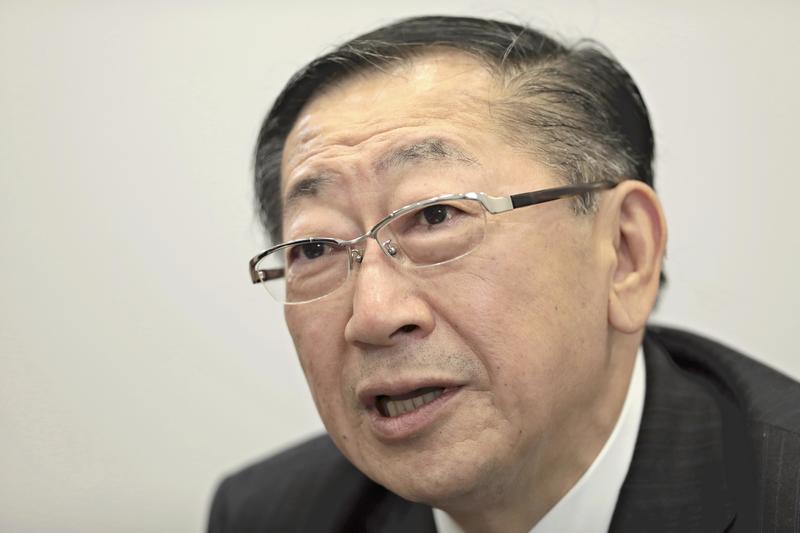
More than 60 percent of JR Kyushu's consolidated operating revenue comes from outside of its railway business. This was achieved through years of business diversification done to compensate for losses in its railway operations. For this installment of Leaders, a column featuring corporate management and senior executives, Toshihiko Aoyagi, president of JR Kyushu, explains how he runs a private corporation responsible for managing public transportation in local areas.
[In 1987, the government privatized and divided the heavily indebted Japanese National Railways into seven companies, collectively called the Japan Railways Group. New companies included East Japan Railway Co. (JR East), Central Japan Railway Co. (JR Tokai) and JR Kyushu. JR Kyushu began operations with a large number of surplus workers.]
We had 15,000 employees when we were privatized, but we only needed 12,000 to operate our railways. The biggest managerial challenge at the time was how to secure salaries for those extra 3,000 employees.
The surplus workers were told to find a way to feed themselves. That's how it was done back then. We launched every kind of business we could think of. Employees who the day before had been station staff, train drivers and conductors began running yakitori chicken and udon noodle restaurants. Some even tried to run a fishing pond.
Needless to say, we experienced many failures. We recorded a huge loss after a long-overdue decision to pull out of the automobile dealer business. Meanwhile, almost our entire investment in a residential development project in Kumamoto Prefecture had to be written off as a loss.
Colleagues were temporarily transferred to other companies to learn how to conduct business. Koji Karaike, the former president and current chairman of JR Kyushu, learned from scratch how to run a business during his stint at major retailer Marui Group Co.
I was always in charge of railway services, so I was envious of colleagues who got to launch new businesses. I thought, "It must be nice to be encouraged to do more even after failing like that." On the other hand, I was constantly told to increase efficiency in railway operations.
Management at the time encouraged each person to fight for the company's survival. I believe the experience gained from the repeated failures of my colleagues -- who had only known the railway business [before privatization] -- formed the foundation of our company today.
[Business steadily improved, and the company was listed on the First Section of the Tokyo Stock Exchange in October 2016, after Aoyagi had become president.]
Upon privatization, the three companies that operate outside of Japan's largest island, Honshu -- Hokkaido Railway Co. (JR Hokkaido), Shikoku Railway Co. (JR Shikoku) and JR Kyushu -- were all running a deficit and collectively dubbed "the three island companies." The name was bizarre in my opinion, because after all, isn't Honshu also an island? When JR Kyushu was listed on the TSE First Section, I felt deep pride in the fact that a "three island company" had made it. Back when we were privatized in 1987, I don't think anyone believed that one day one of the island companies would be listed.
[Consolidated operating revenue hit a new record for the fiscal year that ended this March. The railway business accounted for only 34 percent of the revenue, while the retail and restaurant business was 24 percent, followed by 21 percent for construction and 16 percent for real estate including station buildings. The company has even expanded into the Tokyo metropolitan area, operating hotels, condominiums, office buildings, restaurants, drugstores and other businesses there.]
When I look back, I can see that businesses that have grown are the ones that create synergy with our railway operations. In my view, we've come this far because it reached the point of desperation, where employees truly believed: "No one will help us. We have to make it on our own."
Locals waving at trains
When we were privatized, our timetables were based on outdated ideas from when trains were the only mode of transportation. We operated long trains with many coaches only a few times a day, as if saying to customers: "Adjust your schedule if you want to ride."
However, that strategy doesn't work in the age of the automobile. We had to change our mind-set to create timetables and provide trains that would meet the demands of customers.
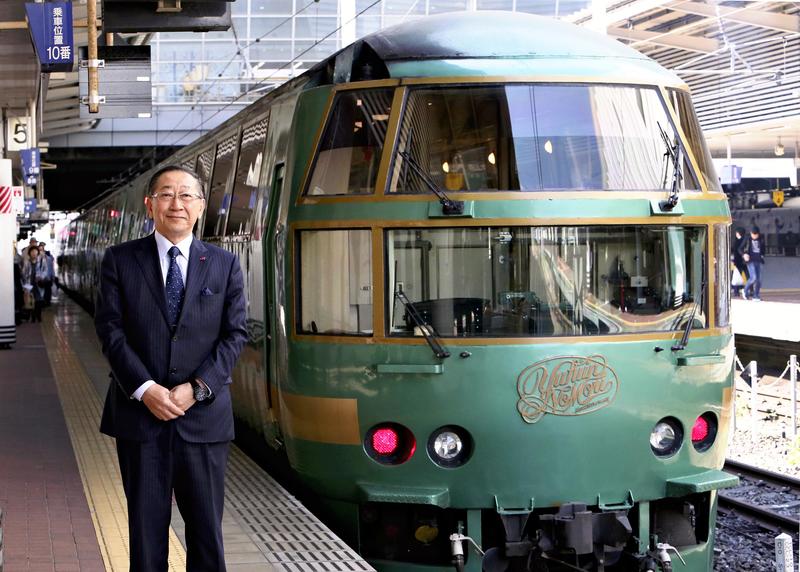
[JR Kyushu currently operates 11 types of "D&S (design and story)" sightseeing trains, including the limited express "Yufuin no Mori" that connects Hakata with Beppu, Oita Prefecture, via Yufuin also in Oita. The D&S trains' unique designs and services reflect the local flavor of areas along the route. The luxury sleeper train "Seven Stars in Kyushu" has remained popular since its 2013 launch, with passengers still selected by lottery.]
All along the D&S routes, you can encounter scenes of local people waving at trains to offer a warm welcome. The custom began in 2009 with the launch of the SL Hitoyoshi, an old-fashioned steam locomotive that runs between Kumamoto and Hitoyoshi in Kumamoto Prefecture. The mayor of Hitoyoshi at the time wanted to hold a welcome event but didn't have the budget. After giving it some thought he realized, "Just waving hello won't cost a thing." He urged people to participate through the city's newsletter, saying, "Let's all give a wave to the SL Hitoyoshi." After that, locals such as those employed in farming began to wave when the train approached. That warm welcome has since spread to other areas along D&S train routes.
In March 2011, full operation of the Kagoshima route along the Kyushu Shinkansen line began between the cities of Hakata and Kagoshima. We asked people to gather along the route to wave at the Shinkansen train for a television commercial commemorating the start of operations.
I had expected about 1,000 people to show up, but when the day arrived more than 10,000 gathered along the route. It wasn't just waving. People dressed up in different costumes and put on impromptu performances for us. The sight moved JR Kyushu's younger employees to tears. Some even said, "I have never been so touched."
We have since deepened our relationships with local communities, working together with locals on planning a new D&S train and cooperating with local associations of okami-san [managers of ryokan inns or their spouses].
It might look like people along the tracks are just offering a simple wave, but for passengers there's a warm feeling of thanks that is conveyed. I don't think a more beautiful form of communication exists.
Conventional lines in red
[In March 2018, JR Kyushu reduced the number of trains operating on a daily basis across the Kyushu region by 117, setting the total at 3,011. It was the largest reduction in operating trains since privatization.]
Most of JR Kyushu's conventional lines operate in the red. The number of passengers is expected to keep falling.
Local people have called on us to keep the trains running despite the deficit, saying it's our duty as a public transportation firm, but we can't keep operating long-term without making a profit.
[A U.S.-based investment fund that owns 6.1 percent of the company's shares made six proposals at the annual general shareholders' meeting on June 21, including a share buyback. Share buybacks allow a company to boost the value of its shares by purchasing its own stocks on the market to reduce the number of shares. Though the proposals were either rejected or tabled, JR Kyushu's use of financial resources was called into question.]
I understand that we must fully take the shareholders' thoughts into consideration. However, it is also a fact that we need to invest in growth such as by developing station buildings, and secure the financial resources needed to update facilities that are indispensable to ensuring railway safety.
We have to grow the company while striking a balance between railway operations and other businesses.
I am looking forward to considering the future shape of public transportation together with local people, and to continuing to contribute to the sustainable development of the Kyushu region through diverse business activities.
-- Toshihiko Aoyagi / President of Kyushu Railway Co.
Born in Fukuoka Prefecture in 1953, Aoyagi graduated from the Faculty of Engineering at the University of Tokyo in 1977 and joined the former Japanese National Railways. After the company was privatized in 1987, he joined Kyushu Railway Co. Aoyagi has assumed various posts including director and general manager of the Kagoshima regional office in 2005, and senior managing director and director general of the railway operations headquarters in 2012. He took up his current position in June 2014.
-- Key Numbers
706 outlets
JR Kyushu's group companies were running 706 retail stores and restaurants as of the end of March 2019. Its business has extended beyond the Kyushu region -- for example, its izakaya restaurant chain, Umaya, operates in Tokyo and Shanghai. According to its consolidated financial results for the year ended March 2019, consolidated operating revenue was 440.3 billion yen and consolidated net income was 49.2 billion yen. It employed a total of 17,765 people as of the end of March.
Read more from The Japan News at https://japannews.yomiuri.co.jp/