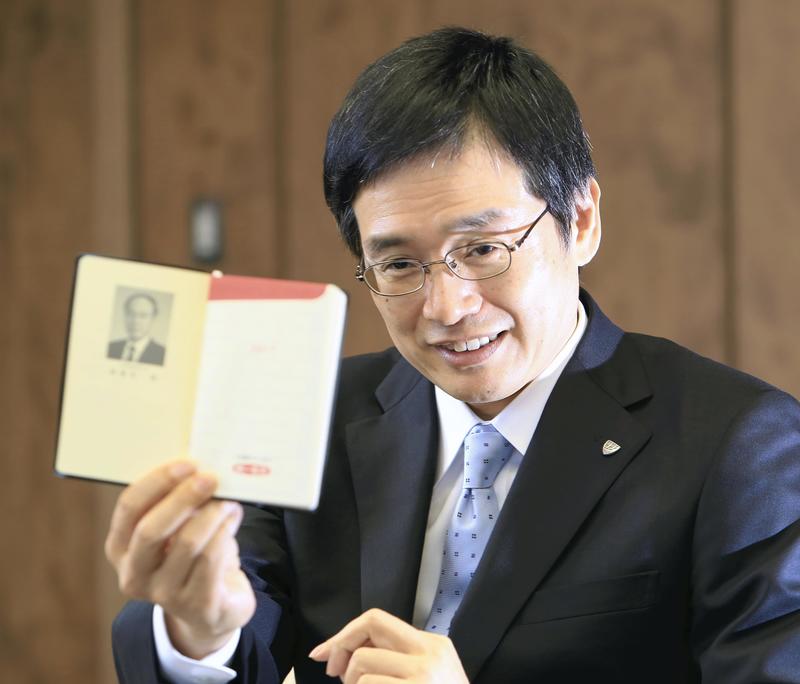
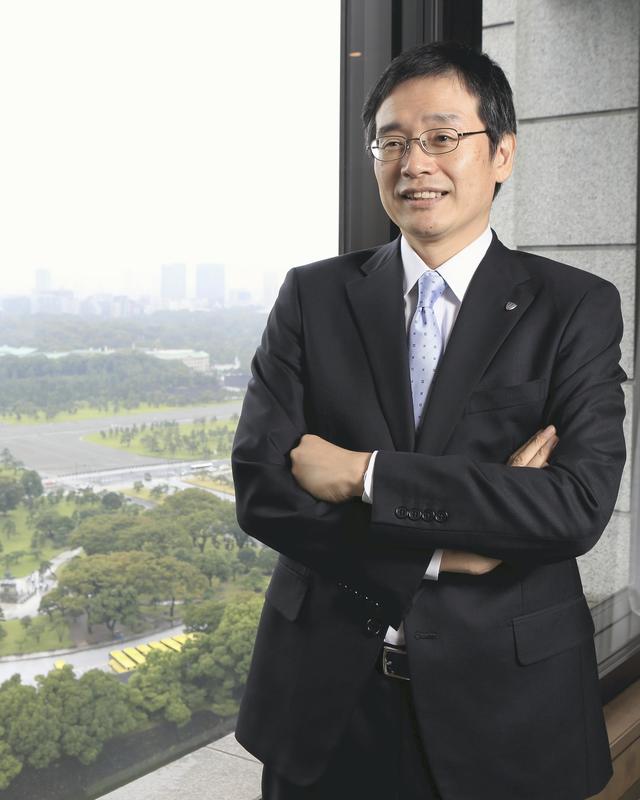
Life insurance provides peace of mind, but the industry is at a turning point due to the maturity of the Japanese market. For this edition of "The Leaders" column, which highlights corporate management and senior executives, The Yomiuri Shimbun spoke with Seiji Inagaki, president of Dai-ichi Life Holdings, Inc., about the company's business strategy for growth including overseas expansion. The following are excerpts from the interview.
Last year, after being offered the job of president, I embarked on a solo tour of the areas associated with the company.
One of the places I visited was the area affected by the Great East Japan Earthquake. The company's office in Kesennuma, Miyagi Prefecture, was flooded and three members of our sales team died. During the visit, I saw embankments being raised and noticed that reconstruction was still in the initial stages.
At the time of the disaster, there was a sales staff member living in an evacuation shelter who did everything they could to confirm the safety of customers. There was a child who had lost their entire family and had held onto a promotional towel decorated with anime characters that had been distributed by the company. We used the towel as a means of identifying the recipients of insurance payouts.
March 11, 2011, was a day when all of our employees reaffirmed the core reason why life insurance is necessary.
During World War II, immediately after the atomic bomb was dropped on Hiroshima, the head of our local branch office at the time is said to have decided to make insurance payments based on his own memories and customers' claims, despite the fact that he lost his family. I learned that after he retired, he became a priest at a temple in his hometown in Yamanashi Prefecture, which I also visited.
When I think about my predecessors' sense of duty and their commitment to putting the customer first, I am truly awed.
Inagaki became president this April. At 53, he was the youngest person ever to become the president of a major financial firm in Japan.
I am not concerned at all with age. However, it did give me pause when the former president -- now chairman -- Koichiro Watanabe, who is 10 years my senior, handed his position to me with the message, "I hope you will undertake the challenge of innovative changes that is in Dai-ichi's DNA, and not worry about the outcome." That was the only time when I was conscious of my age.
There are many executives older than I am. However, I was head of business planning until March and my style has always been to express my opinion no matter the situation. This has not changed to this day. All our senior executives are outstanding and they give me their well thought-out opinions, if they believe another course of action would be better. It is a very smooth-running system.
British-style discipline
In elementary and junior high school, Inagaki's father, a banker, moved twice and he spent a total of five years in London. During that time, Inagaki attended local schools for 4-1/2 years.
I think my experience overseas represents a starting point in my life. Through studying with British children, I acquired English naturally and my feelings of resistance toward foreign cultures disappeared.
When I was an elementary school student, I once went to a coin laundry with my mother. I was making a lot of noise and a British woman grabbed me by the arm and scolded me severely, saying, "You need to be quiet." I matured under the British style of strict discipline, in which the entire society is responsible for raising children. I'm still grateful to my parents for providing me with this experience.
I was interested in life insurance companies during my school days, since "The Seiho" attracted international attention for their financial and asset management capabilities. When considering employment opportunities, I felt it was an industry in which one could be active globally. I ended up joining Dai-ichi Life Insurance, which was the first company to offer me a job.
My first post after joining the company was at an office on the Chita Peninsula in Aichi Prefecture. I was in charge of processing and making official contracts brought in by the sales staff.
I heard the voices of many different customers there. These gave me a good picture of what customers are worried about and what they want. I was able to appreciate firsthand that the raison d'etre of life insurance is to "provide insurance payouts to people who truly need them." I also saw up close how hard the sales staff worked. This was a highly meaningful period for me in terms of my professional life.
'Bonds' key to corporate growth
Japan's population is now declining and the market for life insurance is expected to shrink in the middle and long term. The negative interest rate policy has caused operational difficulties. The business climate for the insurance industry is becoming increasingly severe.
My motto is to think positively. When a cup is half filled with water, you can either think of it as half full or half empty. This means when you perceive your situation in a positive manner, your subsequent thinking will change.
While I acknowledge the industry faces many challenges, such as Japan's chronically low birthrate and the negative interest rate, when one considers what can be done, we can see that there are a variety of steps that should be taken.
To maintain growth in the face of such adversity, change is of course necessary. The foreign business is one pillar of this. To continue providing domestic customers "peace of mind" through life insurance, it is essential to maintain the base for stable revenue.
Our group company in Vietnam has increased its insurance premium tenfold in the 10 years since we acquired it and the penetration rate for life insurance has risen. There is large growth potential for emerging nations. In addition, our U.S. company Protective Life Corp. has contributed to our improved performance since we purchased it in 2015.
I've heard of many cases where the acquisition of overseas companies resulted in failure. For this reason, it is important that the senior management of companies should speak frankly with each other and confirm that corporate culture, business style and values are compatible when a deal is being considered. Our past presidents have carefully selected companies to acquire including Protective Life.
We have a system in which the chief executive officers of our group companies from around the world gather once a year to discuss group strategies face-to-face. While it is possible to buy companies and attract talent with money, this is not enough. It's about how to build bonds, which money cannot buy, including relationships with customers. This is what makes a company strong.
Dai-ichi Life Holdings' consolidated financial statements for the fiscal year ending March 2017 showed decreased insurance premiums. However, its overseas business operations were strong and its fundamental profits were the highest since its stock listing in 2010. Ten years ago, overseas businesses did not contribute to group profits, but now account for 27 percent of total profits.
In October 2016, we became a holding company, which has simplified coordination of new reforms with other companies among other undertakings. In the future, the important role life insurance companies play in society will extend to prolonging people's healthy life expectancy. We will collaborate with different industries to utilize big data. We've already started selling unique products with insurance premiums that decrease depending on the results of medical exams.
Also, by utilizing our network of sales personnel, we will increase cooperation with municipalities in terms of promoting cancer screenings and watching over the elderly. What we are aiming for is what is "best" rather than "biggest."
We're also implementing our work style reforms. By utilizing cutting-edge robotics and other technology, we aim to reduce our staff workload by about 300,000 hours per year, primarily in time spent on paperwork. This is equivalent to the work of 150 employees. We will redirect our freed-up resources to improving customer service.
Moving ahead, we must constantly change in order to be a company essential to our customers. I want us to be a company where people who seek out new challenges can gather.
-- Key Numbers: 70,000
Since 2007, Dai-ichi Life has operated Dai-ichi Frontier Life Insurance Co., which specializes in bancassurance (over-the-counter sales at banks), and purchased Neo First Life Insurance Co. which has advantages in walk-in shop agencies (insurance stores). The holding company has nine insurance companies including overseas subsidiaries and the group-wide number of employees is 70,000. It is ranked second in the industry in terms of insurance premiums.
-- Profile
Inagaki was born in 1963 in Aichi Prefecture. He graduated from Keio University's Department in Economics in 1986 and joined Dai-ichi Life Insurance. In 1992, he received a Master of Business Administration (MBA) from Harvard University. He spent many years in the corporate planning department and was also involved in raising capital for the acquisition of Protective Life, among other initiatives. He became a director in 2016 and assumed his current post in April 2017.
Read more from The Japan News at https://japannews.yomiuri.co.jp/