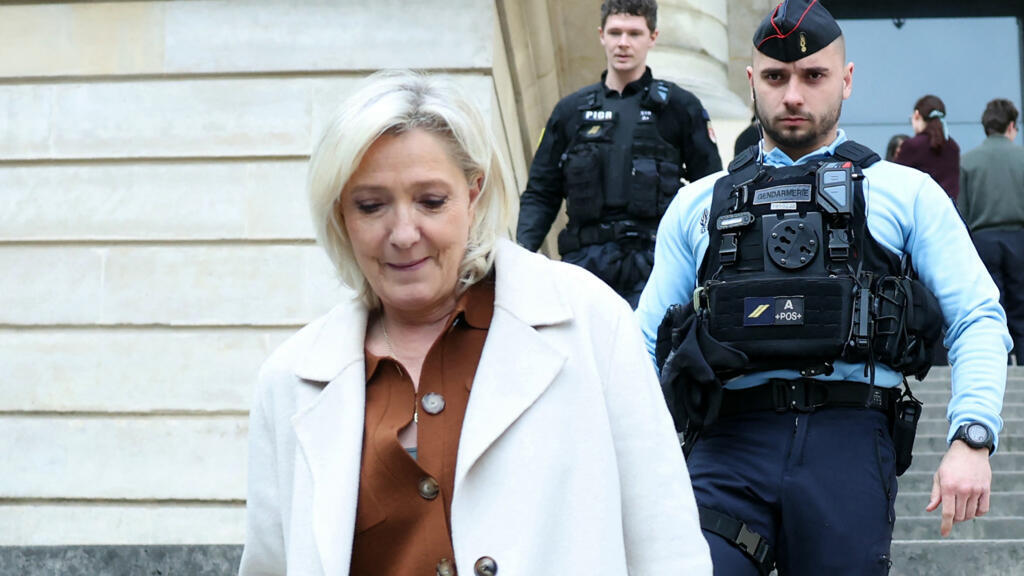
Marine Le Pen appeared before an appeal court on Tuesday to contest her embezzlement conviction, denying that she orchestrated any system to misuse European Parliament funds and seeking to overturn a ruling that has barred her from public office.
Far-right figurehead of the National Rally, Marine Le Pen, spent nearly five hours in the dock on Tuesday as she sought to persuade the Paris Court of Appeal that there was no organised scheme behind the use of parliamentary assistants by her party’s MEPs – and that each contract should be judged on its own merits.
Facing judges in her appeal against a conviction for embezzlement, the three-time failed presidential candidate repeatedly pushed back against the prosecution’s central claim of a coordinated operation.
“The word ‘system’ bothers me,” she told the court. “It suggests manipulation.” Instead, she insisted, every arrangement was a “different case”, and she denied having issued any instructions.
That point strikes at the heart of the case against Marine Le Pen. In the first-instance ruling last spring, judges considered the existence of a system decisive in handing down a stiff sentence: four years in prison, including two suspended, a €100,000 fine and, most damagingly, five years of ineligibility with immediate effect – a ban that currently blocks any bid for the presidency.
Prosecutors accuse Le Pen, her party – then known as the National Front – and ten other senior figures of misusing European funds by hiring parliamentary assistants for their MEPs who, in reality, worked solely for the party.
The alleged misappropriation of public money, to the detriment of the European Parliament, was put at €3.2 million, after €1.1 million had already been repaid by some defendants.
French far-right leader Le Pen in high-stakes trial ahead of presidential race
Emails, ‘castles in the air’ and rising tempers
At the start of her questioning before presiding judge Michèle Agi, Le Pen adopted a measured tone, keen to show contrition – a marked contrast with the stormy atmosphere of last year’s criminal court hearing.
But the calm did not always hold as judges probed more awkward elements of the file.
She was challenged over an internal email between “third-party payers” linked to the European Parliament that appeared to propose a game of musical chairs for assistants to avoid “catastrophe”.
“It seems that only financial considerations are at play,” the magistrate observed. “That may be how it looks,” Le Pen replied, “but they were building castles in the air.”
Another message, from party treasurer Wallerand de Saint Just – “I think Marine knows all about this” – was cited in response to concerns raised by an MEP about fictitious jobs.
Le Pen said she had not been a recipient. “If I had received an email like that, I wouldn’t have replied so casually,” she insisted.
She also argued that the party’s own wage bill undermined the idea of a cost-cutting scheme.
“The National Front’s payroll kept increasing in 2014, 2015 and 2016,” she said. “If there had really been a desire to lighten the party’s load, it would be obvious. It is absolutely nowhere to be seen.”
France's Le Pen says had 'no sense' of any offence as appeal trial opens
Assistants, dual roles and a shift in blame
Earlier in the day, the court heard from Julien Odoul, now an MP for the Yonne department, over his role as a parliamentary assistant to National Front MEP Mylène Troszczynski in 2014–2015.
Odoul admitted he did not in fact work for her. Investigators found just twelve exchanges between them over 18 months, with their longest phone call lasting four minutes and 17 seconds.
He told the court that Troszczynski had instructed him to “make himself useful” at party headquarters, where an organisational chart listed him as a special adviser to Marine Le Pen, then party leader.
Le Pen later said Odoul could have held both roles, noting that he did not work full-time for her. While she said she assumed he was employed, she insisted she was unaware that he was officially attached to Troszczynski.
After briefly hinting last week at a change in strategy – questioning whether a crime had been committed at all and focusing on the absence of intent – Le Pen ultimately offered only a limited mea culpa. “It may have been questionable, even reprehensible,” she said, “it may not have been ideal, but all these people were working” for their MEPs.
The only clear new element in her defence was an attempt to shift responsibility to her father, Jean-Marie Le Pen, whom she described as “in a way the leader of this mini-group” of MEPs until 2016, despite having handed over the party leadership five years earlier.
The appeal hearing is set to continue until 12 February.
(with newswires)