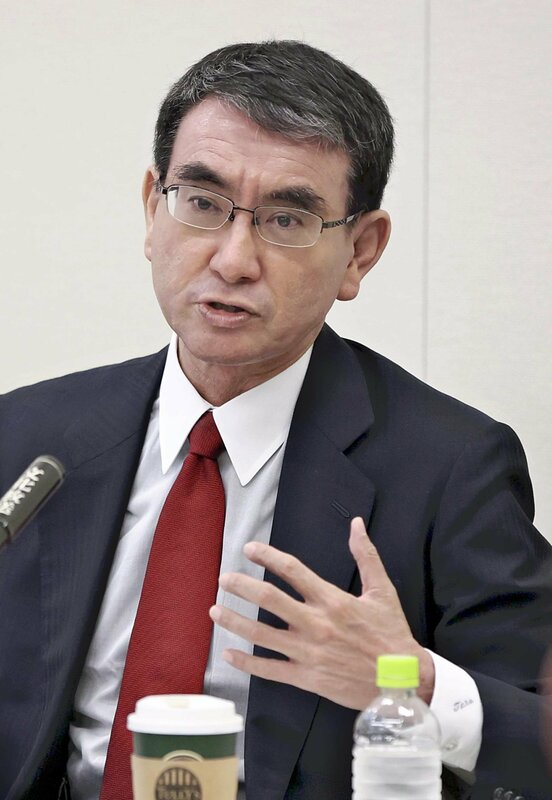
The Yomiuri Shimbun has interviewed each of the four candidates in the Liberal Democratic Party's presidential election about their policies and political stances. The series begins with Taro Kono, 58, the administrative and regulatory reform minister. The following is excerpted from his interview.
The Yomiuri Shimbun: What do you think are the points of contention in the party presidential race?
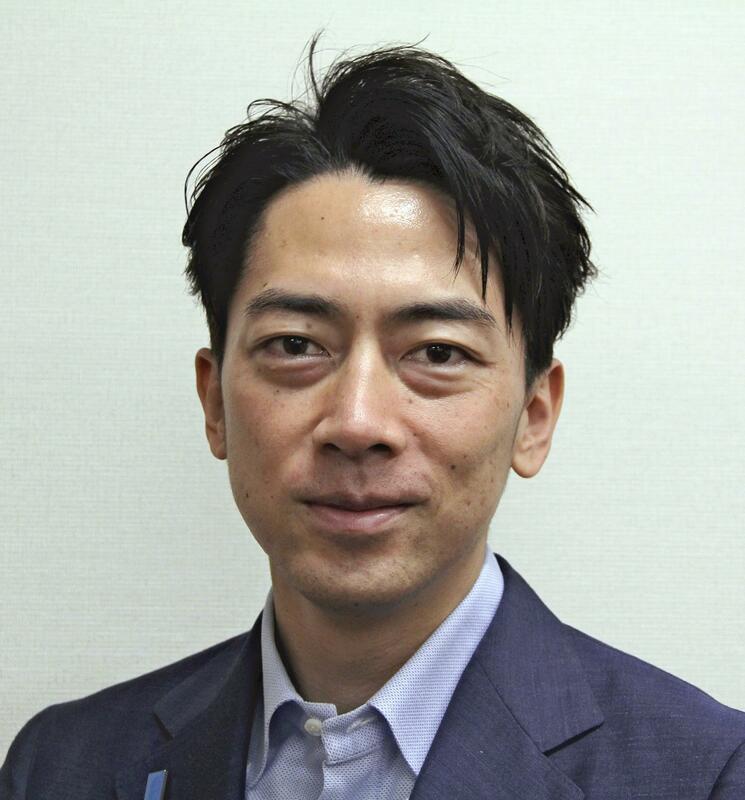
Taro Kono: Does the Liberal Democratic Party continue to be a political party which listens to the voices of the public? Is there something that demands the party's ear even more than the public? I think these are the questions that are being asked most. The people have long had requests on the subject of social security, but we have still not quite managed to respond to those requests. The biggest theme for me is solid reform of areas including the pension system, health care, nursing care and child-rearing.
Q: What specifically would pension system reform entail?
A: Ultimately, a minimum guarantee is needed. Under the basic pension system, when [a person's] insurance premiums go unpaid, that amount comes out of their pension. Does this system truly provide a minimum guarantee? The guaranteed minimum portion has to be funded through tax revenues instead of premiums. I think the consumption tax would be good [to use as a revenue source].
Q: What are your thoughts on measures to cope with the novel coronavirus?
A: If antigen test kits were mass-produced, made cheaper, and gave results faster, they could be deployed in various settings and used to return the economy to normal. The government will support capital investments necessary for the purpose. Even with vaccination certifications, there is still a chance of breakthrough infections [in vaccinated people], so testing is important.
It is still taking awhile for stimulus funds to arrive in the bank accounts of dining establishments. Ideally, the registration of these eateries should have been fully digitized, so the money could have been transferred into their accounts at the push of a button. It would be absurd not to launch such a system. I will move ahead with support measures that utilize digital capabilities to the maximum extent.
Q: What plans do you have for the economy?
A: Abenomics [former Prime Minister Shinzo Abe's economic policies] aimed to reboot the economy with monetary easing and fiscal spending, and then realize a third goal of implementing an economic growth strategy. But it could not sufficiently ignite the growth strategy. Though companies' profits ballooned, they sat on those earnings, and have not raised worker wages. We need to clarify that a rise in wages is the goal, for example, by making companies that raise labor's share of income eligible to receive special corporate taxation treatment.
Q: What are your thoughts on Japan's defense policy?
A: Tensions have continued in East Asia, as seen in North Korea's development of nuclear weapons and missiles, and China's military buildup. A best scenario would be aligning with the Five Eyes [an intelligence alliance of Australia, Britain, Canada, New Zealand and the United States], with Japan ultimately joining the network to make the "Six Eyes."
Q: Would you reappraise the "nuclear fuel cycle" for the reuse of spent fuel at nuclear power plants?
A: The fast breeder reactors envisioned in the nuclear fuel cycle can no longer be developed. Now that the nuclear fuel cycle can no longer be realized, it is necessary to discuss how to deal with nuclear power plants. It's important to present nuclear energy's implicit issues to the public, and once the public correctly understands [these issues], to then solve them one by one.
Q: What do you think about letting married couples choose separate surnames and same-sex marriages?
A: I am for both. Of course, same-sex marriage presents a constitutional issue. Such questions of values ought to be open to wide debate in the Diet, with members not bound by party affiliation.
Q: You've drawn criticism for what some have called a heavy-handed treatment of bureaucrats.
A: I think there are instances where I do need to choose my words more carefully. As foreign minister, as defense minister, and now as a minister in charge of vaccination, I have always received a great deal of assistance from the various ministries and their teams. I have always encouraged quite a free and frank discussion when formulating policies, which has enabled me to draw out the strength of my team. Going forward, I will need to enlist the strength of the formidable Team Kasumigaseki to propel the wheels of government. [Kasumigaseki is the area of Tokyo where many ministries have their headquarters, while nearby Nagatacho is the location of the Diet Building.]
However, I do not intend to mince words when it comes to pointing out the fallacies of bureaucratic thinking that is not attuned to reality.
-- A candidate who could dismantle vested interests
Environment Minister Shinjiro Koizumi offered the following characterization of Taro Kono, whom he supports:
[Kono] is uncommonly committed to challenging vested interests and righting the bad habits of Nagatacho [politicians] and Kasumigaseki [bureaucrats]. He is a "fighting politician."
With Taro Kono, what you see is what you get. He does not make adjustments to fall into convenient step with others or the circumstances.
In August, Prime Minister Yoshihide Suga, Mr. Kono and myself gathered in the dormitory for House of Representatives members. I was surprised when he appeared wearing a T-shirt, shorts and sandals, while the prime minister wore a suit. He has his idiosyncrasies. Inevitably, these idiosyncrasies will strike everyone in their own way.
My father [former Prime Minister Junichiro Koizumi] was also called an eccentric. Some said he was a cold and ruthless man, while others found him to be exceedingly warmhearted.
Such is the fate of the eccentric.
Back during the 2009 LDP presidential election, I cast my ballot for Mr. Kono. The LDP was part of the opposition at the time. I felt he could be entrusted with a fresh start of the party through transformative reform.
My feelings remain the same today.
Mr. Kono is capable of making new inroads in fields inaccessible to others.
I hope this will be the election that gives us Prime Minister Kono at last.
Read more from The Japan News at https://japannews.yomiuri.co.jp/