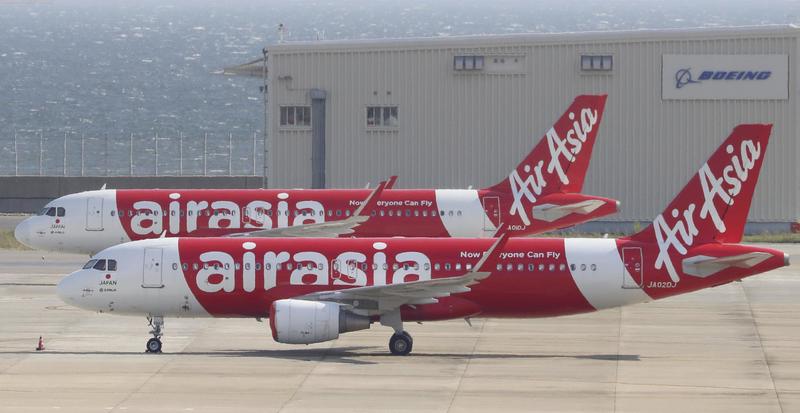
Low-cost carrier AirAsia Japan has announced that it is ceasing operations, an effect of the global aviation industry being hit hard by a sharp drop in passengers following the spread of novel coronavirus infection. Above all, many LCCs lack financial strength, leading to bankruptcies and other difficult situations for these airlines.
-- Only 4 routes
From the 2000s, AirAsia Group grew rapidly under the leadership of executives such as Executive Director and Group Chief Executive Officer Tony Fernandes. Having introduced thorough cost-cutting measures, including the shortening of time spent by an aircraft at destinations to improve operational efficiency, the company became globally known as a pioneer of the LCC business model.
AirAsia Group established joint ventures with local companies and other parties not only in Malaysia, where it is based, but also in Thailand and the Philippines. By expanding its short-haul and medium-haul routes, mainly within Asia, the company met demand from middle-class travelers, whose numbers increased as their home economies grew.
AirAsia Japan was established in 2014 with investment from parties including Rakuten, Inc. and sporting goods store operator Alpen Co. It was once the focus of industry attention in Japan as it is independent from any major airline company.
As it took a long time to plan safety and other systems, however, it wasn't until late 2017 that the company was able to launch service in Japan. It operated only four routes, all based from its hub at Chubu Centrair International Airport in Tokoname, Aichi Prefecture.
AirAsia Group suffered financial difficulties after overseas travel restrictions were imposed globally amid the pandemic. It reported a net loss of 992 million ringgit (25 billion yen) in late August for the April-June period.
-- Bankruptcies
Bankruptcies have hit LCCs overseas. In March, British airline Flybe filed for bankruptcy, while Thailand-based airlines NokScoot and Nok Air went bankrupt this summer.
Situations are serious in Japan, too. Japan Airlines has a 50% stake in Jetstar Japan, which last month reported a net loss of 7.7 billion yen in its financial results for the fiscal year ended June 30, the first time it has been in the red in five years.
The Narita, Chiba Prefecture-based LCC last month also offered buyouts or unpaid leave to all 600 pilots and flight attendants.
Zipair Tokyo, a wholly owned subsidiary of JAL, postponed the launch of international service initially scheduled for May. Currently, the LCC operates cargo flights to cut labor costs and help increase profit.
Osaka Prefecture-based Peach Aviation, an affiliate of ANA Holdings Inc., reported a net loss of 9.4 billion yen in its financial results for the fiscal year ended March 31.
-- Few areas to cut
Even if airlines cut a large number of flights in line with declining demand, it is difficult for them to cut personnel costs, aircraft parking fees, maintenance and other expenditures. Even as sales fall, the costs remain significant, seriously deteriorating balance sheets.
Compared to conventional airlines, LCCs are more susceptible to being hurt by a low passenger load factor since there is already less room to cut costs in the first place. LCC load factors are said to have to be at 80% or so for the airline to stay in the black, whereas conventional airlines can turn a profit with load factors of about 60%.
Unless airline demand recovers, the business environment for LCCs is likely to deteriorate further.
The International Air Transport Association predicts global airline demand will return to pre-pandemic levels in 2024, so the business environment for the airline industry is expected to remain difficult for the time being.
"There will likely be more airline bankruptcies," said J. F. Oberlin University Prof. Hajime Tozaki, an aviation industry expert.
Read more from The Japan News at https://japannews.yomiuri.co.jp/