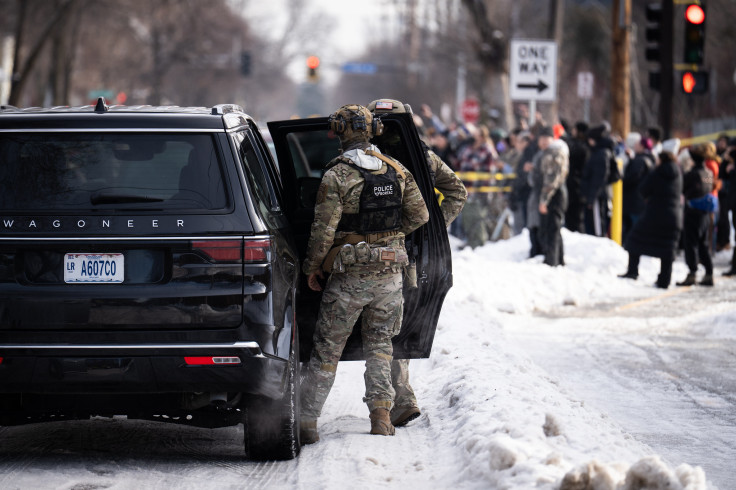
ICE agents have drawn fresh criticism following their recent deployment at airports across the United States. The agents were deployed to assist unpaid Transportation Security Administration (TSA) members amid ongoing staffing shortages. However, reports suggest not all agents have fulfilled the tasks assigned to them.
Photographs of some ICE agents standing idle during a busy period at the airport have sparked concern among travellers. Not only about the agents' presence, but also about whether they have the skills and training required to provide effective support at security checkpoints.
ICE Agents Criticised
On X, photographs of ICE agents apparently at ease have circulated widely. In one image, several men in uniform are lined up on the second floor of an airport, appearing to be standing idle. Another photograph shows agents in conversation.
'It must be infuriating to TSA agents, who are NOT getting paid, to see lazy ICE agents, who ARE getting paid, lounging about the airport and doing nothing to help either them or passengers,' the user who posted the photographs wrote.
Mrs Betty Bowers, America’s best Christian:
— Rebeccat (@TolenRebecca) March 23, 2026
“It must be *infuriating* to TSA agents, who are NOT getting paid, to see lazy ICE agents, who ARE getting paid, lounging about the airport and doing nothing to help either them or passengers.” pic.twitter.com/Vk4tefcyDx
The Shutdown Behind the Deployment
The ICE deployment follows more than six weeks of partial government shutdown that has left TSA workers without pay since mid-February, after a funding standoff over Department of Homeland Security appropriations. More than 300 TSA employees have resigned since the shutdown began, according to DHS figures, creating mounting pressure on airport security operations nationwide. President Donald Trump ordered the ICE deployment on Sunday, directing border enforcement director Tom Homan to oversee the effort across more than a dozen airports.
Why ICE Agents Are Deployed at US Airports
Several ICE agents have been deployed to airports across the US to provide support to unpaid TSA members, with responsibilities including managing queues and passenger flow. The agents were not deployed to replace TSA staffers, as they are neither trained nor certified in aviation security.
'TSA officers spend months learning to detect explosives, weapons, and threats specifically designed to evade detection at checkpoints — skills that require specialized instruction, hands-on practice, and ongoing recertification. You cannot improvise that. Putting untrained personnel at security checkpoints does not fill a gap. It creates one,' Everett Kelley, president of the American Federation of Government Employees, said in a statement.
Why Travellers Are Concerned
The presence of ICE agents at airports has proved distressing for some travellers, given concerns about the agency's record in detentions. In San Francisco, a video of a woman being detained by ICE agents in front of her daughter has circulated widely on social media. In the footage, two individuals identifying themselves as ICE agents, neither of whom appeared to be wearing a visible badge, were filmed using force to remove the woman after she declined to comply.
One X user claimed the woman is a US citizen. The agents' legal basis for the detention has not been independently verified. A spokesperson for San Francisco International Airport described the incident as an isolated case and said it should not cause concern among passengers. San Francisco Mayor Daniel Lurie described the incident as upsetting.
Some passengers at the airport reportedly asked the agents to show their badges, though the agents did not produce identification.