The legal team asking the supreme court to provide a once-and-for-all decision about same-sex marriage in the US filed their opening salvoes on Friday.
Attorneys representing a case challenging Michigan’s ban on such marriages filed their opening briefing arguing that state bans against the practice deprive same-sex couples of their constitutionally protected rights.
The US supreme court agreed in January to hear cases from Kentucky, Ohio, Tennessee and Michigan.
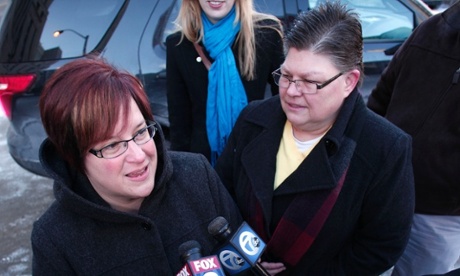
The Michigan case was brought by nurses April DeBoer and Jayne Rowse. The women initially sought joint adoption rights for their three children, but amended their case to seek the right to marry, which comes with adoption privileges in Michigan.
“Each day and each development brings us closer to knowing whether we will be able to marry and make our family as safe and secure as it can be,” said DeBoer in a statement. “We’re both proud and humbled to be representing so many families who have the same hopes and dreams that we do.”
In March 2014, a federal judge struck down the state’s ban, but the decision was stayed and the state refused to recognize hundreds of marriages that occurred immediately following the judge’s decision. In January, a federal judge said that the 323 marriages conducted in the period when the practice was legal in the state must be recognized.
Friday’s briefing was submitted by the five attorneys in the Michigan case.
The state’s ban “harms children financially, legally, socially and psychologically”, the briefing says. “It stigmatizes and humiliates adults and children, it reduces the stability of relationships, and it deprives children of the protections of having two married parents.”
The briefing also addresses the issues of states’ rights versus federal rights, which were subject to renewed attention when a federal judge in January overturned Alabama’s ban. Some state judges said they were not required to follow a federal judge’s decision and refused to issue marriage licenses in counties across the state.
“When you don’t recognize marriages from these 37 states where they can now be entered into, you are refusing to recognize the results of the democratic process in many of those states,” said Alphonse Gerhardstein, an attorney in the Ohio case.
Amicus briefs supporting the plaintiffs for all of the cases are due on 6 March. Oral arguments are expected at the end of April and the supreme court’s decision is expected by the end of June.
The legal team said they have not determined who will be arguing the case before the country’s highest court, a slot that would probably define the chosen attorney’s – or attorneys’ – career.