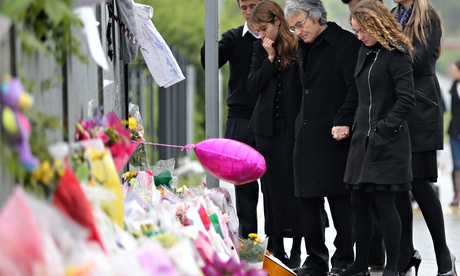
The law must be changed to ensure that the identities of juvenile killers and their families remain secret, says the barrister who defended the schoolboy murderer of teacher Ann Maguire.
Richard Wright QC represented Will Cornick, who was sentenced last week to a minimum of 20 years for killing Mrs Maguire, 61, a popular teacher at Corpus Christi Catholic College in Leeds.
Mr Justice Coulson warned Cornick, who was 15 when last April he stabbed Mrs Maguire seven times as she taught a Spanish class, that he might never be released. But the decision to allow his name and photograph to be published by the media has dismayed his family and child welfare experts, who fear it has placed him and his siblings at risk.
In his only interview following the trial, Wright said that revealing his client’s identity had been done against expert advice. “The evidence from the psychiatrists who examined Will was that it would mean he would be subject to the attentions of other inmates and his vulnerability would increase – and that’s from a starting point of someone who has been on 24-hour suicide watch.”
Wright revealed that Cornick had already been moved once within the prison estate because of fears that other inmates would attack him. “The risk to his life might not be immediate, but that doesn’t mean you can ignore the fact that he’ll be the target of attacks in prison. That’s got to be part of the welfare balance.” Wright said the opinion of experts who had examined his client was “unequivocally that rehabilitation will be more difficult if this boy is named and also, because the parents were playing such an important role in supporting their son, it would have a devastating effect to [effectively] name them.”
He said Coulson’s decision not to continue applying section 39 of the Children and Young Person’s Act 1933 – ensuring a juvenile defendant’s right to anonymity – had grave consequences for both his client and his family. “Will Cornick has two siblings,” Wright said. “Where is the protection for them? They are just as much victims and just as likely to suffer from being named.” Even if the judge had insisted that section 39 should be continued, the law was unlikely to preserve Cornick’s anonymity.
“Section 39 has limited effect because of the way it’s drafted,” Wright explained. “It was written before websites and bloggers, and therefore has no bite on the internet. The boy had been named on websites, social media and Twitter, and the police were powerless to do anything. We identified a number of individuals who had identified Will in a very hostile way. The police were wanting to act, but they received advice that they had no powers to do so. The mere fact of naming him on social media was not in contravention of the court’s [anonymity] order, and that’s obviously a problem.”
An amendment to the criminal justice and courts bill should see this addressed, with social media subject to reporting restrictions. But the identity of juvenile offenders is now likely to be a matter of public record if the Court of Appeal upholds a ruling from a lower court determining that their right to anonymity expires when they reach 18.
Wright said: “We need to have a social debate about whether we live in a progressive society that really wants to put rehabilitation at the forefront of the youth justice system. Its statutory aim is to rehabilitate young offenders – section 44 of the Children and Young Person’s Act says the welfare of the child must be a consideration. But obviously you’ve got to balance it with the terrible offence committed here.”
He suggested Cornick’s case had “crystallised” the issues surrounding anonymity for juvenile offenders. “There are intense and understandable emotions, including outrage, from the public, but the other side is the calm and rational debate about where we go from here. What sort of criminal justice system do we actually want? Where do you place the rehabilitation of young offenders and the welfare of the child? That’s got to be considered as part of the legislative agenda.”
Wright’s comments were echoed by Penelope Gibbs, chair of the Standing Committee for Youth Justice: “All the victims who appeared in court have, rightly, had their anonymity protected. We think Will Cornick should have remained anonymous too, not because we’re sorry for him but because the evidence says he is more likely to be rehabilitated if not named. Media interest is not the same as public interest. If we want fewer victims, we need to give anonymity to children who commit crime.”
Wright conceded that calls to protect the identity of young offenders who had committed terrible crimes was not something politicians or the public would welcome. “The populist, public mindset is that a young man committed a murder, so why should we be interested in this argument? That will always be the problem with trying to effect reform in this area because there aren’t many votes in this for politicians …
“The criminal justice system, surely, is at the heart of what you are as a nation. It’s about how you respect young people and what sort of society you want to live in. These are important questions, but maybe not ones that are popular to answer and debate.”