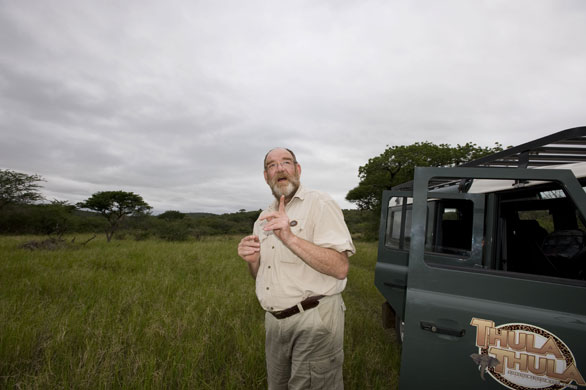
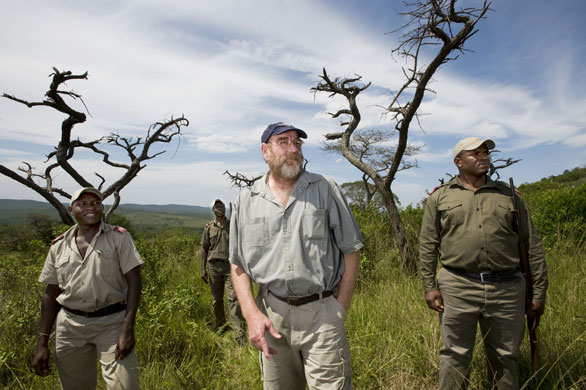
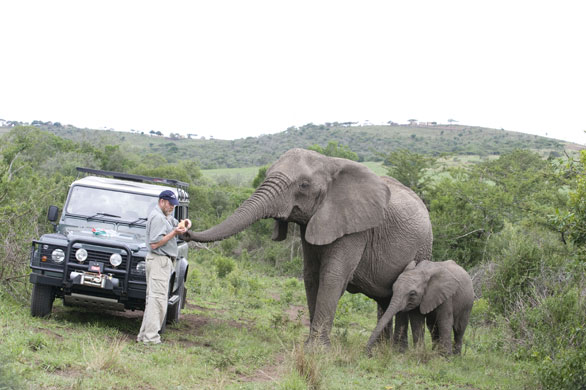
Anthony's South African game reserve, Thula Thula, is some 30 miles inland from the port town of Richards Bay, 100 miles along the coast from Durban. A sprawling oasis of brown scrub and trees amid an unnatural green desert of planted sugar cane, the reserve and its animals offer a focus for his lifelong passion for conservation and wildlife. Tall, bearded and a heavy smoker, Anthony looks every inch a bushmanPhotograph: Suki DhandaThula Thula is deep in the heart of Zulu country. Rorke’s Drift, the mission station immortalised in the film Zulu, where 139 British soldiers held firm against 5,000 Zulu warriors in the 1879 Anglo-Zulu war, is less than two hours’ drive away. Several Zulu tribes farm the surrounding land, and goats wander between the clay and cement buildings that scatter either side of the dusty road connecting the reserve to the local villagePhotograph: Suki DhandaWhen Baghdad was bombed, Anthony set out to save the zoo's animals. “I knew Baghdad had the biggest zoo in the Middle East and I couldn’t stand the thought of the animals dying in their cages. I contacted the Americans and the British and said, ‘You have any contingency plans?’ Nobody was interested. I couldn’t get any support from anybody so I thought, I’ll just go. I went there for the animals”Photograph: Suki Dhanda
Uday Hussein, son of the dead dictator Saddam Hussein, feeds one of his lions. His animals were among those rescued by Anthony. This burnt photo was salvaged after a mob looted the housePhotograph: Hurriyet/ReutersAnthony with some of the US troops who worked alongside Republican Guards to save the zoo. The story, outlined in Babylon’s Ark, a 2007 book which Anthony wrote with journalist Graham Spence, has attracted the attention of Hollywood, with a major film, Good Luck, Mr Anthony, in the works. US banks and corporations now pay Anthony to talk to their employees, hoping the lessons of how to bring order from chaos could turn round failing businesses. And the zoo itself is a thriving attraction in the recovering city, with 5m visitors last year and regular loans of animals from zoos abroadPhotograph: Public DomainWhen Anthony and his two Kuwaiti guides arrived at the zoo in 2003, Husham Hussan, the zoo’s deputy director, burst into tears. Anthony initially saw little hope. Black clouds of flies swarmed over the carcasses of dead animals that had been tossed into dens to feed the live ones. Rubbish littered the ground, baboons and monkeys were running free, while parrots, falcons and other escaped birds circled overhead. Lying near a massive bomb crater, an off-target product of shock and awe, was a decomposing pony. The surviving animals, including lions, tigers and this an Iraqi brown bear, were listless and scrawny “I said it was so bad that we were wasting our time,” recalls Anthony. “I thought we should borrow an M16 from a soldier and just shoot them all. I’m not used to seeing animals, lions and tigers looking like that. Husham persuaded me not to and said we’ve got to try. We started from there.”Photograph: Spencer Platt/GettyLions at Baghdad zoo. With a handful of Iraqi zoo staff, Anthony worked on the vital needs for captive animals: water, food and hygiene. With the city’s infrastructure smashed, water had to be dragged by bucket from a stagnant canal, while donkeys provided meat for the carnivores. “We went out and bought donkeys off the street and the donkey always had a cart, so the guys wouldn’t sell the donkey without the cart. I still think of how we left those carts all over Baghdad.”Photograph: Public DomainAnthony worked in Baghdad for six months, during which time he transformed the fate of the zoo, in the ruins of the city’s once majestic al-Zawra park. Of 650 animals at the zoo before the invasion, just 35 were still alive when he arrived. The rest had died in their cages of thirst and hunger, or had been stolen. There was no food, no water and the remaining animals, the ones with teeth and claws to defend themselves from hungry looters, were lame, starving and dying of thirst. By the time he left, the animals were healthy, the cages clean and the zoo a viable operation once againPhotograph: Suki DhandaAnthony shares the Thula Thula reserve with his wife Françoise. Like many who spend their time in the bush, Anthony talks of a sense of connection with nature. “There’s some sense that the animals have, and people who spend time with animals get better at tuning into it.” It’s easy to dismiss such talk, until you see him with the elephantsPhotograph: Suki DhandaThula Thula has a herd of former delinquent elephants which would otherwise have been shot for dangerous misbehaviour. Anthony has worked to rehabilitate them, to the extent that they will even come when he callsPhotograph: Suki DhandaAnthony is convinced the animals know him. He cups his hands to his mouth and calls: “Come baba, come girls.” For 10 minutes there is silence. Then, on the far side of a clearing, the trees rustle and the first giant grey head breaks above the bushes. Another follows, pausing only to rip a branch from a tree. Soon, as seven or eight of the herd approach, Anthony ushers us from open ground into the relative safety of the vehicle. Within seconds, the animals are poking their trunks through the open windows, their wrinkled faces and eyelashed brown eyes just yards awayPhotograph: Suki Dhanda
Sign up to read this article
Read news from 100’s of titles, curated specifically for you.