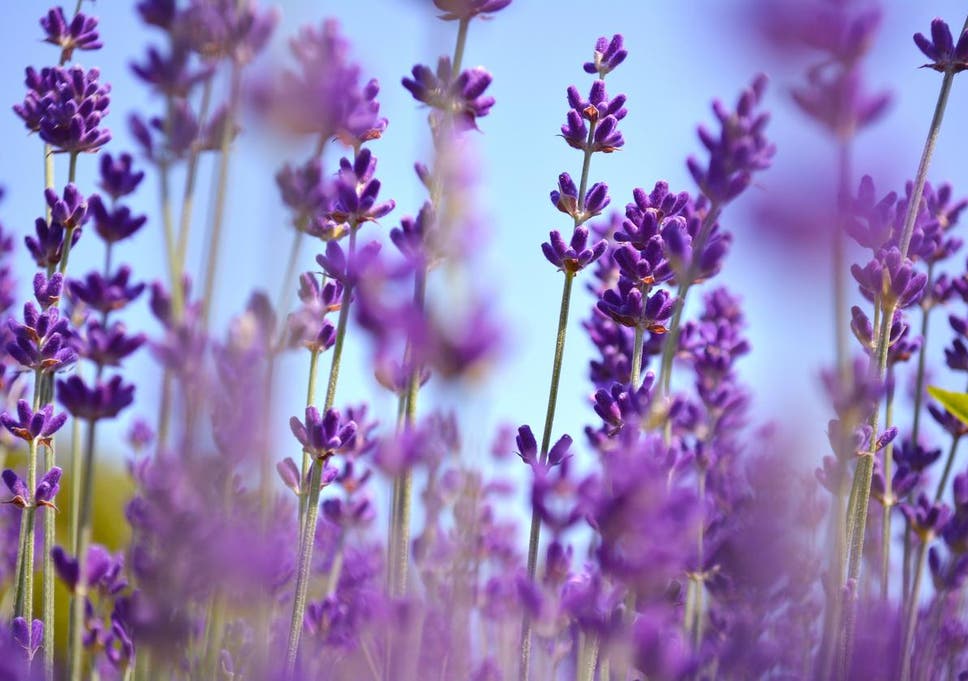
The famous relaxing effects of lavender are real and could even be used medically to treat anxiety, new research suggests.
From blooming gardens to aromatherapy oils and bubble baths, people have long claimed that lavender has calming and relaxing benefits.
And now, scientists have confirmed that the smell of the purple plant really does help people unwind.
So much so, that it could even be used to calm patients before surgery, as an alternative to sleeping tablets and to treat anxiety.
Researchers at Kagoshima University in Japan came to this conclusion after analysing whether the smell of linalool, a fragrant alcohol found in lavender extracts, helps mice relax.
They found that mice which were exposed to the aroma did in fact show less signs of anxiety.
'In folk medicine, it has long been believed that odorous compounds derived from plant extracts can relieve anxiety,' co-author Dr Hideki Kashiwadani said.
'As in previous studies, we found that linalool odour has an anxiolytic [anti-anxiety] effect in normal mice.'
Unlike sedative drugs such as benzodiazepines, which can effect a person’s movement in a similar way to alcohol, the researchers also noted that smelling linalool did not impair the movement of the mice at all.
However, they did find that mice who had no sense of smell did not benefit from the same anti-anxiety effects, indicating that the relaxation in normal mice was indeed triggered by olfactory signals evoked by linalool odour.
What’s more, the anti-anxiety effect in normal mice disappeared when they were pre-treated with flumazenil, which blocks GABAARS – the brain cells receptors targeted by benzodiazepines.
“When combined, these results suggest that linalool does not act directly on GABAA receptors like benzodiazepines do - but must activate them via olfactory neurons in the nose in order to produce its relaxing effects,” explains Kashiwadani.
“Our study also opens the possibility that relaxation seen in mice fed or injected with linalool could in fact be due to the smell of the compound emitted in their exhaled breath.”
The researchers claim that more studies are now needed to establish the safety and efficacy of linalool administered via different routes before a move to human trials.
Nonetheless, they believe that the findings bring us closer to clinical use of linalool to help relieve anxiety and stress.
The research is published in Frontiers in Behavioral Neuroscience.