
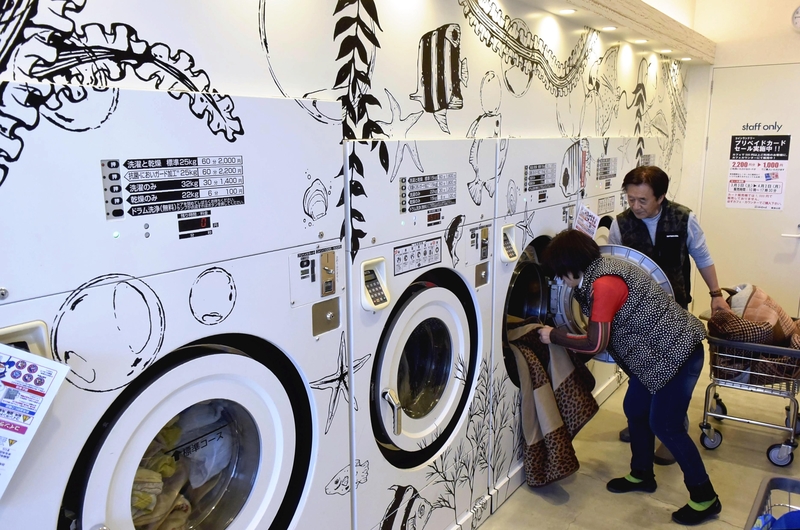
Self-service laundries are going through an evolutionary cycle. A growing number of them have an adjoining cafe, bicycle shop or other type of store and form part of a multiuse complex where people can enjoy spending time while waiting for their washing to finish.
The prevailing image of laundries in Japan had been one of unstaffed facilities used mostly by men who lived alone. But these days laundries meet the needs of elderly people and two-income families in which both parents are too busy to keep up with the housework.
NinOval wash cafe's Suitashikinzan branch in Suita, Osaka Prefecture, is a laundry with an adjoining cafe. It has become increasingly popular. Yoshiko Hashimoto, a 65-year-old homemaker in Suita, visited the laundry with her husband to wash some blankets.
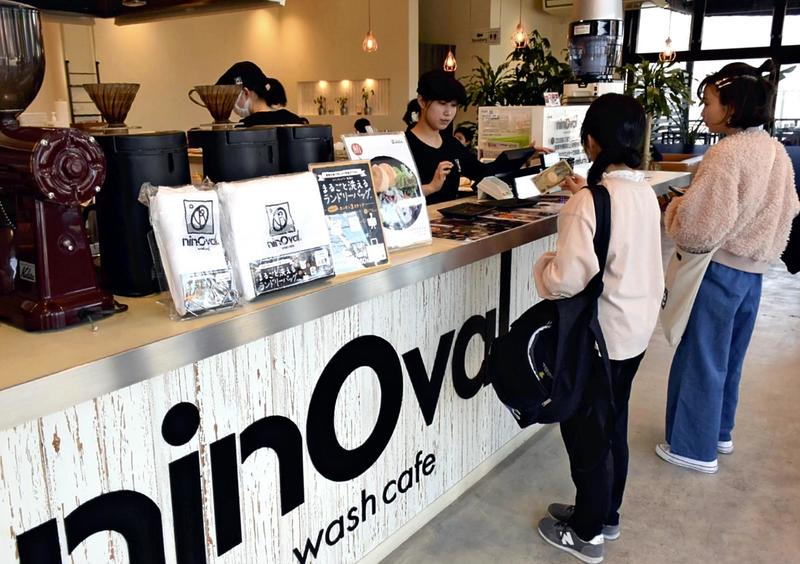
"I brought my pet dog, and I enjoy sitting outside at the cafe and eating its famous pancakes while waiting," she said.
The laundry's wide range of washing appliances also has impressed customers. It has 15 machines of various sizes, including ones exclusively for washing shoes. The largest machine can wash a 32-kilogram load -- about four times what an average household machine can handle -- in 30 minutes and costs 1,400 yen to use. If customers enter their mobile phone number into the fee payment machine, an automated voice message is sent to notify them when their washing is done.
The facility opened in the summer of 2016 and is operated by Osaka-based Nomura Cleaning Co. "This isn't a place just to do your washing," said Kentaro Yoneda, chief of planning & marketing department of Nomura Cleaning. "We tried to create a shop people can enjoy visiting."
Nomura opened a second ninOval store in Izumiotsu, Osaka Prefecture, in March 2017.
New niches in society
Similar complexes featuring a self-service laundry have popped up in other areas. STYLE-B, a bicycle shop that opened under a set of railway tracks in Shinagawa Ward, Tokyo, in March, has a coin-operated laundry, cafe, two showers, a vegetable store and other amenities.
"Residents who live nearby and people who commute by bicycle stop here and relax in the cafe or get their bike checked while waiting for their washing," said Mitsuharu Higashi, manager of STYLE-B.
The Laundry Lounge in Kumamoto adjoins a coffee stand and a general store selling houseplants, chairs and other items.
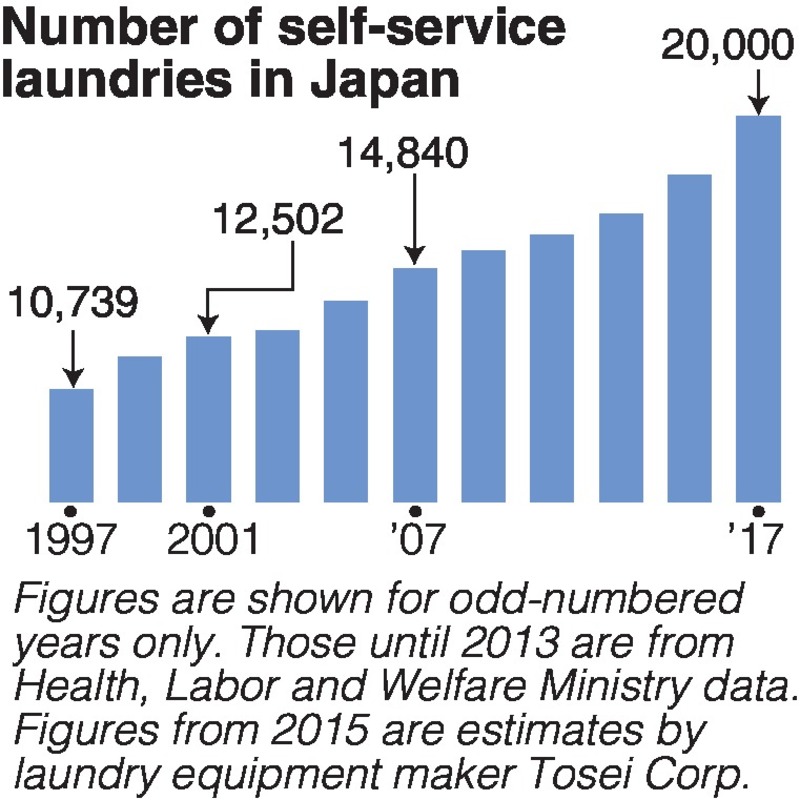
The number of coin-operated laundries also is rising. According to an industry estimate, about 20,000 such businesses dotted the nation in 2017, a 30 percent increase from 10 years earlier.
Hiromi Takesue, marketing manager of Electrolux Japan -- the Japanese branch of a major Scandinavian home electrical appliance maker -- said self-service laundries were finding new niches in today's society.
"There is growing demand, especially among two-income households. They want to shorten the time spent on housework, so they go to laundries to use machines that can wash large loads," Takesue said.
Behind the rise of self-service laundries is the increase in high-rise apartment buildings, where residents cannot dry their washing on the balcony for safety reasons. Another factor is high demand for facilities to wash futon bedding whole as a measure against allergies and hay fever.
"More laundries are being designed to attract women, aiming at creating a space where women can spend time comfortably," Takesue said.
Great for elderly people
Self-service laundries also are playing a big role in rural areas for elderly people and people who have limited access to shopping facilities.
On May 19, a multipurpose facility opened in the Kono district of Minamiechizen, Fukui Prefecture. As well as a laundry, the facility has a convenience store and space for activities encouraging interaction among elderly people.
The facility is run by a company funded by entities including the Minamiechizen municipal government and a prefectural consumers' cooperative, in cooperation with major convenience store chain operator FamilyMart Co.
According to the town government, the Kono district has no dry-cleaning shops and 40 percent of the population of about 1,700 residents is 65 or older. Kazuhiko Yamazaki, official of the prefectural consumer's cooperative, has high hopes for the facility.
"This district faces the sea, where washing hung outside can get a salty smell. There was a strong desire among residents for such a facility. I hope it gets plenty of use and becomes a social hub for people in the region," Yamazaki said.
Read more from The Japan News at https://japannews.yomiuri.co.jp/













