The base of the pyramid domain is at a crossroads. Over the last decade there has been much growth in the number of BoP enterprises, and an increase in investor interest and willingness to invest in them. Many organisations and businesses have invested their resources to better serve the poor, using many different approaches. However, there has been little collaboration or sharing of those best practices in order to build better ventures.
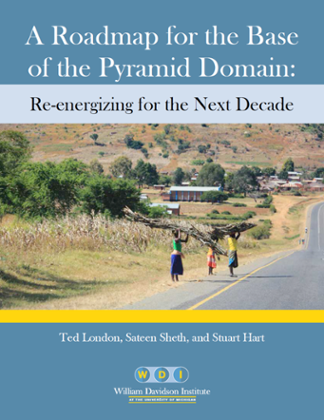
To address these challenges, we developed and recently released A Roadmap for the Base of the Pyramid Domain: Re-energizing for the Next Decade (the BoP Roadmap). The roadmap is an action agenda that charts a way forward for the BoP domain.
The BoP roadmap asks us to not only act for today, but to build for tomorrow, in order to truly achieve the promise of building a community of sustainable, scalable BoP enterprises focused on the alleviation of poverty. It is intended to create a stronger and more robust community that shares and learns together. As the old African proverb goes “If you want to go fast, go alone. If you want to go far, go together”. If we want to achieve our goal of alleviating poverty, we need more than a small number of successful ventures, we need transformational change. This won’t happen if we only share our successes, we must also share and learn from our failures in order to understand what works, what doesn’t work, and how to achieve predictable and scalable performance of BoP enterprises.
The BoP roadmap is the result of in-depth research and discussions as well as the outcomes of the BoP Summit hosted by the William Davidson Institute at the University of Michigan in October 2013. (To learn more about the specific outcomes generated from the BoP Summit, read our companion piece, “Base of the Pyramid Summit: Shaping an Action Agenda.”). This action-oriented report constitutes a set of prioritised recommendations designed to enhance the development of the domain over the next decade.
The four key initiatives presented in the BoP roadmap include:
- Scalable BoP enterprise initiative. This initiative addresses the challenge of not having enough pilot ventures to become sustainable, scalable enterprises. It emphasises generating a much deeper understanding of the tools and knowledge needed to build more sustainable and scalable BoP ventures.
- BoP ecosystem building initiative. This initiative addresses the challenge of not having a deep enough understanding of the types of partnerships needed to effectively facilitate BoP enterprise development. This initiative will assess the landscape of partnership models, develop strategies and recommendations for BoP enterprises to leverage the existing ecosystem, and provide insight for the development community on existing gaps, and opportunities to address them.
- Mutual value creation initiative – This initiative addresses the challenge of not having a deep enough understanding of opportunities and challenges for BoP enterprises to generate net positive poverty-alleviation outcomes. This initiative will help BoP enterprises better understand the value proposition they offer the BoP, and explore the relationships between social impact, strategy and enterprise performance.
- Global training and knowledge initiative – This initiative addresses the challenge of not having a sufficiently robust portfolio of training programs and other types of platforms to support effective sharing of the latest knowledge and tools with BoP enterprises, and to develop future BoP leaders. This initiative will create training programs and leverage and/or build virtual and other platforms to support BoP enterprises and develop future leaders.
We launched the BoP roadmap last week in Washington D.C. with keynote presentations from Ted London and Stuart Hart that set the context for the development of the roadmap and provided an introduction to the four major initiatives. This was followed by a panel discussion with representatives from Gesellschaft für Internationale Zusammenarbeit (GIZ) GmbH, the United Nations Development Programme (UNDP), the BoP Global Network and UNDP, which focused on how these organisations are already taking action on the recommendations in the roadmap. The event concluded with interaction among the attendees that explored how we, as a community can take further action on implementing the roadmap initiatives.
Implementing these initiatives will require leadership, support, commitment, and investment by the greater BoP community. A number of organisations have already taken leadership roles and have committed to contribute to the development of one or more of the BoP Roadmap Initiatives. For example, we are currently collaborating with GIZ on a project focused on better understanding the landscape of organisations that support the scaling of inclusive businesses, or ‘scaling facilitators’.
We are also working on collaboration with the UNDP that focuses on understanding best practices in ecosystem building, a topic that UNDP has explored in “Realizing Africa’s Wealth”. Initially focused on case studies in the Philippines, this work will seek to develop ecosystem building tools that can be applied to multiple geographies, sectors and stages of enterprise development, and which will help both enterprises and scaling facilitators to more effectively build partnership ecosystems that support inclusive business.
These are indeed exciting and challenging times for the BoP domain. Despite our successes, we must continue to push toward the next generation of BoP strategies and spend more time considering how we can co-create an even better future for the BoP domain. This means having a longer-term vision not only for specific enterprises, but also for the domain as a whole. While we have made progress, this is not the end of the journey. The BoP roadmap lays out the path ahead of us, but success requires a willingness to continue to invest in learning, as well as doing. We look forward to collaboratively building the domain we all aspire to achieve.
Ted London is senior research fellow and director of Base of the Pyramid Initiative at the William Davidson Institute at the University of Michigan. Colm Fay is research manager of the BoP Enterprise Sustainability and Growth Program at the William Davidson Institute
More from the Business Call to Action partner zone:
- Time to start challenging our assumptions that start-ups can’t reach scale
- Low-cost tablet PC looks to aid education in poor communities
- Empowering farmers through mobile communication in west Africa
Launched at the United Nations, the Business Call to Action (BCtA) is a global alliance hosted by the United Nations Development Programme headquarters in New York. Follow: @BCtAInitiative
Content on this page is paid for and provided by Business Call to Action, sponsor of the role of business in development hub