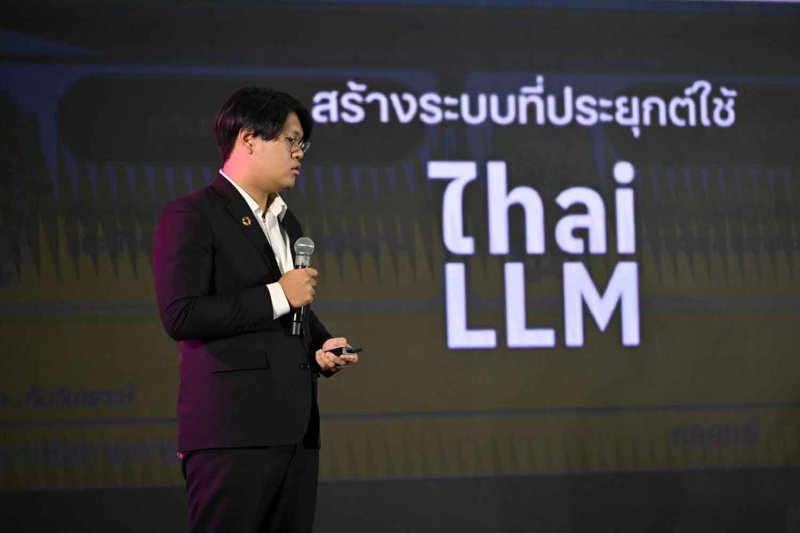
Thailand is advancing artificial intelligence (AI) sovereignty through domestic large language models (LLM) such as ThaiLLM, led by the Big Data Institute (BDI) and its partners.
The initiative aims to reduce reliance on foreign technology while ensuring AI systems reflect Thailand's language, culture and national priorities.
The project builds a system around high-quality Thai datasets, infrastructure such as the Lanta supercomputer and rigorous benchmarking standards.
"Thailand's sovereign AI strategy must focus practically on cultural and language data as well as model sovereignty," said Tiranee Achalakul, president of BDI.
There are risks to relying entirely on foreign AI infrastructure, she noted. For example, the US government has restricted the export of specific AI models, which resulted in sudden shutdowns for foreign users.
"If Thailand builds its core public software on foreign platforms that suddenly revoke access, the country would be forced to start from scratch," Ms Tiranee said.
BDI is collaborating with ministries, universities and associations to build a foundational Thai LLM, using open-source models trained specifically on Thai laws, medical data and culture.
The goal is to slowly reduce reliance on foreign platforms, cultivate a new generation of local AI researchers, and provide a cost-free, open-source system for Thai businesses to use, she said.
Apivadee Piyathamrong, principal data integration and senior expert at BDI, said while 56% of global AI projects focus on computing infrastructure, 90% of them still rely heavily on the US supply chain.
Thailand's sovereign AI strategy will prioritise the data and software layers, she said.
The plan features three stages: fast and fair adoption by focusing on sector-specific real-world data to create actual demand; investing in champions by pushing applied R&D to create core AI companies; and scaling up to create a true AI economy.
Patipan Prasertsom, head data specialist at BDI, said Thai-language data accounts for only 0.37% of the internet, which results in foreign AI models struggling with Thai-specific contexts.
"For example, older foreign models failed to understand the cultural purpose of building sand pagodas at Thai temples because their training data lacked local context," he said.
To address this obstacle, BDI negotiated with various public and private entities to donate secure, copyright-cleared data to train the Thai LLM.
The Thai LLM project is already yielding results. A medical model is being piloted at Siriraj Hospital to help doctors and nurses screen patients.
BDI made these models available as open-source downloads and offers an application programming interface (API) that supports more than 1,700 users for tasks such as document summaries and data matching.
Future plans include creating reference use cases, supporting multi-modal data (such as images), and expanding API access.
Thailand benchmark
Vataya Chunwijitra, head of the AI Research Group at the National Electronics and Computer Technology Center (Nectec), said the agency focused on developing the "AI Thailand Benchmark", which serves as a pillar to build a reliable sovereign AI system for the country.
The thousands of foreign AI models released globally are benchmarked primarily on English or Chinese data, leaving a massive gap in Thai cultural and linguistic understanding, she noted.
For instance, when a foreign model was asked to generate a Thai warrior, it produced an image of a dark-skinned man wearing Chinese armour and Indian shoes.
Ms Vataya warned if Thailand relies solely on these models, local heritage such as the Phi Ta Khon ghost festival could be lost or misunderstood by future generations. Foreign AI lacks context for regional Thai dialects, Thai laws, and local wisdom such as traditional Thai medicine and acupressure, she noted.
To ensure AI models used in Thailand are competent in local contexts, Nectec developed a specialised benchmarking platform. A feature of this platform is the use of blind test sets, meaning the evaluation data is kept completely hidden from developers, which prevents them from training their models on the test answers, ensuring the performance scores reflect true capability and transparency.
To bring AI from development to safe, practical applications, developers first test their models against Nectec's benchmarking platform to find the best-performing option for their specific domain.
Models then proceed through a formal standardisation process to prove they are safe for critical use, such as assisting doctors in hospitals.
Ms Vataya said Nectec plans to establish these benchmarks as the official standard for government IT procurement.
"Instead of relying on subjective evaluations, government agencies will be able to use these benchmark certificates to purchase and implement AI software with total transparency and confidence," she said.
Nectec is hosting online AI competitions by providing developers with free access to the Lanta supercomputer to train their models, which are then submitted to the benchmark platform to evaluate their transparency, reliability, and Thai language proficiency.
AI sovereignty
Kobkrit Viriyayudhakorn, honorary president of the AI Entrepreneur Association of Thailand, urged businesses to adopt sovereign AI to reduce dependence on foreign providers and strengthen long-term competitiveness.
He said recent export controls restricting access to certain overseas AI models demonstrated the risks of relying on foreign platforms, which could disrupt business operations without notice.
Sovereign AI is built on three pillars: control of data, AI models and infrastructure. Geopolitical tensions, stricter data privacy regulations and falling costs for open-source AI have made local deployment commercially viable.
Mr Kobkrit said businesses can gain four advantages: greater control, lower costs, regulatory compliance, and customised AI models that create competitive differentiation.
He recommended a hybrid approach, using foreign AI for non-sensitive tasks while deploying locally hosted models for sensitive data, with the long-term goal of helping Thailand evolve from an AI user into an owner of its own AI capabilities.
Sarana Nutanong, head of the Natural Language Processing and Representation Learning Lab of Vidyasirimedhi Institute of Science and Technology and a contributor to the Thai LLM project, said AI development involves complex and constantly evolving challenges with no clear answers.
He framed the work around three questions: "How do we know it is complete?", "Would another method produce different results?" and "What comes next?"
Mr Sarana said Thailand needs more data engineers, system engineers and machine learning specialists capable of developing efficient models and secure infrastructure, supported by education through to PhD level.
He warned Thailand could lose top researchers if universities remain focused on outdated academic incentives, such as pursuing journal publications mainly for promotion.
"Institutions must adopt global standards of excellence in computer science to retain skilled talent," said Mr Sarana.
In the near term, Thailand should bridge the gap between academic research and commercial applications by studying AI behaviour, developing measurement standards and making models easier to adapt for specific industries, he said.
However, newly appointed assistant professors should be given time to develop strong research methods before being pushed into industrial projects.
"This foundation will better prepare them to solve complex real-world problems later," Mr Sarana said.