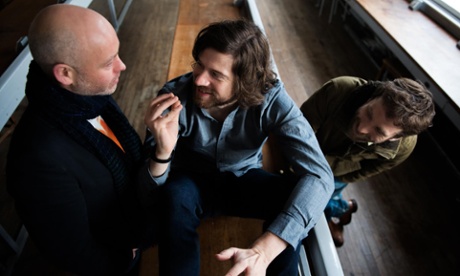
“At some point,” says Martin Green, accordionist and one third of the folk trio Lau, “we should maybe record some actual traditional music.” He is looking sheepish, as if he has just acknowledged a big guilty secret. “I mean wooden instruments, no cables. Thing is, we often turn up at a tour venue, spend two hours setting up loads of complicated electronics, then sit around playing fucking hornpipes.”
The paradox is pure Lau, who are steeped in tradition, simultaneously enthralled by the extended soundscapes made possible by effects, samples, multilayered composition and all manner of music that they listen to in their spare time. They are hardly the first folk band to muck about with form, but what makes the Lau brand so successful – aside from each member being a formidable performer in his own right – is the way they distill their heritage and build an expansive ensemble sound buzzing with pop, improvisation, electronica and classical influences. Fiddler Aidan O’Rourke describes the result as a sort of multiheaded beast: “All of the noise on stage is from one instrument that it takes three people to operate.”

Lau’s latest album, The Bell that Never Rang, is the closest they have come to writing straight-up pop songs. It’s full of stomping beats, obvious builds and brightly singable tunes – “really satisfying stuff that most muso bands go out of their way to avoid,” says the group’s singer and guitarist Kris Drever. They attribute the sound to two factors: spending a week in New York last year between performances (“we went bankrupt going to a million shows; we saw Lady Gaga and John Zorn at The Stone”) and hiring the indie-pop producer Joan Wasser. “Where classical meets Zorn meets pop music – that’s the sound we wanted, and Joan totally gets that,” Drever says. “She was a classical violinist; now she is undoubtedly a pop star. We love pop music; Joan gave us the confidence to embrace that. We chose Joan because we love her music. Also her clothes: if your producer has gold trainers on, you’re going to try harder.”
Yet their three distinct regional voices are still unmistakably there, etched into the arc of the phrasing and the earthy tug of the harmonies. O’Rourke grew up near Oban in Scotland and the lilt of his playing is pure west coast, flavoured by Gaelic song and bagpipe ornamentation. Green cut his teeth in Cambridgeshire playing slow, bittersweet morris dances, while Drever learned his rugged lyricism from his father, Orcadian folk luminary Ivan Drever. Together it makes for a potent mongrel pedigree. Drever describes it as “folk music from a made-up country”.
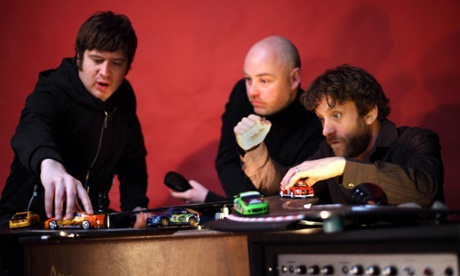
Now they have given that country a name: Lau-Land. This weekend, the Colston Hall in Bristol hosts the fourth and final instalment of Lau’s rambling Lau-Land festival, intended to celebrate their wide-ranging influences by bringing various “hero performers” of theirs together under one roof. (The name has the ring of a funfair, I suggest: “exactly!” O’Rourke beams. “We can’t afford the bouncy castles, but hopefully the ‘fun’ bit is accurate.”) Programming is deliberately non-genre specific – it’s the “bubbling pot thing” that they want to emphasise – and this weekend Malian Tuareg band Tinariwen, Syrian party singer Omar Souleyman, American folk-rock vocalist Sun Kil Moon and Scottish miserablist Aidan Moffat.
“What we really want to do is force different kinds of musicians to hang out with each other,” Green says. “Folk festivals are good at social interaction, but it seems like the hipper the festival, the less interaction there is.” When I ask about highlights of previous Lau-Land weekends in London, Edinburgh and Gateshead, the answers all involve impromptu crossovers: improvisor Fred Frith singing sea shanties in the pub, Portishead’s Adrian Utley having a pint with Irish trad fiddler John Carty. “There’s a reasonable chance John Carty had never heard of Portishead, and vice versa,” Drever grins. “But all of this stuff is what makes us tick.”
I’m talking with the band at Green’s parent’s home in York, a rambling townhouse overlooking the river Foss where the trio often make pit stops during north of England tours. When I arrive they are drinking coffee around a huge kitchen table strewn with bits of sound equipment and pliers; Tim Matthew, the band’s sound engineer and tour manager, is tinkering with a complex-looking piece of kit for the next night’s gig. They reminisce about their formation with the kind of deadpan mutual mockery that comes from nearly a decade on the road together. They met in the folk pubs of Edinburgh, three crack session-musicians with a shared bent for testing the limits of form. “We all love writing tunes,” O’Rourke explains, “and we each had loads of material that nobody else was going to play, so we formed the band as a kind of experimental composition outlet.”
They are keen to point out the dangers in the scale of their success – they’ve been named Best Group at the BBC Radio 2 folk awards an unprecedented four times – and Lau-Land Bristol includes a roundtable discussion titled Folk Revivals: Good for the Music or Damaging to Traditions? “‘Are bands like Lau bad for traditional music?’ is a question bands like Lau should definitely be asking,” Drever says. “It would be problematic if today’s young traditional musicians grew up listening to us and think, ‘I’m gonna play like them’, rather than properly investigating local traditions where they come from. You would end up with a generation who didn’t know how to play The Bucks of Oranmore, but who could trot out our tune Far from Portland.” O’Rourke says he used to be worried about singing with his regional accent. “Now I’m proud of what we do. We’re making a new noise that nobody has made before, but you can still hear where we come from. I think that’s a good thing.”
After our interview Lau head to a Taraf de Haidouks concert and I tag along, curious to hear the raucous Romani party band with their ears. Their reaction is part jaw-dropped admiration – “you’d better get practicing,” Drever says, elbowing Green as the Romanian accordionists fling notes out at eye-watering velocity – and part incredulity. There is a gleefully shambolic stagecraft to a Taraf show; band members wander off stage at random and several different tunes often start at once. “Did they even come close to a set list?” Drever wonders aloud later, revealing by contrast the level of fastidious care that goes into every element of a Lau track. “We really do try quite hard to make sure we get everything right.”
In the van on the way home, they talk about their love of listening to music together. It’s as important to their sound, they say, as composing or detailed rehearsing. Drever hooks up his iPod and plays tracks by Carty and the California instrumental outfit Tin Hat. They ask whether I’ve got anything good with me, and a rummage in my bag produces a CD of Bach’s music for violin and harpsichord. On it goes, volume up, and we wend our way back to York blaring graceful sonatas through the tinted windows.
-
The Bell that Never Rang is out now on Reveal Records; Lau-Land is at Colston Hall, Bristol, 29-31 May. Box office: 0844 887 1500