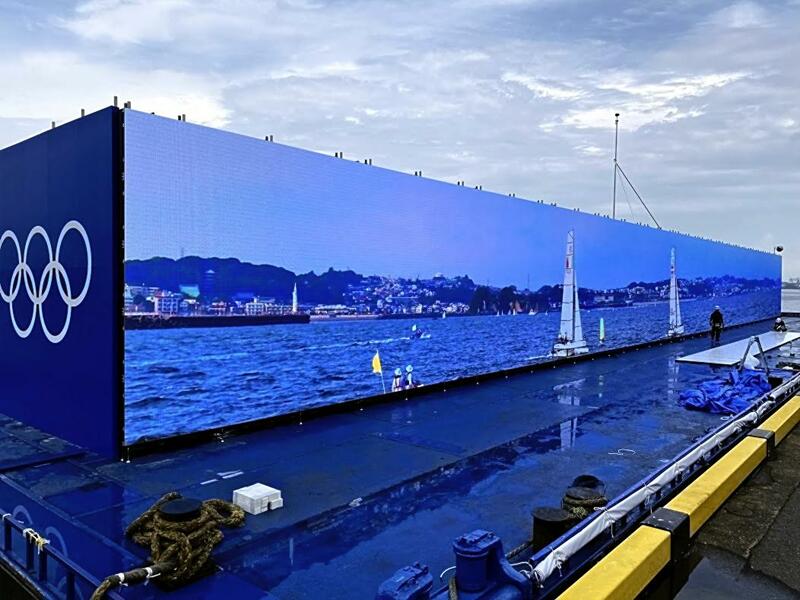
The Tokyo Olympics had been positioned as a showcase for using the 5G high-speed, high-capacity communication standard to enhance viewers' experiences. While many of the events were held without spectators and the general public could not access most venues, experiments were conducted to create new viewing experiences for several sports.
For the sailing events, NTT Corp. and other companies teamed up to float a 55-meter-wide, 2-meter-high display offshore in front of the competition venue. High-resolution images taken by special boats and drones were combined in real time using artificial intelligence and instantly transmitted to the screen.
By using 5G to transmit the images, the races were able to be broadcast almost simultaneously.
"Until now, spectators could only watch the race from the shore through binoculars, but now they can experience it as if they were watching the race from a special seat on a cruise ship in the sea," said a person in charge of the project.
At the swimming venue, NTT Docomo, Inc. distributed goggles to about 140 spectators. Once the goggles were put on, augmented reality (AR) technology made it possible to display over the pool information introducing the athletes and their standings in the race.
Swiss luxury watchmaker Omega, the official timekeeper of the Olympics, introduced new technology for the first time to measure in real time data such as athletes' speed, acceleration and position, and provided it for live TV broadcasts.
In track and field, sensor tags weighing just 16 grams were affixed to the athletes' bibs. From the sensors, receivers in the venue collect about 2,000 pieces of information per second, including speed, acceleration, and the position of the athlete. The data helped make it easy to understand the tiny elements that factored into winning an event, such as the point at which maximum speed is reached and the differences between athletes.
As swimsuits leave little space for sensor tags, swimmers are tracked using four cameras located on the ceiling. The images were analyzed by AI to provide the athletes' positions and speed in meters per second.
Omega Timing CEO Alain Zobrist, who is in charge of technology development, said that people not only can enjoy watching the events, but they also can understand the games deeper through such data. He added that this type of data also help improve athletes' performance.
Intel Corp. technology also provided viewers with new senses of realism through TV and other media.
In basketball, high-resolution cameras were installed throughout the venue to capture the action. Players' data in 3D was recorded to enable 360-degree replays. The system made it possible to see the athletes' movements involved in making some difficult plays that are hard to judge with the naked eye.
Read more from The Japan News at https://japannews.yomiuri.co.jp/