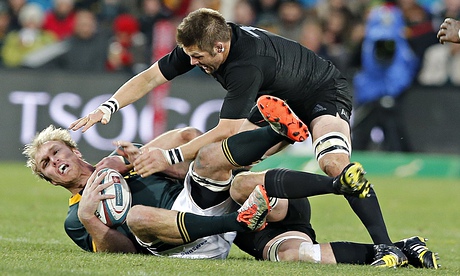
Steve Hansen, the New Zealand head coach, spent much of the week going on about driving mauls and how they were blighting the game because they were impossible to defend, so when the All Blacks, who were trailing by three points in Johannesburg, had an attacking lineout seven minutes from the end the Springboks set themselves to defend a forward surge.
They marked the All Blacks’ lineout targets but the ball was thrown to New Zealand’s captain, Richie McCaw, on his 140th Test appearance. The flanker found himself surrounded by space and took his side to a victory which for most of the first 70 minutes had looked unlikely. Lima Sopoaga’s conversion meant South Africa had to score a try to win and the fly-half marked his Test debut with a late penalty to seal victory at the end of a match played with a tempo and intensity that showed why England had spent the previous two weeks flogging themselves at altitude.
It was 10-10 at the end of the first half that started at a pace which never dipped. New Zealand’s ploy of keeping the ball in hand, even in their own 22, reckoned without the presence of two openside flankers in the South Africa back row, Francois Louw and Heinrich Brüssow, starting his first Test since the last World Cup.
The Springboks’ policy from the start was to put immediate pressure on the ball carrier, whether mobile or on the deck, and the two wing forwards, in tandem with their hooker, Bismarck du Plessis, were relentless in their pursuit of turnovers. They were so successful that the All Blacks rarely found themselves in attacking positions, tactically adrift for once.
The two tries in the opening period came from turnovers. South Africa scored the first after nine minutes when they trailed to a penalty by Sopoaga. It followed a flurry of kick returns and when Israel Dagg decided to end the sequence and fling out a blind pass to Kieran Read who was standing near his 22, Bismarck du Plessis read it and not only thumped into the No8, but turned him so that the supporting forwards were able to ruck over the ball.
Three passes later, Willie le Roux cut through a midfield defence that was so porous that Ma’a Nonu was pulled five minutes into the second period. Handrè Pollard extended the lead with a penalty on 20 minutes but for all the zest South Africa showed, led by a rampant Burger at No8 who had set his time machine back 10 years, their judgment under pressure was not acute enough, as le Roux showed early in the second half after another turnover when he chipped to the line for Charles Piutau to mop up when Bryan Habana was unmarked outside him.
There were times when the All Blacks looked vulnerable and they struggled to deal with the hard-running centre Damian de Allende who, even in two defeats this month, has formed a midfield partnership with Jesse Kriel that looks enduring. Their selection, which saw some vastly experienced players rested, suggested they regarded the Rugby Championship, as they had four years before, as a means to the end of the World Cup, but no team in the professional era has had such a capacity to win from unpromising positions.
They drew level with the final move of the first-half, swamping Cornal Hendricks on halfway after the wing had caught a kick and wresting the ball from him to counterattack at pace. Sopoaga exploited space on the right to free Ben Smith with a quarter-back pass. It was, though, South Africa who were energised by the break, Kriel slicing through Conrad Smith and Nonu to put his side ahead again after running on an angle to catch Pollard’s short pass.
Back came New Zealand. Dane Coles looked more like a centre than a hooker as he stepped into space and outpaced the defence on run to the line. It should have been the moment the All Blacks took control with the home side having lost Louw and Jannie du Plessis to injury, but the Springboks dominated the next 20 minutes, winning penalties which they kicked to touch and drove mauls.
Lood de Jager was a few millimetres just short of the line from one as he stretched for the line and the second-row Sam Whitelock, a half-time replacement for the debutant James Broadhurst, who had been caught out a few times in possession, was sent to the sin-bin for playing the ball on the floor. South Africa had just taken the lead with a Pollard penalty and the capacity crowd anticipated the kill.
New Zealand were penalised for collapsing the first scrum after Whitelock’s yellow card, but when South Africa’s prop Vincent Koch was forced off with a cut head sustained as he dropped a pass on the line, the Springboks opted for uncontested scrums because they had to replace a tighthead prop with a loosehead, Trevor Nyakane. They surrendered the momentum and McCaw made them pay.