OSAKA -- It has been five years since the death of rakugo storytelling master Katsura Beicho, the first recipient of the Order of Culture from the rakugo world, and researchers continue to compile a database of the wide trove of materials that he left behind.
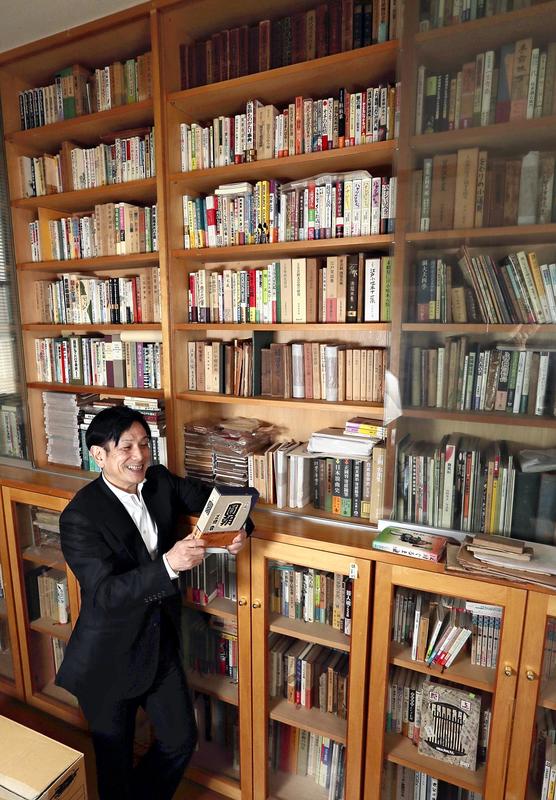
The project, which involves sorting through about 50,000 items that include books and other materials, is aimed at preserving for future generations the wisdom of Beicho, who was also known as a researcher of entertainment and culture of the Kamigata style that developed in the Kansai region.
"I hope it will be made public one day," said Katsura Yonedanji, 61, Beicho's eldest son and a rakugo performer in his own right.
At Beicho's residence in Amagasaki, Hyogo Prefecture, there are about 20,000 books on entertainment and other arts that he had collected during his lifetime. Also stored are another 30,000 items that include handwritten notebooks on his rakugo performances and music albums.
Of particular note is a poster for his first solo performance in Tokyo in 1967, at a time when Kamigata rakugo was hardly known in capital. There are also photos from his childhood, and a handwritten draft of the rakugo story "Ichimonbue" (cheap whistle), which is now regarded as a classic.
The documenting of the materials started about five years before his death, led by rakugo researcher Koji Ozawa, 75, and Ayako Furukawa, 47, an assistant professor of the International Research Center for Japanese Studies in Kyoto, who specializes in the history of Kamigata entertainment.
At present, about 7,800 items have been digitized, of which about 2,000 have been cataloged. "It is a valuable cultural resource that is useful for research in a wide range of fields, from Kamigata entertainment, kabuki and bunraku puppet theater to language, customs and history," Fukukawa said. "Digitization is of great significance by enabling new uses."
Kamigata rakugo declined significantly after World War II because many theaters burned down during the conflict and it was under pressure from manzai comedians.
Beicho became an apprentice of Katsura Yonedanji IV in 1947, soon after the end of World War II. He worked hard to revive Kamigata rakugo, gathering testimonials and documents from rakugo elders. Having laid the foundation for the current development, he died on March 19, 2015, at 89.
"After seeing Kamigata rakugo face a crisis, Beicho thought it was his mission to revive and pass on Kamigata rakugo," Ozawa said.
Read more from The Japan News at https://japannews.yomiuri.co.jp/