Fleet Street was once considered the most important location for journalism in the world, with Britain’s national newspapers making the street their home for centuries.
The tightly-knit network of alleys and backstreets around Fleet Street became the embodiment of the British Press, and was notorious as much for the bustling offices full of hacks as it was for the numerous smoky bars frequented by them.
But since the 1980s, the street’s era as a hub for journalism in the UK has waned and now the last two journalists working on the street are set to leave.
Reporters Darryl Smith and Gavin Sherriff will be the last to switch off the lights as the Dundee-based Sunday Post closes its London office on Friday.
Mr Sherriff has worked on Fleet Street for 32 years and leaves his job as the Sunday Post’s London chief reporter.
Speaking to the BBC, he said when he began work it was in a smoke-filled newsroom where typewriters were the tools of the trade.
He said Fleet Street then was “lorries with large rolls of paper struggling to get down side-streets to printing presses and lots of pubs, filled with journalists and printers”.
“Now it's an endless number of sandwich bars out there. Unthinkable 30 years ago.”
His colleague Mr Smith has worked on Fleet Street for 25 years, latterly as a feature writer for the Sunday Post.
He said: “There is so much history here, and to be one of the last ones, I feel unworthy of the torch that I'm carrying.”
Fleet Street, or the “Street of Shame”, as it is known by many, has been home to publishers since the 16th century, and London’s first daily newspaper, The Daily Courant, was published there in 1702.
By the 20th century, Fleet Street as a national and international centre for journalism had been cemented, and was captured in its pomp in Evelyn Waugh’s 1938 satirical novel Scoop in which unscrupulous authoritarian editors battle for prominence as their writers drink heavily in bars.
But Fleet Street’s demise began in 1986 when Rupert Murdoch moved publication of his News International titles The Times, News of the World and The Sun to new premises in Wapping. Despite furious opposition from print unions, all of Mr Murdoch’s Fleet Street print staff were sacked, thereby breaking the power of the unions, and electronic printing began in Wapping.
The following year, the Telegraph left its mock-Egyptian tower for Canary Wharf and the Financial Times moved out of Bracken House near St. Paul’s Cathedral, crossing the river to Southwark.
In 1988, the Daily Mail made the move to west London, removing Lord Rothermere’s original boardroom and relocating it to offices in Kensington.
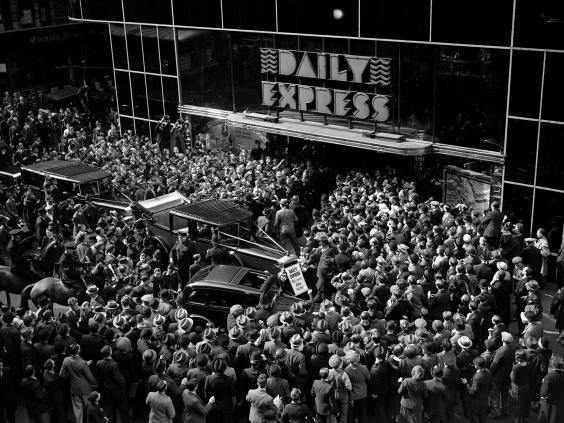
In 1989 the Express left its spectacular art-deco offices on Fleet Street for Blackfriars Road.
But though all the journalists may now be gone, Fleet Street’s legacy lives on, as a byword for the UK’s national newspapers.