With four months having passed since nationwide temporary school closures, schools have begun to reopen in various parts of the country. Amid this move, large elementary schools whose enrolled pupils exceed 1,000 have continued trial and errors to prevent coronavirus infections. Their efforts aimed to avoid the "three Cs"― closed spaces, crowded places and close-contact settings ― include setting up seven entrances at school buildings as well as additional libraries.
--Empty classroom used as library
The Chiba municipal Shinjuku Elementary School in Chiba Prefecture, which reopened fully on June 8, has 1,003 pupils and 32 classes.
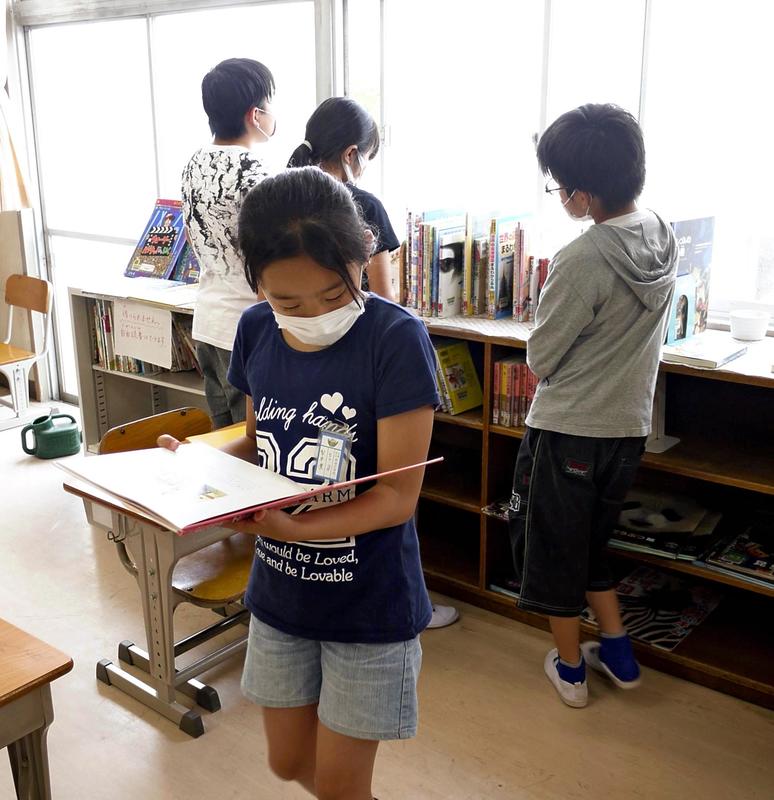
As a move to avoid the "three Cs," the school undertook a project to set up a second library and transferred some books from its conventional library to a new one in an adjacent unused classroom during the whole month of April -- a task that included replacing the books' call numbers -- while the school was closed. The step was taken because a crowded situation was feared to occur if the only conventional library was used for classroom activities.
Before the school was closed, the library could also be used during recess but it was decided that this option should be suspended for the time being. However, the number of books that can now be borrowed at one time has been increased from one to three.
On June 24, 35 pupils of the school's 5th grade, class 3, went to the conventional library and the second library to borrow books. Shino Hasebe, 10, who borrowed three books, said with a smile: "I could finally borrow the next books in a series that I had left off. It is unfortunate that we cannot come to the library freely, but I'm happy that the number of books we can borrow has increased."
"I want to help children foster their passion for reading books while paying attention to preventing infections," said homeroom teacher Shinnosuke Yoshida, 37, as he watched over the children.
--'Distancing' kept for swimming class
There is also a large elementary school that has begun swimming classes.
Kagoshima municipal Chuzan Elementary School in Kagoshima Prefecture, which is another big school with 1,435 pupils, has adopted a system in which girls use both the male and female changing rooms, which were conventionally used separately, while boys change their clothes in a classroom.
Additionally, the school's only swimming pool was normally used by two classes simultaneously but the use has been limited to one class this year.
And teachers have reportedly taken on the task of preparing simple masks, which are made by tying rubber bands to folded kitchen paper, for children who have left their mask at home.
At Niigata municipal Toyano Elementary School in Niigata Prefecture, which has 1,000 pupils, an entryway has been set up at seven locations.
The step was taken because it took as long as 15 minutes for all the pupils to enter the school on the first day of its reopening in April when entry to the school building was restricted to avoid congestion.
Moreover, a doorway has been installed at the prefabricated schoolhouse where third graders learn.
The school's vice principal Hideki Itagaki said that the lower-grade pupils tend to stick with their friends even if they are asked to stand at a certain distance from each other. For this reason, he said the school placed marks at intervals of one meter in front of individual doorways by using colorful adhesive tapes, like light blue, purple and other colors, to ensure the pupils "keep social distancing."
--Praise kids for washing hands
According to The Yomiuri Shimbun's survey of 121 municipalities including prefectural capitals and major cities, schools reopened fully on April 22 and onward in 109 municipalities, or 90%, and almost all of them were to reopen fully in July.
To make up for falling behind in study schedules, some schools will also give lessons on Saturdays and many schools will shorten the summer vacation.
In view of this, a major challenge facing schools for the moment is preventing an outbreak of coronavirus infections and eliminating infections if one happens to breaks out.
Prof. Hideyuki Tobe of Saitama University, an expert in school health science, said: "Teachers are required to provide sufficient time for pupils to carefully wash their hands and wait while keeping a certain distance, explaining why they have to do so. It is also advisable for teachers to attentively watch pupils when they wash their hands and praise them if they do it thoroughly, thereby creating the psychological environment in which pupils feel like wanting to wash their hands."
Read more from The Japan News at https://japannews.yomiuri.co.jp/