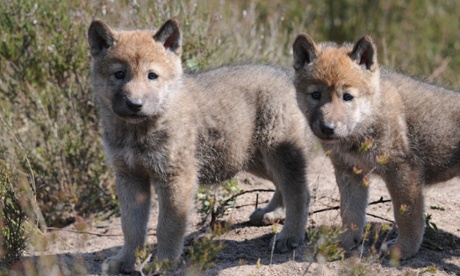
Large carnivores – brown bears, Eurasian lynx, grey wolves and wolverines – are making an extraordinary comeback in Europe, according to research published in Science. Given the troubled history between humans and carnivores like these and the density of humans on this continent (almost 100 human inhabitants per km2), the following facts are truly remarkable.
One-third of mainland Europe is now home to at least one of these beasts. Compared to the situation facing carnivores in the middle of the 20th century, almost every population is now either stable or increasing. There are 17,000 bears and 12,000 wolves living amongst us. “It’s a conservation success story,” says Guillaume Chapron of the Swedish University of Agricultural Sciences in Riddarhyttan, Sweden and the lead author on the paper.
Bringing all the relevant data into a single succinct publication is no mean feat. “It was really hard,” admits Chapron. The study covers 26 different countries and involves 76 different authors. “We needed to dig in old reports, in Finnish, Romanian, Albanian.” I ask whether coordinating carnivore researchers might be harder than conserving carnivores, but Chapron is too diplomatic to answer.
Back in August, I wrote a feature for New Scientist about the return of large carnivores in Europe and I touched on some of the reasons for the recovery. The Science paper outlines several contributory factors. But, says Chapron, the EU Habitats Directive adopted in 1992 was absolutely crucial. Looking to the future, there are obviously plenty of challenges. “There is no conflict between predators and people. There is conflict between people about predators,” says Chapron. “When they come back, they don’t come back alone they come back with a set of questions, such as how do we use the land?”
But the take-home message – one that may be relevant to conservationists on other continents – is there is no reason why humans and large carnivores can’t occupy the same landscape. “We have managed.”
Here – species by species – are the key stats I pulled from the paper. All data pertain to the situation in mainland Europe.
Brown bear
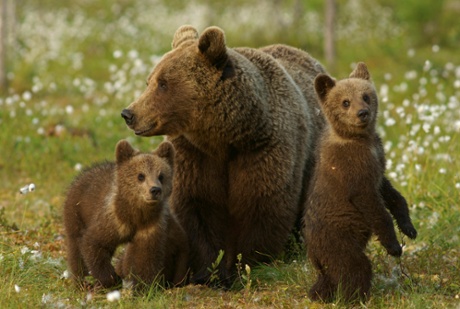
Countries: 22
Area: 485,000 km2
Population size: 17,000
Populations that are stable or increasing: 10/11
Average human density: 19 inhabitants / km2. Photograph: imageBROKER/Alamy
Eurasian lynx
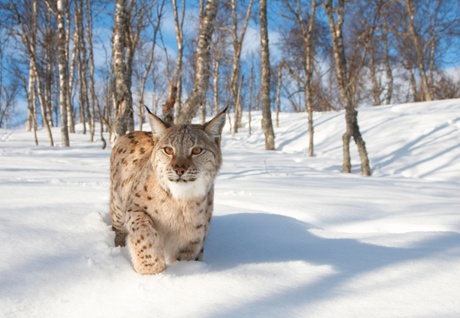
Countries: 23
Area: 813,400 km2
Population size: 9,000
Populations that are stable or increasing: 10/11
Average human density: 22 inhabitants / km2. Photograph: blickwinkel/Alamy
Grey wolf
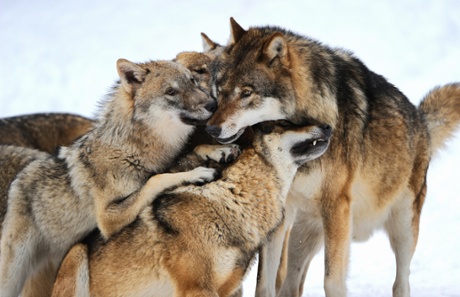
Countries: 28
Area: 798,300 km2
Population size: 12,000
Populations that are stable or increasing: 9/10
Average human density: 37 inhabitants / km2. Photograph: Alamy
Wolverine
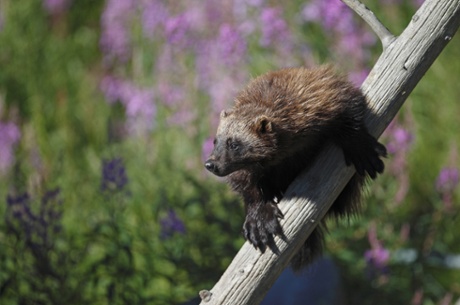
Countries: 3
Area: 247,900 km2
Population size: 1250
Populations that are stable or increasing: 2/2
Average human density: 1 inhabitant / km2. Photograph: FLPA/REX