LOS ANGELES _ An 18-year-old man whose fatal shooting by Los Angeles police officers sparked protests over the weekend was killed after he turned toward officers with a gun in his hand, Los Angeles Police Chief Charlie Beck said Monday.
The killing of Carnell Snell Jr., who was black, became the latest local touchstone in the national debate about policing and how officers use force, particularly against African-Americans.
Snell was shot Saturday near his 107th Street home after police say he ran from a car with paper plates that officers had tried to stop, thinking the vehicle was stolen.
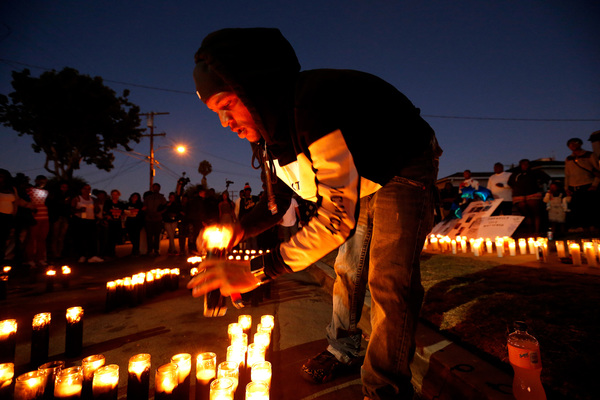
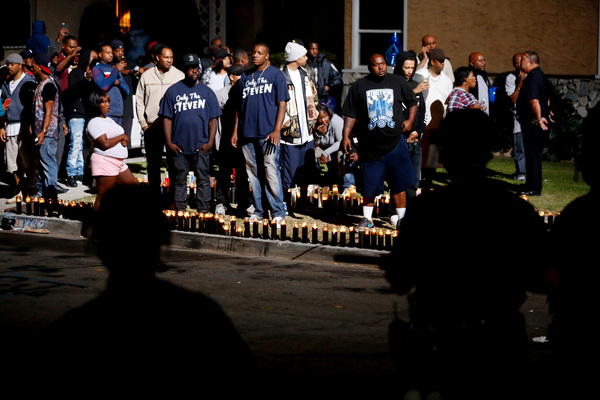
As a vigil for Snell turned into another demonstration Sunday evening, word spread of another fatal police shooting in South Los Angeles, near 48th Street and Ascot Avenue. Coroner's officials have not yet identified the person killed, whom the LAPD described as a man between the ages of 18 and 22.
Beck said that the events leading up to Snell's shooting began about 1:40 p.m., when officers working near 108th Street and Western Avenue spotted a light blue Nissan that had paper plates. As the officers watched the vehicle, a person sitting in the back seat looked toward them, then ducked "as if to hide from them," Beck said.
That person was later identified as Snell, the chief said.
The officers started to follow the car, which slowed down, Beck said. As officers activated their lights and sirens, he said, the car slowed even more and Snell got out, "holding his waistband as if he was supporting something."
Thinking Snell was holding a gun, the officers chased him, Beck said. At some point during the 200- to 300-yard pursuit, the chief said, the officers saw Snell pull out a gun and hold it in his left hand.
They chased him to a driveway of a house on 107th Street, Beck said. There, the chief said, Snell turned toward police, the gun still in his hand.
Police fired six rounds at the 18-year-old, Beck said. Initial information indicated he was struck twice, in the torso and knee.
Snell died at the scene. Beck said a loaded .40 mm handgun was recovered "no more than 5 feet away" from his body. Beck said it doesn't appear that Snell fired the gun because the weapon was fully loaded.
The officers did not have body cameras, the chief said, but a video from a nearby business "clearly shows" Snell running with the gun in his hand.
The second shooting happened about 5 p.m. Sunday, when gang enforcement officers responded to a report of a man with a gun near 48th Street and Ascot Avenue. The officers spotted a man matching that description _ a Latino man with a gray sweater and black pants _ and began to approach him, Beck said.
The man then turned and pointed a handgun at the officers, the chief said, prompting police to fire their guns. Paramedics took the man to a hospital, where he later died.
The gun, Beck said, turned out to be a replica weapon, with its orange tip covered by black paint or pen.
Those officers were wearing body cameras, Beck said. The chief watched the video Monday morning.
"It clearly supports the officers' prior statements and versions of this incident," Beck said.
While one resident told the Los Angeles Times she saw police fire some of the shots when the man was on the ground, Beck said the body camera footage "clearly refutes" such reports.
"That did not happen," he added.
Both of the investigations were "fluid and ongoing," Beck said. "Many facts are not known yet."
But, the chief said, the officers in both shootings "feared for their lives."
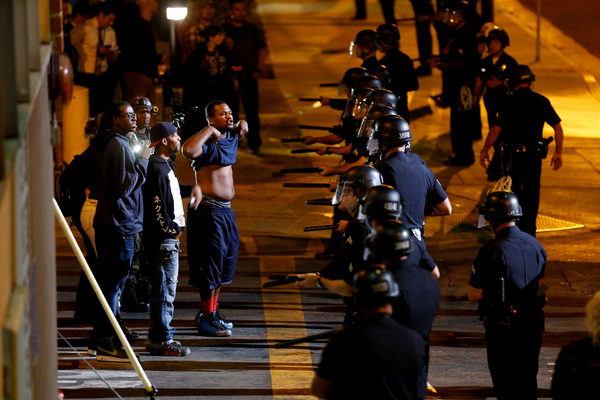
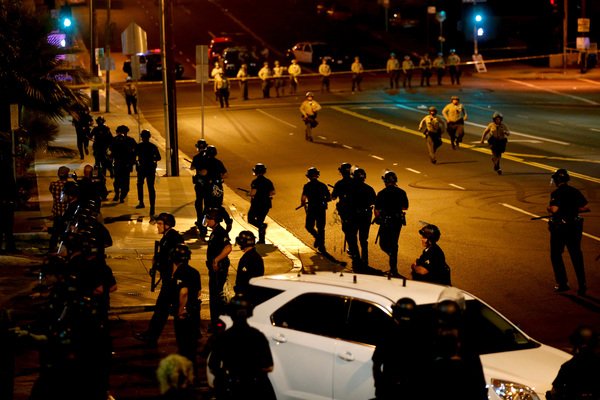
As Beck spoke to a room full of reporters, a crowd of protesters marched into the lobby of the LAPD's downtown headquarters. Their chants _ "Let us in!" _ could be heard as Beck spoke.
About 11:30 a.m., police declared an unlawful assembly inside the lobby, telling the group of about 25 people to leave or risk arrest. The group began chanting Snell's name and called for Beck's firing.
About 15 minutes later, officers formed a line and slowly moved the crowd and reporters out of the building toward a sidewalk outside. An LAPD spokesman later said two arrests were made.
Tiffany Peterson, 45, said she watched Sunday afternoon's shooting from a window in her family's home across the street from Ascot Elementary School. Peterson said she saw the man run down the block from 48th Street and Ascot Avenue and said he stopped when officers in a police cruiser got out. The man appeared to put his hands by his side, though she said she could not see his hands.
One of the chasing officers fired without warning, she said.
"They jumped out of the car and they didn't tell him to freeze or nothing," Peterson said Monday at the scene of the shooting. "They just shot him."
She said police fired a second volley when the man was on the ground. She said she could not see whether the man was armed. A parked vehicle partially obstructed her view of what happened, she said.
"If they would have given him a command he might have complied," Peterson said. "But they didn't give him no option."
She said she hasn't told her story to police yet because she is afraid of retaliation. A small memorial had been erected at the site of the shooting by Monday morning, with five votive candles underneath a simple sign that read "Stop police killings." Duct tape marked where bullets had struck the school and a nearby fence.
About 20 people were standing near the scene, though none of them knew the dead man. Peterson said residents in the neighborhood have no relationship with the LAPD.
"We don't have no communication with them, that's sad," she said.
Peterson, who flagging down passing cars insisting they come to a 6:30 p.m. vigil for the man, said she has been unable to sleep since witnessing the shooting.
"Every time I close my eyes, I just see him drop," Peterson said of the shooting.
Shanae Rivers, Peterson's cousin who also lives in the neighborhood, said incidents like the shooting make her less likely to trust police.
"They're supposed to protect and serve," the 38-year-old said. "But they're not protecting anyone but themselves."